A forest of words
Editor’s note:
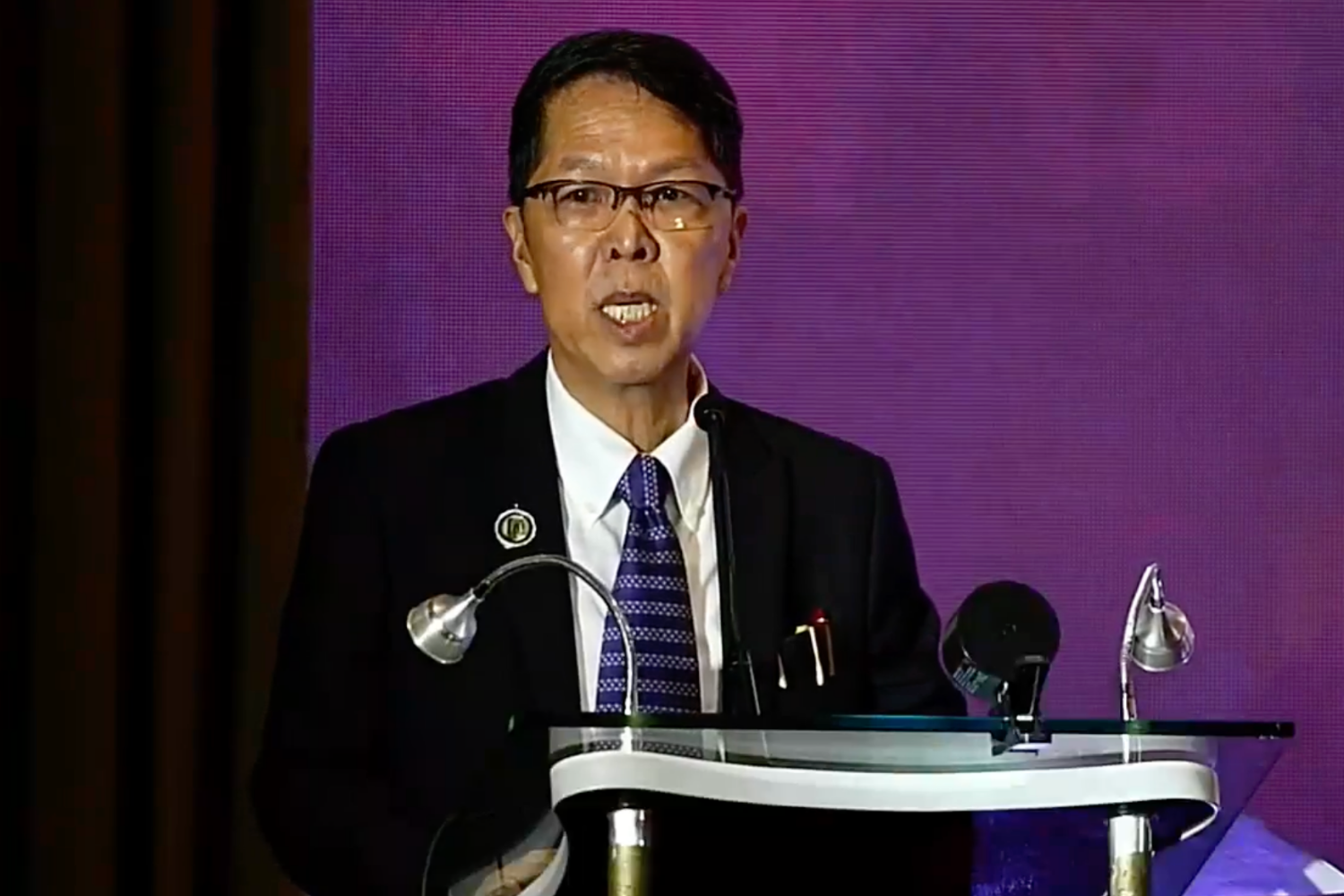
This is the full transcript of Nicolas Pichay’s speech as recipient of the 2026 Gawad Dangal ng Lahi at the Don Carlos Palanca Memorial Awards for Literature.
The citation recognizes individuals who “have contributed immensely to the development of Philippine literature and have aptly become role models for Filipinos.”
An accomplished poet, playwright, essayist, translator, and lawyer, Pichay explores the intersections of literature, history, and public life through his work. He is also a columnist and theater reviewer for radar.
Inducted into the Carlos Palanca Awards Hall of Fame in 2007 after earning six First Prizes, Pichay has also received the S.E.A. Write Award, Gawad Pambansang Alagad ni Balagtas, and the University of the Philippines Outstanding Alumni Award in 2024.
Minor edits have been made for readability.
Distinguished guests, fellow writers, friends.
Since we are among writers, permit me to begin with a word. And because I am often a surrealist at heart, I invite you to take my hand as we wander through a Dadaist world of associations, connections, and perhaps a few unexpected detours. And in the end, I promise to bring you back to this, our Palanca Awards.
Are you ready? Let us start with one word: Biagco.
It is an Ilocano word. “Biag” is “life,” “co” is “my.” Literally, it means “my life.” My parents used to call each other biagco. Even when they were arguing.
Now, I have always wondered about that. Imagine calling someone my life while you are telling them exactly what is wrong with them. Or perhaps that is precisely the point. You can be angry with someone and still call that person your life.
In English, we have “my beloved,” “my precious,” “sweetheart,” “darling.” Some of these expressions, I suspect, would now be considered rather cringe by younger people. But biagco has a certain weight to it. It sounds less like a term of endearment and more like a declaration of ownership. My life. You are my life. And perhaps, on a particularly difficult day, you are the reason my life is so difficult.
My family moved to Zamboanga before I was born. I grew up speaking Ilocano, and also Bisaya and a little Chavacano. I grew up moving among these languages, sometimes without realizing which language I was using.
One of my favourite Bisaya words is “kasing-kasing.” It means heart.
Kapag relaxed ka: Kasing-kasing. Kapag nakita mo ang crush mo: Kasing-kasing. Kasing-kasing. Kapag mataas ang blood pressure mo: Kasing-kasing. Kasing-kasing. Kasing-kasing.
The heart, apparently, has its own language.
The many languages
We often speak of language as a means of communication. Language can be ritualistic or ceremonial. Sociologically speaking, it is an inheritance. It is both meaning and memory.
Language is experiential. It carries past lives and lives towards the future.
Love, freedom, poverty, corruption.
We speak of them as though their meanings were settled, when in fact we are constantly positioning them in context and redefining them in terms of our values.
For example: Communist states invoke democracy as readily as the most ardently capitalist nations. J.K. Rowling has found herself at odds with transgender people over the meaning of the word “female.” Words are constantly being contested, claimed, defended, and sometimes redefined.
Words are delicious. They are never entirely finished. With words, we keep pursuing meaning. And meaning is often just beyond our grasp. Like water. This may sound like a frustrating exercise. But that is the pleasure that writing gives.
I sometimes think of writing as entering a giant forest and being swallowed by meaning. There is the sheer presence of the familiar and the unfamiliar. And there is the impossible challenge of conquering it.
Writing is an exercise in being inspired and disappointed by the power and untrustworthiness of words. This is a problem.
And I have lived with this problem in two professions: law and literature.
Language of law vs. literature
Where the law is clear, words are contained by their meanings. They are expected to behave and seldom escape their confinement. They define rights, impose obligations, and prescribe penalties. A statute can determine who is the rightful owner of a property, who is entitled to claim a particular legal status, and who may be punished with imprisonment.
And yet, where words are equivocal or imprecise, lawyers spend a great deal of time arguing about what they mean. This is where they get their bad rap, when in fact, they are merely doing their job. For even when the law seeks precision, its provisions are not always free from ambiguity when applied to real-life situations.
Eventually, a judge must decide which interpretation will prevail. In its quest for precision, the law abhors ambiguity.
I look at literature differently.
Literature has the luxury of leaving doors open. It lets two contradictory things coexist in the same story. A character can have opposite traits at the same time. Endings can be open-ended. Not all stories require the reader to deliver a verdict.
Early in my legal career, I remember being heavily scolded by a senior partner because my pleadings were too descriptive. I had a tendency to tell the story more than the legal point.
Despite that, I never lost the knack for clinging to a narrative.
Perhaps that is the difference between the lawyer and the writer in me. The traditional lawyer wants to tell a story quickly in order to get a favorable judgment. On the other hand, the writer is more interested in discovering why there was trouble in the first place.
The two are not necessarily in opposition. But they ask different questions.
Because of this, over the years, I have become conscious of the languages people use in their respective fields: the language of professions, and the language of advocacies, which gives expression to causes and demands for change.
And then there is another language that I hear increasingly across the world.
The language of hate and cancel culture
The language of hate. I hear it in public discourse and across social media. It normalizes aggression against people with whom we disagree, whether over politics, religion, or the way they live.
The language of hate needs no reason beyond a difference in how it rationalizes the world. Unlike the language of free discourse or social criticism, it needs no evidence because it has already invented a label. The Other is an enemy, an idiot, a traitor, or a threat. Once the label has been attached, there is very little left to uncover. Labeling is convenient but it short-circuits conversation.
A language of hate breeds its own literature.
Its author sees a binary world of villains and victims, attributes motives, draws conclusions, and finds so many reasons to be offended. Often, the writing is clever, designed to bait attention. Sometimes, it uses the language of satire, but instead of revealing human weakness, it breeds it to multiply. And with the speed of digital technology, it magnetizes people to hate together.
The consequence of the literature of hate is the phenomenon of cancel culture. Social media has made it possible for people who had been relegated to the margins, or rendered incapable of speaking out, to expose wrongdoing and hold people to account. I think this is important.
But the same environment also encourages instant, often unconsidered, judgment.
A post becomes an accusation. And a community renders a verdict. And the verdict becomes a demand for stoning, like the crowd that gathered to condemn the woman accused of adultery in the Bible.
Once someone has been branded a saint or a sinner, all other considerations are set aside. We stop asking questions because the judgment has become final.
But people, like words, rarely hold one meaning.
On this point, I recall Juan Luna. “Spoliarium,” his magnificent opus, has secured its place in history and the visual arts.
Yet in 1892 Paris, Luna shot and killed his wife, Paz Pardo de Tavera, apparently convinced that she was having an affair. His mother-in-law, Juliana Gorricho, was shot in the head and died, and he wounded his brother-in-law, Félix Pardo de Tavera, who had come to her defense.
The French court acquitted Luna on the grounds of crime passionnel. In 19th-century France, a man’s wounded honor apparently weighed more heavily than the suspicion of adultery, especially if committed by a wife. I wonder, though, how this defense applied to his mother-in-law and brother-in-law. As far as I can tell from the historical records, neither was suspected of having an extramarital affair. And Luna was certainly not married to either of them.
I bend my knee to Luna, the painter, and to his lawyer, too, for successfully arguing the case. But I feel awkward about the way a gun was used to defend honor.
Does recognizing Luna’s artistic genius make up for what he did? Certainly not. Does his crime passionnel devalue the majesty of the “Spoliarium”? That is more complex.
We cannot erase Luna’s painting or the pride the painting gave Filipinos at a time when our colonizers ignored us. But we must also acknowledge that, by certain historical accounts, Luna, like his brother Antonio, had something of an anger management problem. Antonio, we recall, was killed by his own soldiers, reportedly because of his cruelty toward them.
I am not suggesting that we suspend judgment, excuse wrongdoing, or silence people who have been harmed. Being a great artist or respected writer is never a license to do wrong, and institutions must be held accountable. Abuse can happen anywhere, including our literary community
I suggest that our community of artists and writers must also take responsibility for creating safe spaces. We must agree on clear rules of conduct and mechanisms for reporting and addressing abuse when it happens. We must accept this responsibility to take care in places where we gather to socialize or to mentor, including classrooms and writing workshops.
Where there are cries for help, we must not look away. But we must also exercise prudence in making judgments and seriously consider our institutional responsibilities.
We must also understand the complicated relationship between the creator and the work and between the accuser and the accused.
As my literature teacher often said, once a work is read, it lives beyond the author’s intention or control. Its values may even contradict those of its author. And in a different, but related way, once an accusation is made, reputations are put to the test.
What this teaches us is that literature, at its best, resists the convenience of easy labeling. It asks us to persistently look, to examine what we think we know, and to live patiently with unresolved contradictions.
That is not an argument for blind forgiveness. It is an argument against reducing a complex world to binary bins of right and wrong. In a society increasingly eager to pronounce judgment, the ability to recognize complexity is itself a contribution of literature.
In my mind, this is also where literature and democracy meet.
Democracy is not simply a matter of election results. It requires patience to coexist with people who speak in different languages, to accept miscommunication and disagreement, and to listen when the irritating person in your community is speaking. It requires us to question the language of those in power, including our own.
Young as I am, I have lived through different political periods in this country. I have seen words used to impose obedience, governments explain crises, and political movements birth their own slang and catchphrases. Always, opposing sides use words to claim moral authority.
This is why the language of democracy can defend democratic institutions or confuse the meaning of democracy. Independence can inspire liberation or become a tired slogan. Reform can describe genuine change, or just another word for the same thing.
There is an adage: words can bring about action. “Tama Na! Sobra Na!” can mobilize people. “Never Forget!” can express a collective aspiration. But words like “resilience,” “ayuda,” and “bayanihan” can also excuse inaction, conceal responsibility, and normalize incompetence.
Still, there are limits to what literature can accomplish. A poem cannot by itself undo pain. A play cannot overhaul a corrupt system. A novel cannot solve an agrarian problem. We should be wary of grand claims about art when they allow us to avoid the less glamorous and more mundane work of organizing people into action.
Take the two novels of Jose Rizal, Noli Me Tangere and El Filibusterismo. We have so romanticized them that we sometimes speak as though they alone were responsible for bringing about a revolution. Rizal created memorable characters abused under colonial rule. By holding up a mirror to society, he gave grievances a face and helped Filipinos imagine a common enemy and goal.
But the novels by themselves did not bring down Spanish rule. They may have raised political consciousness and strengthened the esprit de corps of the Katipunan. But it took real people to form an army and lives to be sacrificed in the revolution. The task of liberation came from the work of men and women.
We should not diminish what Rizal accomplished as a writer. But neither should we expect literature to do all of the heavy lifting.
This is one of the traps of being writers, and even I sometimes fall into it. We can become so enamored of words that we mistake beautiful prose for the grand solution to a problem. Speaking of injustice is not the courage needed to attain it. And a happy ending is not synonymous with the effort of building a sustainable community.
Words give people a language for their needs. They can bring the unconscious to the surface and form the backbone of laws that enable change. But even in law, where words are chosen for their precision, they cannot guarantee that change will happen.
And that, too, is something we have to accept about literature: its power is real, but without human intervention, its possibilities remain in the realm of imagination.
Literature in the imagination is good. It introduces us to the unfamiliar and helps us grow out of our complacencies. It lets us inhabit other worlds, be momentarily close to good and despicable people alike, and experience possibilities beyond the safety of our normal lives. At its core, literature has the temerity to question, and to give a voice to those who have not found theirs.
At its best, literature makes us NOT want to look away. And in that act of gazing, we find our sense of humanity.
There is another problem about words that concerns me, although it is not new.
Disappearing languages
Languages disappear even as new vocabularies emerge.
Unused words fade. Nostalgia is not a language policy. A language belongs to the people who use it. It has to speak about the things people actually experience. It must stay relevant.
Writers may contribute to it, enrich it, challenge it, and sometimes rescue words from neglect. But we do not own it.
This is important to me because I have moved among languages. I know that translation is never simply a matter of replacing one word with another. I have translated plays written centuries ago. I am not surprised to discover that a line by someone long dead can still speak to us, although we may no longer understand it as its first audience did. The commonality of thought proves that we share one humanity.
But there are other words whose nuances can never be captured. The limits of language equivalence compel us to discover approximations of thought, finding connections where at first there seemed none. Thus, the act of translation invites us to meet other people halfway.
Translation is a way of sustaining language and strengthening communities. To me, that is what a living language does. And if the life of a community changes, its words must find ways of changing with it.
This is not an argument for abandoning the past. It is an observation that language is dynamic and is never finished.
Future of Filipino literature
I think about this whenever I hear people speak of the future of Filipino literature in all our regional languages. I often question the terminology of “preserving” our literary heritage as if it were something we could stick a pin into and frame. I believe that heritage is better served not by exhibiting it, but by making it useful to the community it came from.
That is why I often wonder whether we spend too much time asking how to preserve the words we already have, and not enough asking what new experiences our languages must learn to describe.
If we want Filipino and our regional languages to remain alive, they must learn to speak about the present in order to describe emerging phenomena. They must accommodate technology, migration, sexuality, politics, popular culture, and the changing arrangements of human life.
Just think of how forcefully the digital and microchip era has changed the world in the span of just ten years. We now have family members living far from each other but united in a group chat. Many legal jurisdictions have recognized same-sex marriage, redefining the concept of family. A language that cannot describe the lives of its speakers will eventually become a language they leave behind.
And so, should we be in constant search of words equivalent to such terms as “ghosting,” “millennial,” “microchips,” “cyberbully”? Or shall we just keep on borrowing from a foreign language and discover that we have lost ours?
The work of writers, then, is not only to keep words alive, but to discover how else they can keep up, spinning words into use.
Speaking of microchips, I cannot talk about writing today without mentioning artificial intelligence. It is, after all, powered by large language models.
Language and AI
As we all know, AI makes it easier and faster to find information, organize material, and retrieve things that might otherwise be difficult to access. The program has become so sophisticated that it has learned to produce sentences, imitate styles, summarize texts, and generate mostly reliable outputs in response to human prompts. It is even predicted that it will exceed human intelligence and capabilities.
There are genuine uses for these tools. I am not surprised if every one of us has used them at one time or another. Even the Supreme Court has acknowledged the inescapable use of the tool. It is amazing how AI can produce a well-written essay on any subject in less time than it takes to brew a cup of coffee.
Teachers worry about students using it all the time, not to aid their writing but as a substitute for it. It is reasonable to anticipate that this practice will go from habit to norm and will follow students as they enter professional life. Pundits worry that creative writers will follow suit.
AI beckons us with the promise of convenience and speed. But what happens to us when we no longer have to struggle for words?
Writing is not a factory operation in the business of producing words to form sentences. It is a process of calming the mind, making connections, structuring logic. All these elements fire up our brains and our capacity to think. It forces us to confront what we know and to clarify our position in the world.
Writing, to me, is always a painful experience. It brings me a lot of fears. I make a lot of false starts going after a thought that eventually leads to a dead end. Sometimes, the process leads to a triumph. But one is never sure.
If we outsource that struggle in exchange for convenience, what exactly are we giving up?
Language and the romantic writer and AI
My pragmatic friends insist that I cling to the notion of the romantic writer as an ardent suitor of an unrequited love who thinks too highly of his precious words. There’s truth in that. A large part of me resists AI because I am addicted to the pain of writing.
But more precisely, I feel that giving up that painful struggle with words will take away that which makes me most human. And in so doing, I would surrender the very ability to create literature.
But I do wonder whether convenience can become a substitute for thought, whether the ability to produce words can make us less interested in thinking about what we mean and more concerned with the commercialization of output.
There is also the question of ownership. Whose words are these? When the program mines the internet for answers, whose labour is being used? Most importantly, who controls the systems that produce and distribute language? In the end, who benefits from the enormous accumulation of human writing?
These questions of ownership and control extend beyond the words themselves. Take Pax Silica and the technological rivalry between the US and China also means a race for the minerals, energy, and water needed to produce them. And this comes with environmental costs that we are only beginning to realize.
I look at this as our generation’s anxiety about new forms of communication. What will be the result? I don’t know.
Whatever answers emerge from this debate, a written work still has to find its way into the life of a reader.
So, let us go back to words.
Language and the reader
A writer may think that a work belongs to him or her. But once a poem, story, or play is published, it leaves the writer and enters into the consciousness of the reader.
A reader may find something the writer never intended. A line may acquire a meaning its author did not anticipate. A character may remind someone of a person they have loved, lost, or failed to understand.
In a sense, the reader completes something that the writer cannot complete alone. Reading is writing completed.
Without readers, we write on sand.
We need readers. We need schools, libraries, publishers, booksellers, translators, critics, and institutions that make books available and reading possible.
Which brings me to the Palanca Awards. The Palanca Awards are part of that ecosystem. And they have certainly been part of my life as a writer.
Palanca
Let me tell you about the time I won my first Palanca. I proudly announced the news to my beloved and mataray na teacher.
Sabi ko, “Sir, I won a Palanca.”
He replied, “What place?”
I proudly announced, “Third place!”
My mentor said, “You are not a winner. Kaya nga third place, e. Hindi first place. You are not the winner. You are only invited to the dinner.”
Years later, I won second place. I reported to him again: “Sir, I won second place in the Palanca.”
And he said, “Second place? Try harder.”
And then I won first place.
Me: “Sir, I finally won first place! I thought he would be very proud.”
But he said, “How many times?”
So, I strove hard.
And when I was inducted into the Hall of Fame, he finally said, “Well done.”
I suppose it took the Hall of Fame to get his approval. Despite his teasing, I knew he was very proud of me, just as we are all proud of our collective achievements here, regardless of our standing. What is important is that we’ve been invited to the winners’ table.
That is what the Palanca Awards have meant to me. It is not only a recognition of a literary achievement but an invitation to keep writing, to keep testing ourselves, and to take our work seriously.
The Palanca Awards contribute to the conversation among writers, our languages, and the community of readers.
And that conversation is larger than any one writer, any one language, any one generation.
But I would like to think that the real value of a literary award is not the roster of winners. It is that in choosing the best, we keep planting a forest of words. A forest that thrives on diversity, on air and expression, sunlight and freedom, heirloom blooms and cross-pollination. A forest as wild, yet with a secret order like God’s creation, where different things are allowed to grow, compete, flourish, and naturally fade as all nature does.
We need the unruly, the experimental, the difficult, the beautiful, the irritating. We need writers who champion writing, challenge one another, live up to contradictions, and make life a little uncomfortable. Otherwise, what are we cultivating? A vegetable garden of agreeable onions? Certainly not.
To me, the Palanca Awards mean that somewhere in this unsurrendering republic, someone is inspired to write. Somewhere else, someone is reading. And perhaps, somewhere in between, two people come across a word that conjures an image so blazing that they carry it like a torch long after the book has been closed—and perhaps even act on what it has made them see.
I began tonight with biagco, a word my parents used for each other.
I cannot know exactly what it meant to them, but I know what it means when I call my partner that.
I have inherited the word. I have given it my own associations. After tonight, someone else may use it in a different way, enriching language in more ways than we know. And perhaps, one day, it will no longer be used at all.
That is the peculiar condition of words. We spend our lives trying to find meaningful words, commanding them to behave, wanting them to stay. Always realizing that they are never entirely ours.
Words move alongside and beyond us. We pass them to other people. They change. They can be used for tenderness or cruelty, for truth or deception, for freedom or oppression. And everything in between. They can outlive us. Or we them. Eventually, they will all disappear, too.
What I think we are expected to do is to remain attentive. To take our cue from the uniqueness of words and resist the temptation to reduce the world into easy labels.
And, with an understanding of the hierarchies of life, to always question the language of power, including our own. To be proud of being called writers without pretending that we have understood everything. And to keep reading, because other people’s words are important, too.
I have explored what words mean to me in my meanderings and digressions, and I am not sure whether I’ve arrived at a useful or comforting conclusion. It is certainly not a promise that literature will save us. But it is a reminder that, in darkness or in light, literature will always be my guide. That I am sure.
Perhaps that is why you keep on writing. And perhaps that is reason enough for the Palanca Awards to endure.
Thank you.
READ:
An unproduced screenplay becomes a Palanca Grand Prize-winning novel
radar Lifestyle
November 25, 2026
Nicolas Pichay calls for safe spaces, accountability in PH lit community
Nikko Miguel Garcia
November 24, 2026
Playwright and filmmaker Dustin Celestino enters Palanca Hall of Fame
Nikko Miguel Garcia
November 24, 2026
Tags: Antonio Lunaartificial intelligenceBisayacancel cultureCarlos Palanca Memorial Awards for LiteratureChavacanoChinacreative writingEl FilibusterismoFélix Pardo de TaveraIlocanoJ.K. RowlingJose RizalJuan LunaJuliana GorrichoKatipunanlanguagelawliteratureNoli Me TángerePalanca AwardsPax SilicaPaz Pardo de TaveraSpoliariumSupreme CourtUnited StatesZamboanga