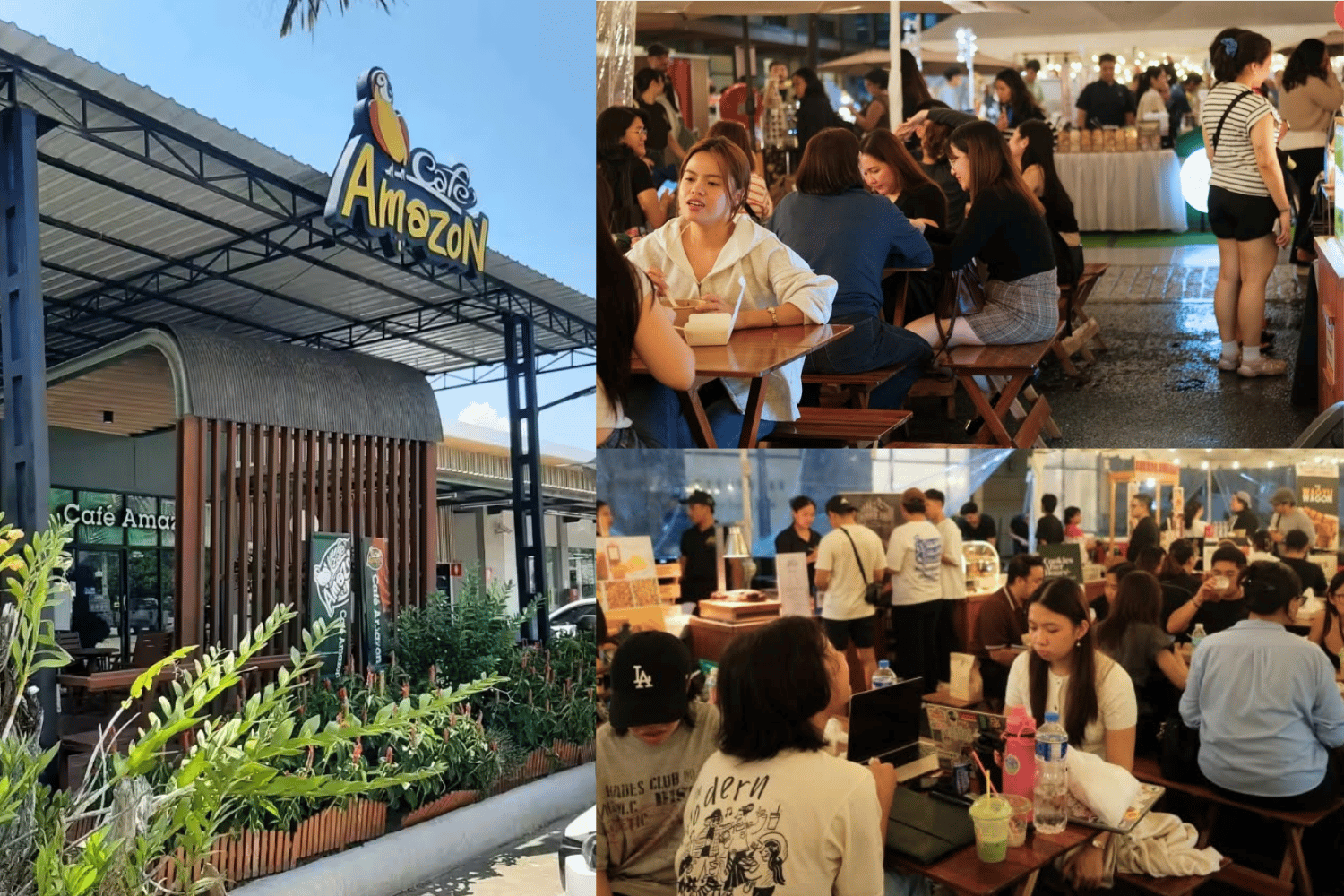
The biggest lesson from Café Amazon is its story about distribution.
Walk through almost any city in Thailand and chances are you’ll spot a Café Amazon. Most are attached to gasoline stations, while others stand on busy streets, inside temples, or even near office buildings.
From a modest coffee shop launched in 2002, the brand has grown to nearly 5,000 outlets across Thailand and overseas, becoming one of the country’s biggest consumer success stories.
Its rise raises an interesting question for Filipinos.
The Philippines has no shortage of coffee drinkers. Cafés have become fixtures in malls, business districts, universities, and even small towns. Local brands continue to expand, independent coffee shops thrive, and Filipino-grown beans have earned recognition from coffee enthusiasts around the world.
Yet the country has never produced a homegrown coffee chain on the same scale as Café Amazon. Part of the answer may lie in how Café Amazon was built in the first place.
Unlike most coffee companies, Café Amazon did not begin as an independent café business. It was created by Thailand’s state-owned energy company, PTT, which already operated thousands of gasoline stations nationwide. That gave the coffee brand something few startups ever enjoy: ready-made locations, a steady stream of motorists, and the financial muscle to expand quickly without having to build a retail network from scratch.
In many ways, the gas stations became the cafés’ first customers.
Philippine coffee market evolved differently
The Philippines has never had an equivalent platform. Local coffee chains have largely expanded one store at a time, competing for mall spaces, commercial buildings, and neighborhood locations. Growth has depended on finding the right sites, raising capital, recruiting franchisees, and building supply chains from the ground up. That naturally takes longer.
The Philippine coffee market has also evolved differently. Rather than being dominated by one local chain, it has become a mix of international brands, homegrown cafés, regional favorites, and independent specialty shops. Consumers have embraced variety, with many willing to try new concepts instead of sticking to a single brand.
This has created a lively coffee scene, but it has also meant that no single company has emerged as the overwhelming market leader. Coffee production itself may not be the deciding factor either.
Although the Philippines grows coffee, local production has long struggled to meet domestic demand, leading the country to import large volumes of beans each year. Running a nationwide coffee chain depends as much on logistics, branding, operations, and real estate as it does on access to coffee.
Story of distribution
Perhaps the biggest lesson from Café Amazon is that it is not simply a coffee success story, but a story about distribution.
Its parent company already had one of Thailand’s largest retail footprints before it ever sold a cup of coffee. The cafés simply gave millions of motorists another reason to stop. That kind of advantage is difficult to replicate.
Still, the question remains worth asking.
The Philippines has produced successful retailers, restaurant chains, and fast-food giants that have expanded well beyond the country’s borders. Coffee remains one of the fastest-growing consumer businesses, and several local brands continue to grow at a rapid pace.
Perhaps the country’s answer to Café Amazon has yet to arrive–or perhaps it will look nothing like Café Amazon at all.
READ: