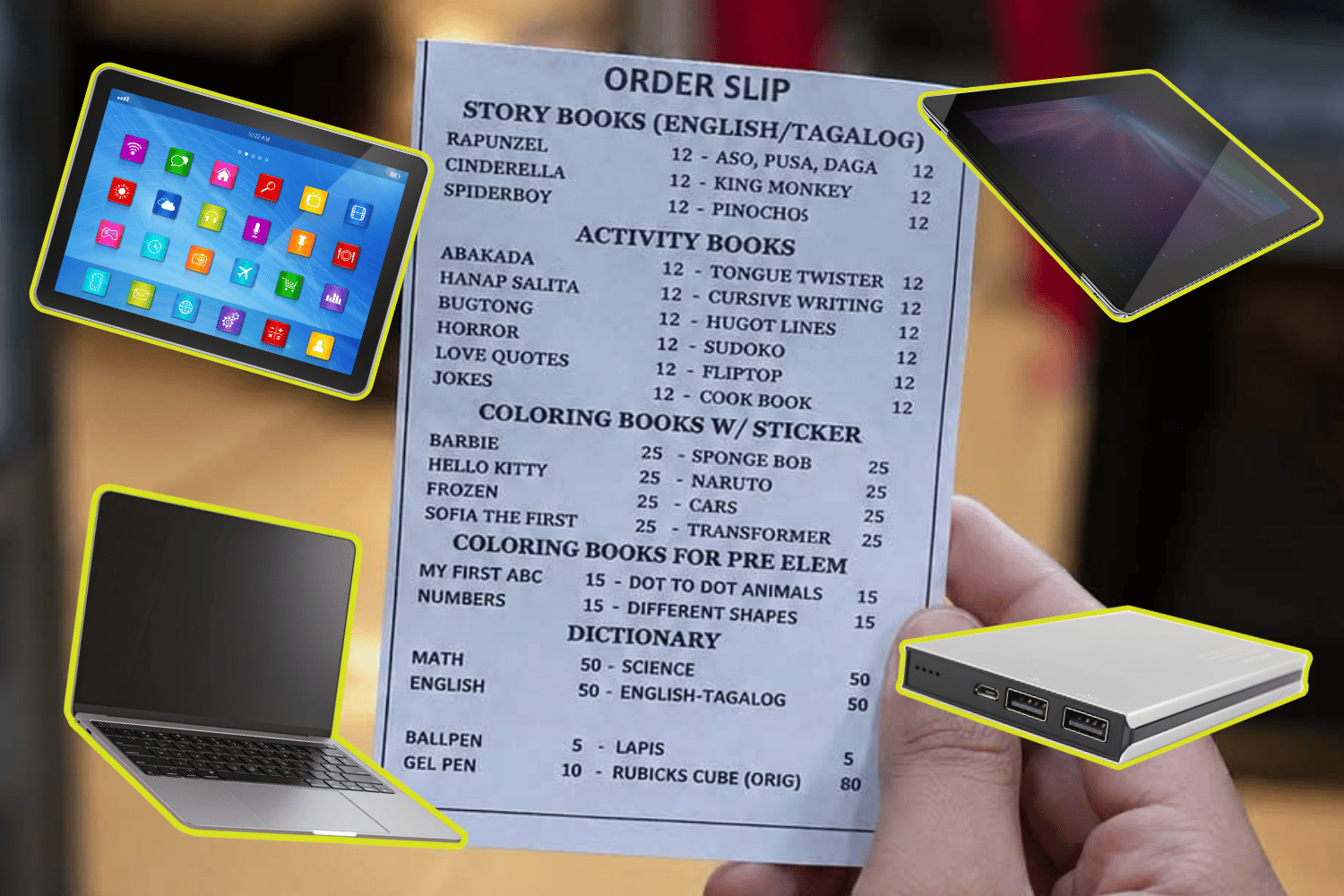
Viral old school supply list triggers nostalgia.
A school order slip recently made the rounds on social media, listing elementary essentials that immediately triggered a wave of nostalgia: a Taglish dictionary, physical coloring books, and penmanship supplies.
For many, the image evokes highly specific childhood memories, with many fondly recalling their memories in the comment section.
“Hahaha same tayo walang pambili 🤝😂 tapos sasabihin pa ng teacher, ‘pila na lahat ng bibili’ tapos ikaw nakaupo lang kasi walang pambili 😭 nakakahiya 😭,” one user wrote, recalling the quiet humiliation of remaining seated while classmates lined up to pay.
Yet, this nostalgia is deeply intertwined with a generational vow. Now parents themselves, many of those same commenters expressed a fierce determination to provide what they once lacked.
“Ngayon nila yan ibigay sa anak ko at siguradong may check yan 🤣 Lahat ng gusto nyang ba[s]ahin ipapacheck ko…bibilhin ko tlga,” another wrote.
But beneath this emotional resonance lies a structural shift in the Philippine educational supply chain, illustrating exactly how the mechanics of student services have evolved over the last two decades.
During the era of the order slip, the back-to-school economy operated on a highly centralized, paper-driven model. Schools effectively functioned as localized retail middlemen for a handful of legacy educational publishers.
Parents would receive a standardized list, hand cash directly to the classroom teacher, and wait for the school to distribute the physical workbooks. This system created a chain where finances were tied to physical printing costs and the localized logistics of publisher representatives delivering boxes of paper to school campuses.
Today, obtaining the needed school supplies is now driven largely by the academic sector’s pivot toward digital integration.
Following the Department of Education’s (DepEd) rollout of the MATATAG curriculum in 2024, which heavily emphasized digital literacy and the integration of localized digital modules, the physical workbook has increasingly been supplemented or replaced by interactive learning applications.
Furthermore, ongoing expansions of the DepEd Computerization Program (DCP) have shifted the institutional focus from supplying physical reference materials to distributing digital tablets and establishing school-based broadband infrastructure.
Consequently, the type of capital parents must invest in has fundamentally changed. The modern student’s supply chain is no longer dictated solely by a teacher’s paper list, but by the hardware and connectivity requirements of decentralized digital learning.
According to 2026 back-to-school market data from e-commerce platforms like Shopee and Lazada, the highest growth categories during the academic season are no longer traditional stationery, but rather entry-level laptops, tablets, power banks, and mobile data load.
As a result, the financial friction for parents has migrated from buying bulk physical books to handling the recurring costs of internet service providers.
This shift has also completely decentralized the act of shopping. Instead of relying on the school as a middleman, modern parents may now navigate a fragmented e-commerce landscape.
Now, there is a need to cross-reference device specifications with academic requirements, hunt for online platform vouchers, and manage last-mile delivery for school supplies that can be sourced from dozens of independent digital sellers rather than a single legacy publisher.
The “back-to-school” economy has not disappeared; it has simply evolved from a localized, paper-driven transaction into a complex digital infrastructure requirement.
While the Taglish dictionary and the penmanship pad remain potent symbols of a simpler educational era, today’s academic reality requires parents to act as independent IT procurers.
Ultimately, the modern order slip is no longer handed out by a teacher; it is built in a digital shopping cart, requiring a new kind of capital to keep students connected to the classroom.
READ:

Benilde film grads take 3 of 4 top prizes at DTI creatives tilt
Marinel Cruz
July 29, 2026
eGovPH Hackathon under fire over poor organization and judging transparency
Athena Dagli
July 25, 2026

ANALYSIS: Disguised blades promise protection—and carry legal risks
Annie Azucena
July 24, 2026