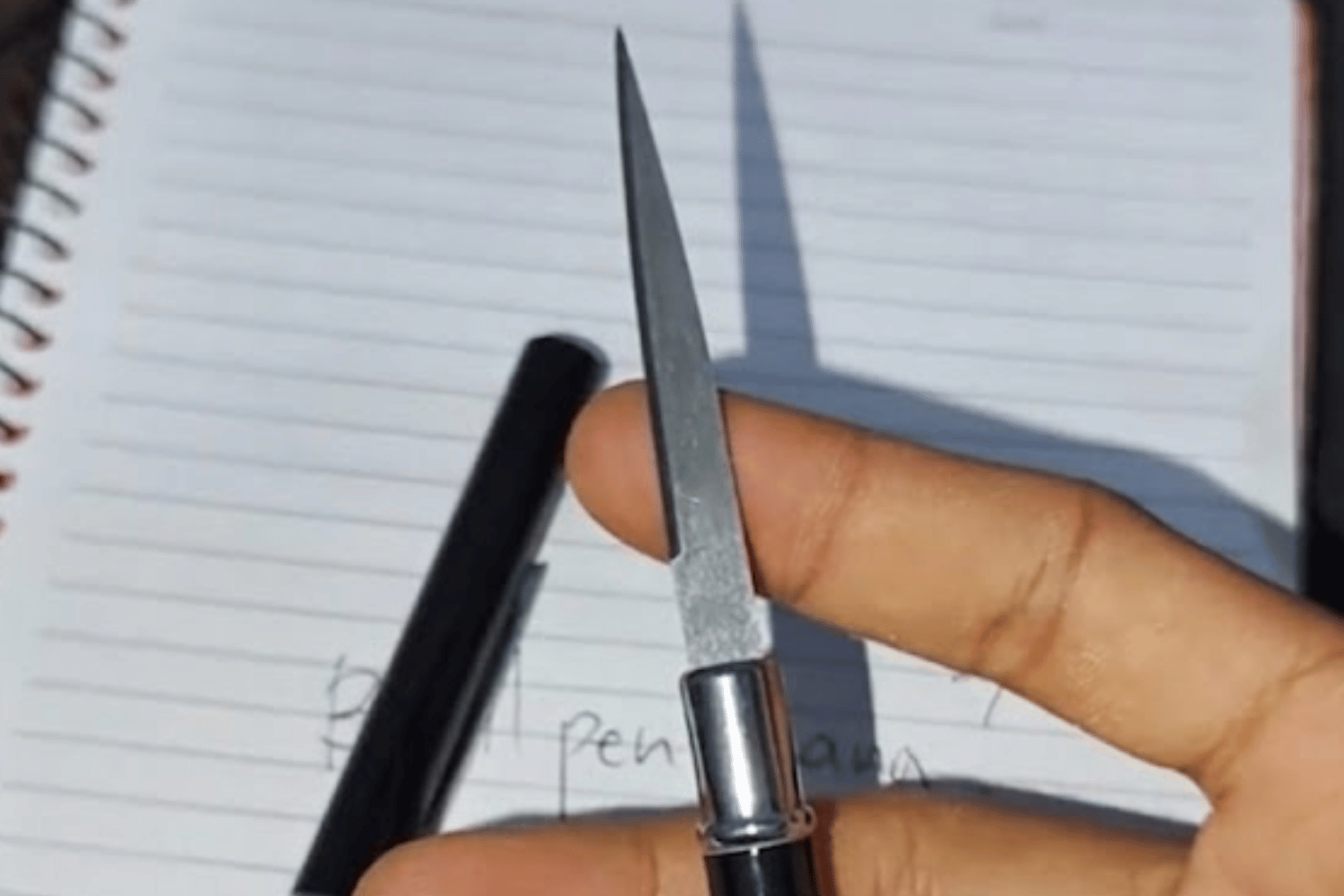
Filipinos turn to concealed tools amid fears over personal safety.
In the name of safety, how far are people allowed to go?
A video on social media showing an ordinary ballpen transforming into a sharp blade has sparked debate over civilian safety and self-defense in the Philippines.
While the appeal of a discreet, everyday-carry weapon is understandable among a public concerned about crime, the law warns that carrying concealed bladed items can turn a tool meant for protection into a serious criminal liability.
Under Presidential Decree No. 9—enacted in 1972 and upheld in national jurisprudence—carrying bladed, pointed, or blunt weapons outside one’s residence is prohibited unless the item is a necessary tool for one’s livelihood or used for a lawful purpose.
Several local government units across Metro Manila have also implemented policies against carrying bladed weapons. Makati City’s amended City Ordinance No. 2017-113, for instance, explicitly prohibits the possession of certain bladed items in public places.
A commuter who carries a concealed knife during a routine security check, or an individual who uses one during a street altercation, may face arrest and prosecution for illegal possession.
In the eyes of the law, carrying a disguised blade for general self-defense is not considered a justified precaution.
However, the interest in acquiring such tools reflects broader concerns about personal safety in urban areas. According to 2023 index crime statistics reported by the Philippine News Agency, crimes such as robbery, theft, and physical injury continue to be reported in densely populated areas and transit hubs.
When security measures, street lighting, and emergency response are perceived as insufficient, some civilians turn to personal protection methods.
However, relying on concealed blades can create additional risks. What begins as an attempt to defend oneself during a robbery or confrontation can escalate into a more serious incident, potentially exposing individuals to criminal charges if the force used is considered unreasonable.
For those seeking ways to improve personal safety, experts often recommend legal and non-lethal alternatives. Pepper spray, also known as oleoresin capsicum, is commonly used as a self-defense tool, although restrictions may apply in certain locations, including enclosed public transportation systems and commercial airlines.
Other options, such as high-lumen flashlights and personal alarms, are also used by some commuters as ways to deter threats, attract attention, and create opportunities to escape dangerous situations.
Beyond physical tools, self-defense training programs that focus on situational awareness, de-escalation, and the responsible use of force have also become available to civilians.
Organizations such as the International Krav Maga Federation Philippines offer training in disciplines like Filipino Kali, Brazilian Jiu-Jitsu, and Krav Maga.
Unlike the perceived security offered by a concealed blade, these programs focus on avoiding confrontation, recognizing threats, and responding within legal limits.
READ: