The building was once designed to represent the future of Philippine banking.
Walk along Manila’s historic Escolta Street and one building looks as though it arrived from another time—or perhaps another planet.
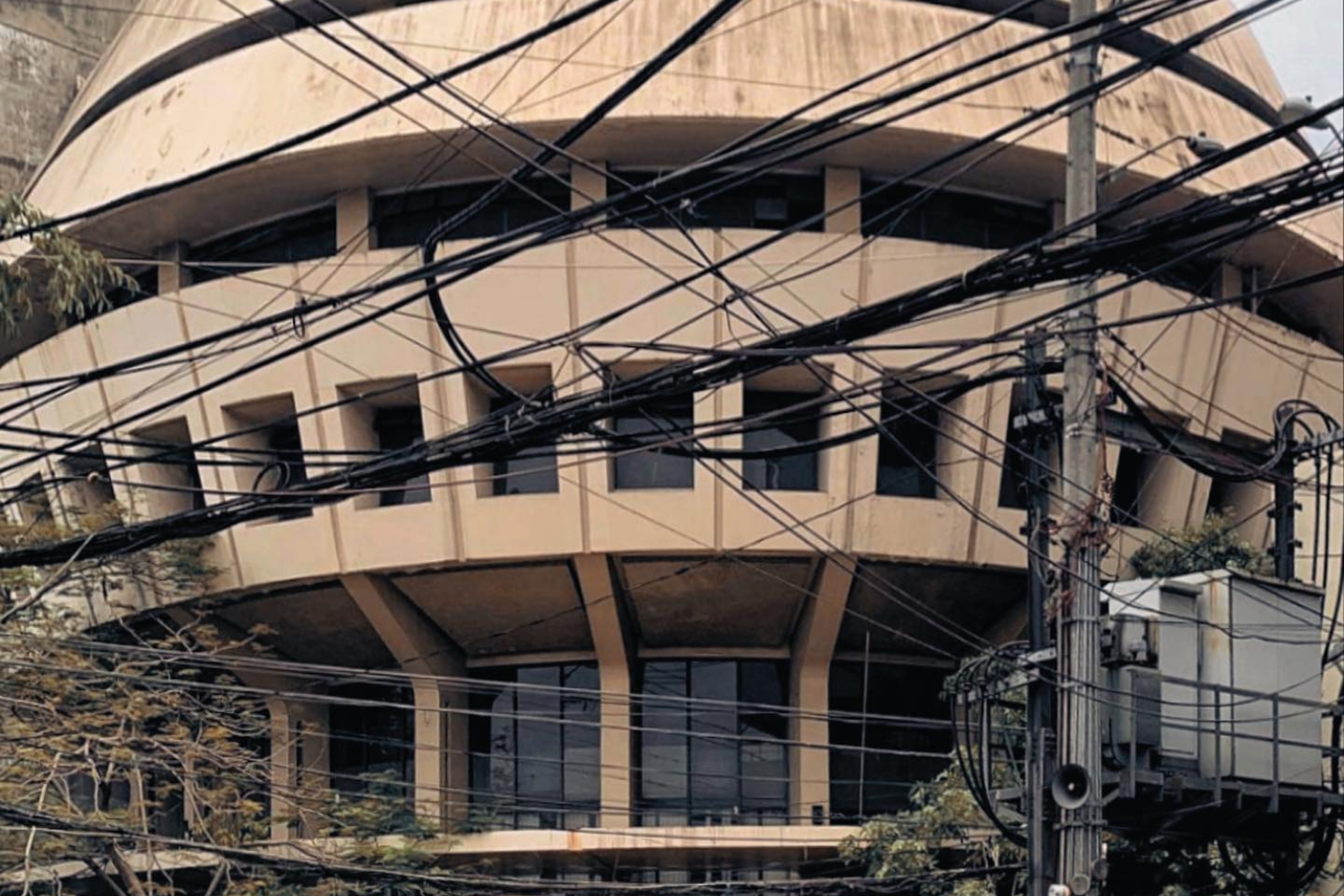
Completed in 1969, the former Commercial Bank and Trust Company Building is an unmistakable mass of concrete, glass and sweeping curves designed by National Artist for Architecture José María Zaragoza.
Its unusual silhouette has earned comparisons to a flying saucer or giant mushroom, making it one of the most recognizable surviving examples of postwar modernist architecture in Manila.
A building from the future
Zaragoza designed the Comtrust Building when Escolta was still synonymous with prestige, finance and commerce. But instead of copying the Neoclassical and Art Deco structures surrounding it, he created something radically different.
The building’s massive concrete upper section appears to hover over its glass-covered lower floors. Architect Dominic Galicia has noted that this dramatic form was more than aesthetic: its mushroom-like overhang helped shade the glass below from Manila’s intense tropical sun.
It was futuristic architecture adapted to the Philippine climate.
The building was also significant in Zaragoza’s career. Better known for religious landmarks such as Santo Domingo Church and his work on Quiapo Church, the National Artist also produced striking commercial architecture during the country’s postwar modernist period.
The 1969 Comtrust headquarters would become one of Escolta’s last major architectural statements before Manila’s financial center increasingly migrated toward Makati.
When ComTrust became BPI
The building also witnessed a major chapter in Philippine banking history.
In 1981, Bank of the Philippine Islands acquired Commercial Bank and Trust Company in what BPI describes as a landmark merger. The former Comtrust headquarters subsequently became associated with BPI and continued operating as its Escolta branch.
The transaction reflected something larger happening around it: Philippine business was changing, and Escolta was surrendering its decades-old position at the center of Manila’s commercial life.
Yet the building survived.
From bank to cultural treasure
In 2019, the National Museum of the Philippines declared the structure an Important Cultural Property, recognizing its architectural and historical significance.
Heritage markers commemorating that status were formally unveiled in August 2023.
The recognition matters in a city where many significant buildings have disappeared under the pressure of redevelopment, neglect and changing commercial priorities.
More than half a century after it was completed, Zaragoza’s strange concrete “spaceship” remains on Escolta.
Once designed to represent the future of Philippine banking, it has become something equally valuable today: a surviving piece of the future Manila once imagined.