Before visitors enter the galleries, they encounter physical evidence of these geological forces.
If you have visited the National Museum of Natural History in Manila, chances are you have walked past it, posed beside it, or wondered why an enormous boulder is sitting right outside the building.
It is not landscaping.
That massive rock facing Kalaw Street is a piece of Mayon Volcano—and a reminder of one of the most devastating eruptions in Philippine history.
The centerpiece of the museum’s outdoor rock garden is an approximately 60-metric-ton andesite boulder associated with Mayon’s catastrophic February 1, 1814 eruption. Andesite is a volcanic rock commonly produced by stratovolcanoes such as Mayon.
The 1814 eruption was among the volcano’s deadliest recorded events. Explosive activity sent ash, volcanic debris and pyroclastic material across communities surrounding Mayon, killing more than 1,200 people and devastating several towns.
It is the same eruption famously associated with Cagsawa, where the church’s surviving bell tower became an enduring image of Mayon’s destructive power.
More than two centuries later, the enormous boulder now displayed in Manila offers visitors a startling sense of the forces unleashed during such an eruption.
The rock was unearthed in Barangay Busay in Daraga, Albay, in 2017. Instead of leaving the geological specimen where it was found, the National Museum brought it hundreds of kilometers from Albay to Manila for preservation and public display.
Moving a rock weighing roughly 60 tons was itself a major undertaking.
Today, it sits prominently outside the National Museum of Natural History alongside other volcanic specimens, including material associated with Mayon’s more recent activity.
Its placement at the museum entrance is fitting. Before visitors even enter galleries explaining the geology and tectonic forces that created the Philippine archipelago, they encounter physical evidence of those forces.
And it is difficult to imagine a more dramatic introduction.
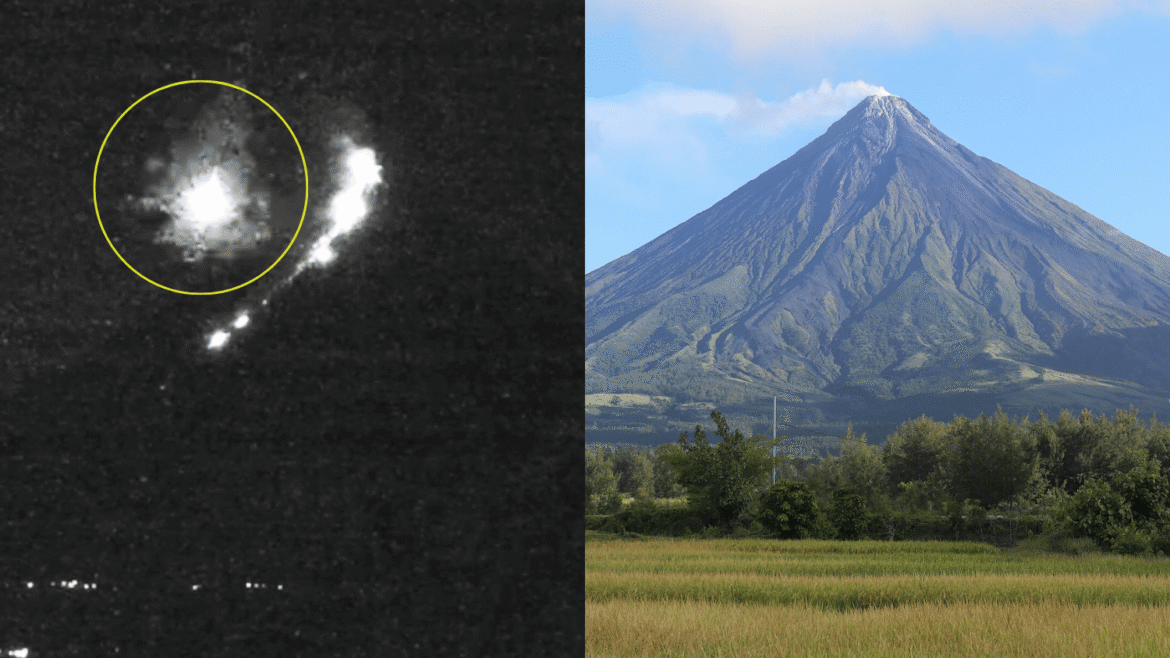
For many people, Mayon is the postcard-perfect volcano famous for its near-symmetrical cone. The giant boulder in Manila tells the other half of its story.
That beautiful mountain can move something weighing tens of thousands of kilograms—and throw it across the landscape.
So the next time you pass that giant rock outside the National Museum, look a little closer.
You are standing beside a piece of Mayon—and a survivor of an eruption more than 200 years ago.
READ: