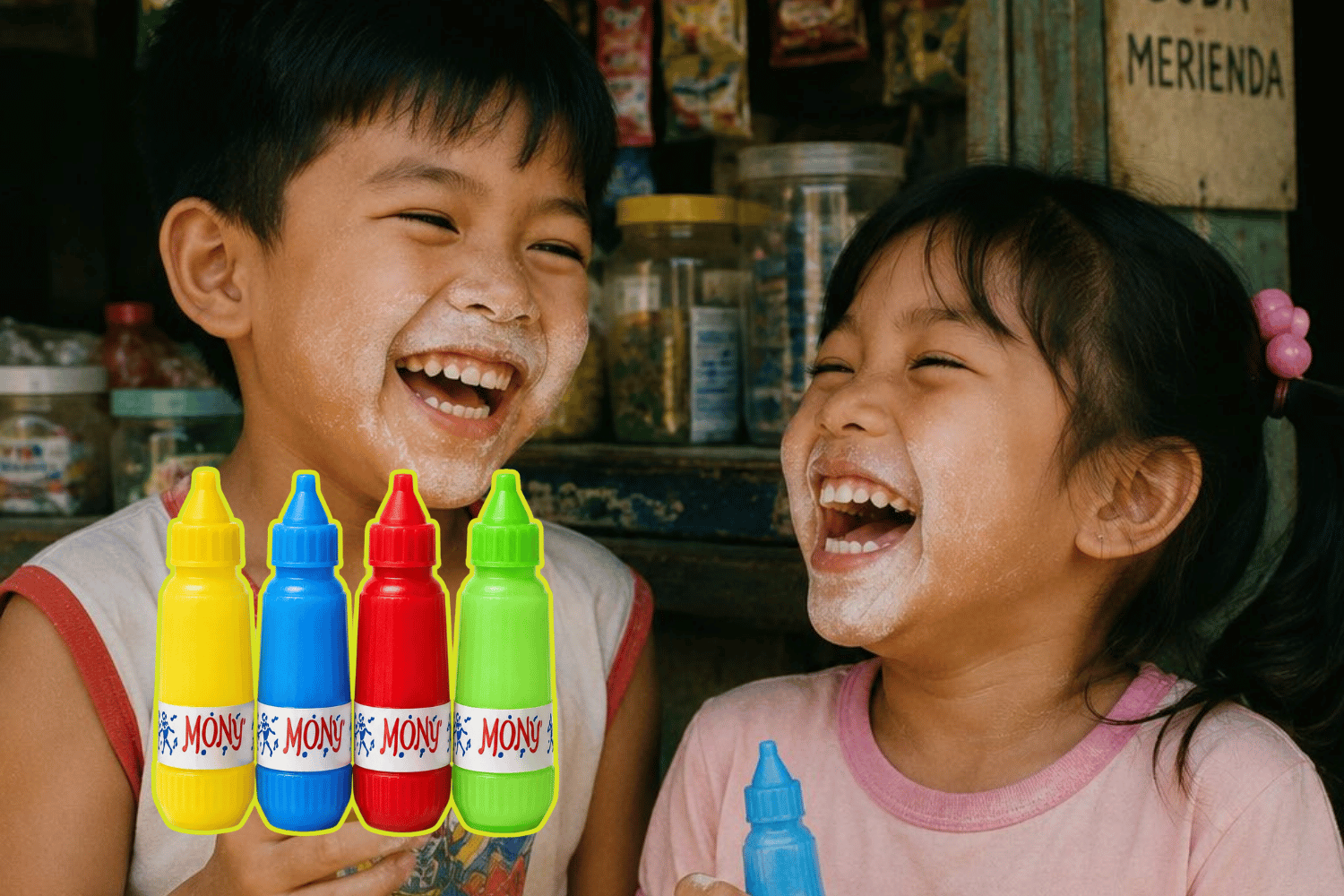
The little bottle continues to trigger nostalgia among netizens.
You could spot it from across the sari-sari store.
Nestled among colorful candies and chewing gum was a tiny plastic baby bottle filled with sweet milk powder. For just a few coins, it became one of the simplest joys of childhood. You would twist off the cap, tilt the bottle toward your mouth, and let the sugary powder melt on your tongue—carefully, so you wouldn’t inhale it and end up coughing.
For many Filipinos who grew up in the 1980s and 1990s, that tiny bottle was Mony Mony.
Long before imported chocolates and convenience-store snacks became commonplace, Mony Mony was one of the treats that defined recess, neighborhood games, and after-school trips to the nearest sari-sari store. Like Haw-Haw, Choc Nut, and Mik-Mik, it became part of the collective memory of Batang ’80s and ’90s.
Its appeal wasn’t just the sweet milk powder inside. It was the experience.
The miniature baby bottle made children feel like they were drinking from an actual feeding bottle, turning an ordinary candy into something playful and memorable. It was cheap enough to buy with loose change, making it an easy reward after running errands or doing household chores.
Years later, the little bottle continues to trigger nostalgia online. Social media posts featuring Mony Mony often fill with comments from adults reminiscing about childhood afternoons spent sharing the powder with friends—or trying not to spill it all over their school uniforms.
But what was once remembered as an innocent childhood indulgence has recently become the subject of an official public health warning.
In 2025, the Philippine Food and Drug Administration (FDA) issued FDA Advisory No. 2025-1208 warning the public against purchasing or consuming “MONY MONY Sweet Blend.” According to the agency, the product is unregistered and does not have a Certificate of Product Registration (CPR), meaning it has not undergone the FDA’s required evaluation for quality, safety, and compliance with Philippine food standards.
The FDA warned that because the product is unregistered, consumers have no assurance that it was manufactured under approved sanitary conditions or that its ingredients meet established food safety requirements. Without regulatory evaluation, the agency cannot verify its quality, purity, nutritional content, or the possible presence of contaminants.
This creates several hidden risks, particularly for children, who have traditionally been the product’s biggest consumers. An unregistered food product may contain undeclared ingredients or allergens that could trigger adverse reactions in sensitive individuals. Improper manufacturing, handling, and storage conditions may also increase the risk of bacterial, chemical, or physical contamination. Moreover, without verified labeling, consumers have no reliable information about what they are actually consuming.
There is also the way the product is eaten. Like other powdered milk candies, Mony Mony is poured directly into the mouth from a narrow opening. Fine powders can be accidentally inhaled, causing coughing, choking, or aspiration, especially among young children. While this risk is not unique to Mony Mony, it underscores the importance of adult supervision and choosing products that have passed the FDA’s safety evaluation.
The advisory has surprised many Filipinos who associate Mony Mony with carefree childhood memories rather than health concerns.
It also serves as a reminder of how much food safety standards have evolved. Decades ago, many snacks were purchased without anyone asking whether they were FDA-registered. Children simply trusted what was available at the neighborhood sari-sari store. Today, consumers are encouraged to check whether food products have proper FDA registration before buying them.
The warning does not erase the nostalgia attached to Mony Mony. For many, the tiny baby bottle will always symbolize a simpler time when a few pesos could buy a moment of happiness.
But memories and safety are two different things.
Mony Mony may forever remain one of the most recognizable sweets of a generation. Yet today, its story is no longer just about childhood nostalgia—it is also a reminder that even the snacks we grew up with must meet modern safety standards designed to protect public health.
READ:
FLASHBACK: The bizarre true-crime rivalry that pitted Kris Aquino against Lorna Tolentino
radar Entertainment
June 22, 2026
FLASHBACK: She wore a Maria Clara to a swimsuit press parade—and won anyway
radar Lifestyle
June 12, 2026
FLASHBACK: The Monterrey Apartments pioneered high-rise living in the Ayala District
radar Lifestyle
June 21, 2026