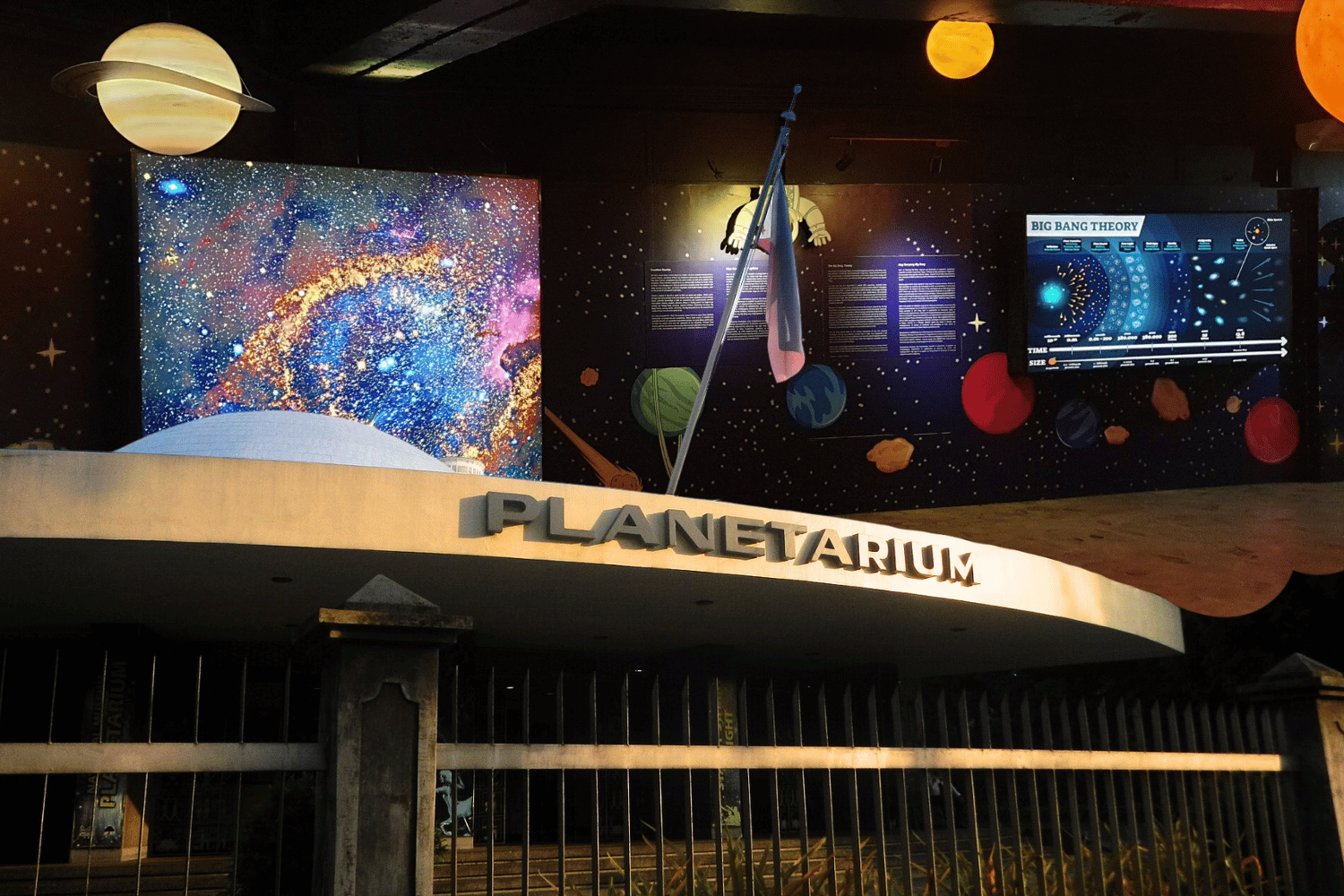
The old Planetarium’s greatest legacy was the curiosity it ignited.
For many Filipinos who grew up in the 1980s, one of the highlights of every school field trip was stepping inside the giant white dome at Luneta. The lights would slowly dim, the room would fall silent, and suddenly the ceiling would come alive with thousands of stars.
For an hour, you weren’t just a student sitting in Manila—you were floating through galaxies, visiting distant planets, and imagining a universe far bigger than the one you knew.
For countless children, that was where a lifelong fascination with science and space first began.
Today, that beloved destination is no longer what it used to be.
After serving generations of Filipinos for nearly five decades, the iconic National Planetarium in Rizal Park has officially been retired. The 46-year-old facility has been permanently decommissioned as part of the National Museum of the Philippines’ redevelopment plans for the National Museum Complex and the wider rehabilitation of Luneta.
The closure marks the end of an era for one of the country’s most recognizable science landmarks.
Built during a time when space exploration captured the world’s imagination, the National Planetarium introduced millions of students to astronomy through immersive dome shows that simulated the night sky. Long before smartphones, YouTube, or virtual reality, it offered a rare chance to witness eclipses, constellations, and planetary movements in a way that textbooks never could.
For many children, it was their first realization that Earth was only a tiny dot in an unimaginably vast universe.
The familiar white dome still stands along Padre Burgos Avenue, but it no longer serves its original purpose. Instead, the structure has been converted into administrative offices for the National Parks Development Committee (NPDC), ending its decades-long role as the country’s premier public planetarium.
Fortunately, this isn’t the end of the National Planetarium itself.
Authorities have announced plans to build a brand-new, world-class planetarium elsewhere within Rizal Park. While details of the new facility have yet to be finalized, the goal is to create a more modern venue equipped with updated technology capable of inspiring a new generation of space enthusiasts.
Until then, visitors to Luneta can still spend an entire day exploring the National Museum Complex. Just a short walk away are the National Museum of Fine Arts, the National Museum of Anthropology, and the National Museum of Natural History—three institutions that continue to offer free access to Filipino history, culture, biodiversity, and scientific discovery.
The old Planetarium may no longer project stars onto its famous dome, but its greatest legacy was never the building itself.
It was the curiosity it ignited.
Somewhere among those darkened seats were future scientists, engineers, teachers, pilots, artists, and dreamers who looked up at an artificial night sky and, perhaps for the first time, wondered what lay beyond the stars.
And that is something no renovation can ever erase.
READ: