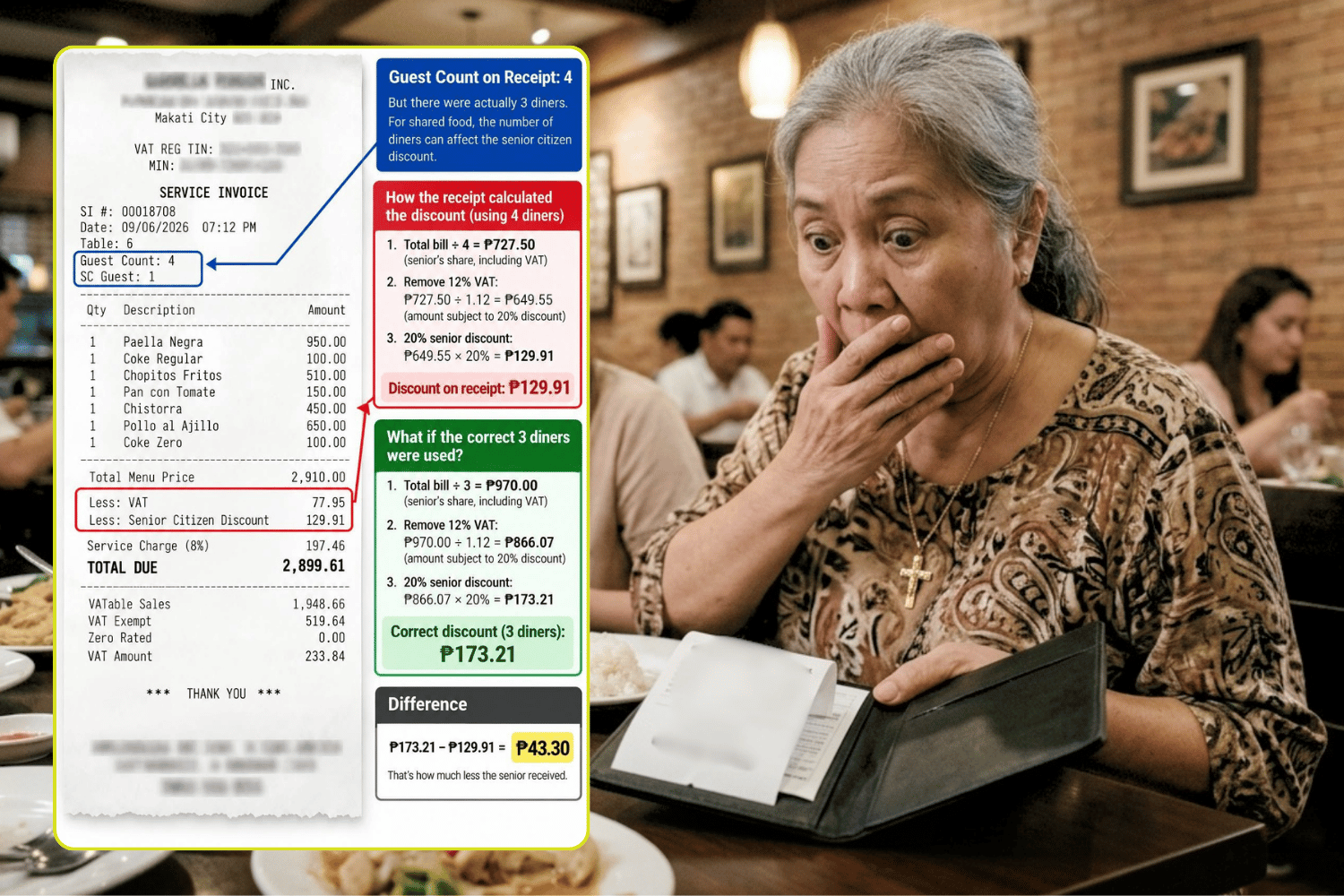
“There were 3 of us, with one senior citizen. But the receipt showed 4 guests,” Mesina wrote. “It seems like a small mistake, but it lowered the senior discount.”
And the math shows why that single extra “guest” can matter.
According to the receipt Mesina shared, their total menu price was ₱2,910.
With four diners entered into the system, the senior’s presumed share was ₱727.50. After removing the 12% VAT, ₱649.55 became subject to the 20% senior citizen discount, resulting in a discount of only ₱129.91.
But there were actually three diners.
Using three people, the senior’s share would have been ₱970. After removing VAT, the amount subject to the 20% discount would be ₱866.07, producing a discount of approximately ₱173.21.
That’s a difference of ₱43.30.
Mistake or something else?
Mesina said what concerned him was that it was allegedly not the first time he had encountered the issue.
“What concerns me is that this has happened to me twice already,” he wrote.
“So I started wondering, is this just a common cashier mistake, or is this sometimes being done to reduce the senior discount?”
Mesina was careful not to accuse the restaurant of deliberately manipulating the transaction, saying he had no proof that the incorrect guest count was intentional.
Still, his experience highlights why diners should check their receipts before paying.
Under Republic Act No. 9994, or the Expanded Senior Citizens Act of 2010, qualified senior citizens are entitled to a 20% discount and VAT exemption on applicable restaurant purchases for their exclusive use or enjoyment.
For food shared by a group, the number of diners can become relevant when determining the senior citizen’s proportionate share. An inflated headcount can therefore result in a smaller discount.
Check before you pay
Mesina, who said he previously worked in the restaurant business and is now developing a point-of-sale system, acknowledged that mandatory senior and PWD discounts can also affect businesses.
But he stressed that giving seniors less than what they are entitled to should never be the solution.
His takeaway for customers is remarkably simple: check the guest count before paying.
A tiny entry on a receipt—“Guest Count: 4” instead of “3”—can easily escape attention.
But as Mesina’s example shows, one imaginary diner could mean a very real reduction in a senior citizen’s discount.
READ: