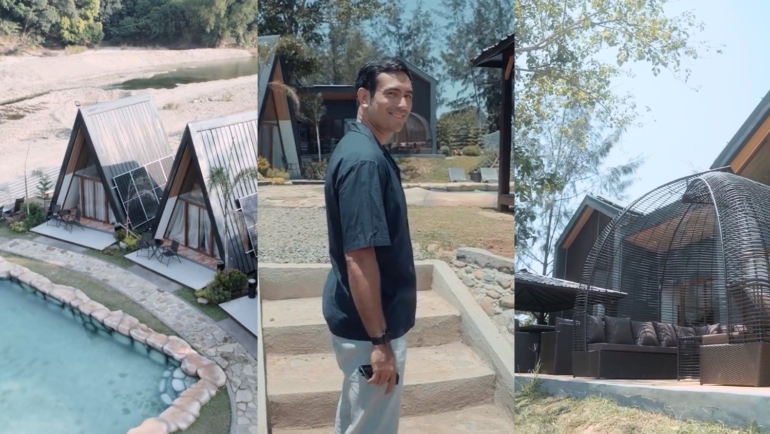
Lily Franky leads Diamonds in the Sand, which explores kodokushi
For Japanese multi-hyphenate Lily Franky, Japan and the Philippines share a lot more in common than most people realize: hidden loneliness, dedication to filmmaking, and small acts of kindness.
Lily—who has appeared in over 40 films, including the 2018 Palme d’Or-winning “Shoplifters”—has witnessed these parallels firsthand while working on “Diamonds in the Sand,” a Philippines-Japan-Malaysia co-production participating at this year’s QCinema International Film Festival.
He’s also starring in another entry, “Renoir.”
Written and directed by documentarist Janus Victoria in her full-length feature debut, “Diamonds in the Sand” explores the Japanese phenomenon of kodokushi (lonely death) alongside the Filipino sense of community.
The story follows Yoji (Lily), a divorced salaryman from Tokyo whose solitary life turns grim after his mother’s death and the shocking discovery of a neighbor’s decomposing body. To avoid a similar fate, he impulsively travels to the Philippines, where he connects with his mother’s caregiver, Minerva (Maria Isabel Lopez), and her daughter (Charlie Dizon)—slowly discovering a different way of being.
“There’s a lot of delicate topics being discussed regarding the long history between the Philippines and Japan,” Lily, via an interpreter, told Radar Entertainment and other select media during an intimate lunch in Cubao, the heart of QCinema. “What I think is important in this film is that instead of just taking up historical news, Director Janus has put up the topic of the lonely death.”

The gravity of kodokushi cannot be ignored. The Japan Times, citing the country’s National Police Agency, reported that over 58,000 people aged 65 and up died alone at home in 2024. Roughly 70 percent of them were found within a week, and about 10 percent were found after over a month. The Guardian’s Tokyo correspondent Justin McCurry called it an “epidemic.”
Lily praised Janus for “making sure that [kodokushi] is recognized around the world.”
“In the movie, it’s kind of shown that there’s no loneliness in the Philippines, but I don’t think that’s really the case,” he added.
Commitment to filmmaking
Another similarity Lily has observed between Japan and the Philippines is their commitment to filmmaking.
“In Korea or in Europe, you can only shoot for a certain number of hours per day, but in Japan and the Philippines, you can keep on shooting as long as you want,” he said, though he acknowledged it can be “not so good” sometimes.
But Lily has a Pinoy sense of humor: “Even if you end the shooting at around 3 a.m., there are still a lot of places where you can eat and drink.” He has an oddly specific favorite: “As long as there’s Jollibee, I’m fine.”
During his visits to the popular fast-food chain, he fondly recalled Filipinos eating and laughing together, some even bringing out food from their bags. He admired their warmth despite inner struggles, unlike in Japanese branches, which see customers eating alone.
“They don’t seem to be lonely, but actually, those people would feel a lot more loneliness when they finally fall into that,” he said.
Portraying Yoji
Lily’s portrayal of Yoji was informed by such observations. “Maybe he’s not really unlikeable per se, so I tried, as much as possible, to pull out from inside me the unlikeable parts,” he said. “Yoji’s unlikable humanity is in me and also in each of us… Someone can’t really be a hero but can’t really be a villain, either.”
A memorable scene showed Yoji vomiting, which Lily noted was taken multiple times from different angles. To induce vomiting, he said he imagined the scene where worms emerge from a decomposing body.
“Don’t you think that’s amazing?” he said, adding he ate katsu curry for it. “I felt that that was my best acting in the entire film.”
Lily shared that he also prepared by watching Filipino films.
Deep understanding of the Philippines
Beyond the set, Lily’s understanding of the Philippines deepened through his personal relationships. “One of my business partners is Filipino. I have Filipino friends, too. I also support some Filipinos’ education. They give me letters every now and then,” he said.
He also noted how Filipinos “talk a lot,” though thinks those in Japan are “probably darker” or “more lonely” because they’re quieter.
Asked what Filipino traits he admires, he mentioned hospitality, which he hopes more people emulate. He also cited the simple yet touching question, ‘Kumain ka na ba?’ (Have you eaten?), depicted in the film as something “very important.”
“I think it should be a common phrase in the world. A lot of people can be saved by just that phrase,” he said.
Lily noted that Japanese neighborhoods also share meals, though the tradition has become less common nowadays. “I wish that it goes back,” he said.
The Philippines has left a lasting mark on Lily, and since he’s also a screenwriter and author, he isn’t discounting the likelihood of writing about the country in a future project.
“Next time, I want to come to the Philippines to travel,” he said. “There’s quite a possibility that the Philippines would be a part of the creative space of my writing.”
“During my filming sessions, Filipinos really left an impact on me,” he added. “I would really like to create something with Filipinos again, even if it’s not a film.”
QCinema Film Festival 2025, themed “Film City,” runs from Nov. 14 to 23. The lineup includes 93 titles across 12 sections.
READ:
Quezon City, Dumaguete named UNESCO Creative Cities for Film, Literature
Nikko Miguel Garcia
November 5, 2025
Erik Matti’s ‘Call My Manager’ kicks off QCinema 2025 with star-studded PH adaptation
Kiko Escuadro
November 11, 2025
Ashtine Olviga gets real about activism in “Manila’s Finest” with Piolo Pascual
Marinel Cruz
November 18, 2025