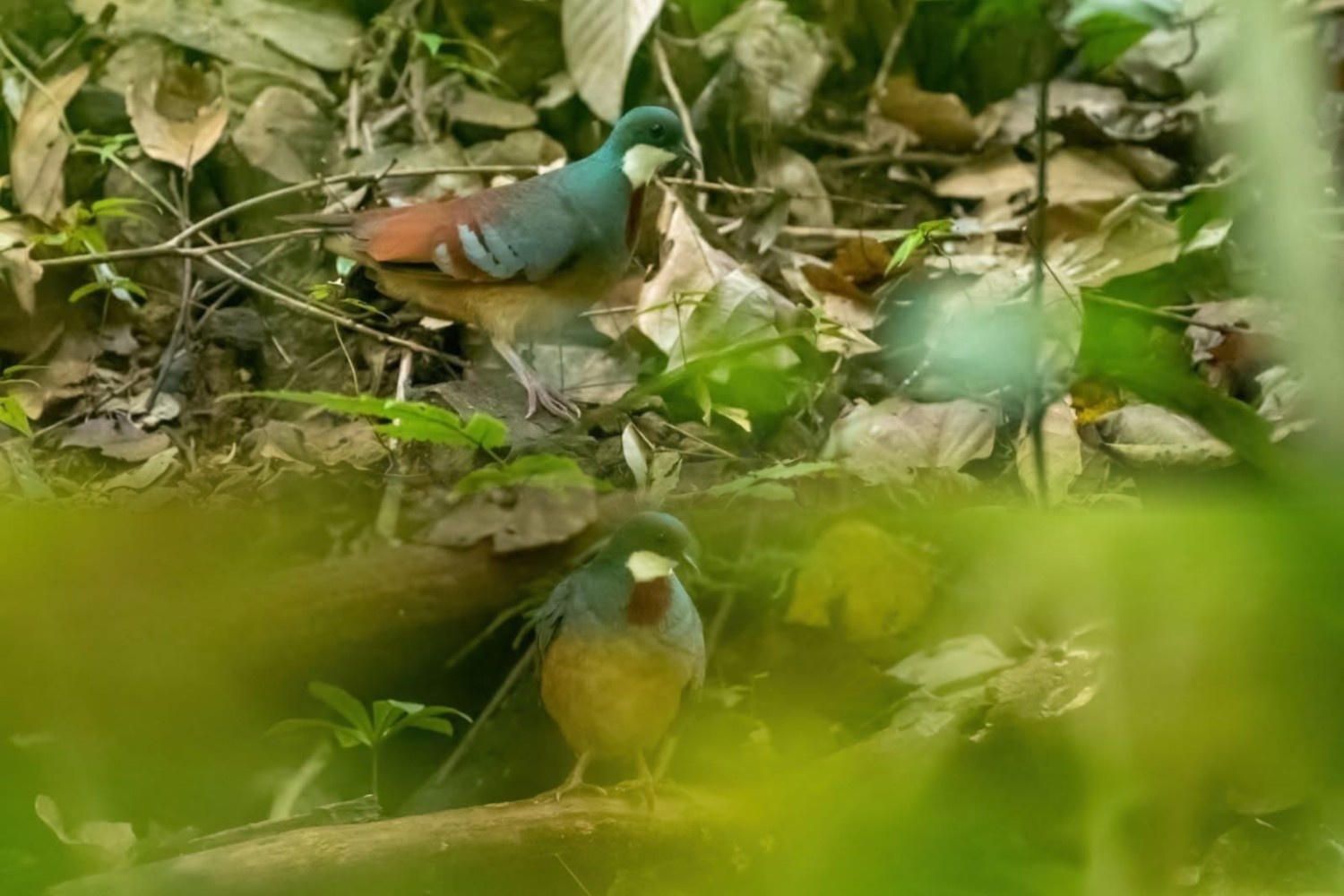
A research team has captured the first modern photograph of the rare Leyte bleeding-heart bird.
For more than a hundred years, the Leyte bleeding-heart existed almost like a ghost in Philippine wildlife lore — a mysterious forest dove known only through old scientific notes, fading records, and stories whispered among conservationists.
Now, the “lost” bird has finally revealed itself again.
The International Institute of Rural Reconstruction (IIRR) announced that the rare Leyte bleeding-heart (Gallicolumba crinigera leytensis) was photographed in the Leyte Sab-a Basin Peatland (LSBP) Hydrological Unit in San Miguel, Leyte, marking what may be the first documented contemporary sighting of the subspecies on the island since 1918.
Distinct for the blood-red patch on its chest and its secretive behavior on dense forest floors, the ground-dwelling dove has long eluded scientists and birdwatchers alike. For decades, researchers relied mainly on century-old notes from ornithologist Ernst Hartert, with no widely recognized modern image of the bird ever publicly documented.
“This may be the first documented sighting of the subspecies on the island, with the photo serving as its first contemporary and publicly known evidence in more than a century,” IIRR said.
The historic photograph was captured by Marvin Jay Sarmiento and his team during biodiversity monitoring activities under the LUYON project, a four-year peatland restoration initiative co-managed by IIRR and Visayas State University Alangalang.
But the rediscovery did not come easy.
“Pure blood and sweat po ng team,” Sarmiento shared. “Imagine spending 7 to 9 hours of silence each day for 5 days straight, waiting beneath heavy rain-soaked canopies. Hunger, insect bites, sleepless nights on sloping ground, and cameras wrapped in trash bags just to survive the weather.”
“There were moments we nearly gave up,” he added, “moments we dozed off from exhaustion—but the research expedition has always been about patience, grit, and believing that nature reveals itself only to those willing to endure.”
Their persistence paid off when they finally witnessed the elusive bird scurrying across the wet forest floor while foraging for seeds and fallen fruit.
Beyond the excitement of rediscovering a supposedly “lost” bird, conservationists say the sighting also highlights the ecological importance of Leyte’s threatened peatlands.
According to IIRR, the Leyte Sab-a Basin Peatland remains one of the few viable habitats capable of supporting the rare species. However, decades of land conversion, drainage, and peat fires have severely degraded the area.
Last April, destructive peat fires swept through parts of the Leyte Sab-a Basin Peatland and Agusan Marsh, intensifying calls for stronger peatland protection policies nationwide.
The LUYON project is currently working with local governments, NGOs, and communities on restoration efforts such as rewetting and revegetation to rehabilitate damaged peatland ecosystems.
Previous biodiversity assessments in the area also documented endangered wildlife such as the Philippine tarsier, Samar hornbill, and blue-naped parrot — further proving the peatland’s importance as a biodiversity refuge.
For conservationists, the rediscovery of the Leyte bleeding-heart is more than just a rare wildlife sighting. It is a reminder that even species thought nearly gone can survive — if their forests survive with them.
READ: