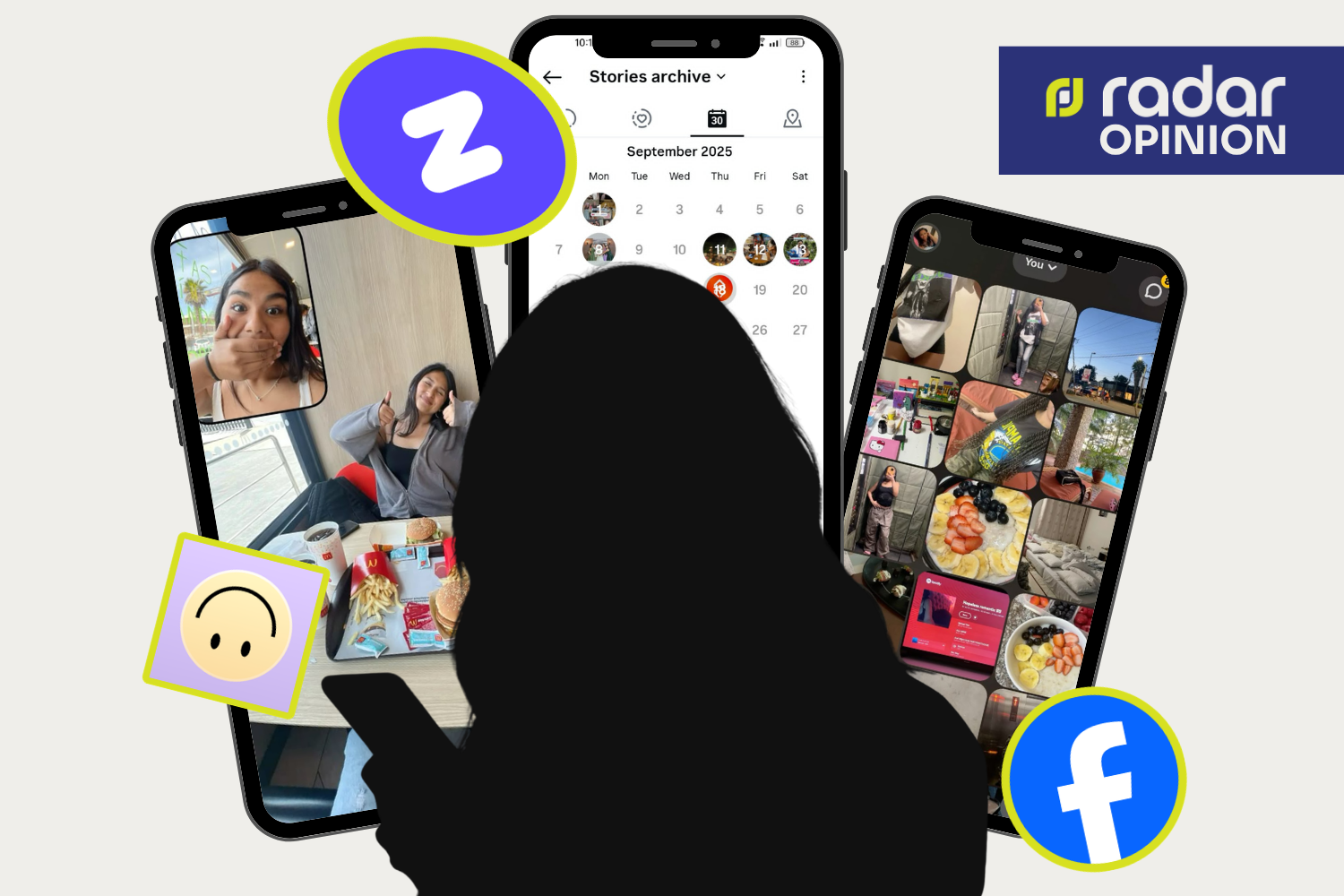
Meta? BeReal? Locket? Bondee? Zepeto? Setlog? Nope.
Every few months or so, a new social media app will emerge claiming to be “not like the other girls”: promising genuine connections and intentional uploads to combat the current cesspool of algorithm gaming and ragebait on mainstream platforms—while still ultimately enabling curation and envy.
BeReal arguably created the blueprint for all the quirky social media that followed. Though the app launched in 2020, its global rise occurred in a post-COVID-19 world—growing from 21.6 million to 73.5 million users in under two months.
The year was 2022 and everyone was re-learning what life outside was like after seemingly neverending COVID-19 lockdowns. Every personal interaction and whiff of fresh air was held dear as if another pandemic were to once again shutter us all inside the next day.
I was a college junior that year, only then getting my first taste of campus life after two years of Zoom classes and Discord hangouts. The older Gen Z narrative of “we didn’t get a high school graduation and missed out on college fun because of COVID” has been repeated to death, but it speaks to a deep longing among my generation that will forever haunt us. There was plenty of growing up that needed to happen between the ages of 18 and 20 that just didn’t because the deadly combo of a global pandemic and government incompetence took that away.
Hopping on the BeReal train at the time felt natural. I wanted to keep tabs on my old friends who stayed throughout the pandemic and keep up with the people I was getting to know for the first time, without worrying if I had skipped their personal updates just because some computer code determined I wouldn’t engage with their posts.
In lieu of curated photosets that at once screamed vanity and insecurity, BeReal would alert users at a random time of day to post about whatever was right in front of you at the moment. It didn’t care if you were on the toilet or in the middle of a breakup—after all, only your closest friends would see the updates. These vignettes disappeared from the feed after 24 hours, a feature first popularized by Snapchat years prior.
Like any other trendy lifestyle practice, BeReal faded into obscurity after some months and everybody still went about their Facebook MyDays and Instagram collages. Then Locket quickly took its place.
There was virtually nothing different with Locket, except users could post several updates in a day. It carried a similar pledge of “Best Friends First,” promising no-nonsense updates with the people who mattered. Like BeReal, it fell out of the spotlight after a few months.
Then came the avatar-based connections. Arguably an offshoot of the “anti-social media” social media platforms, these apps had users interacting through customizable characters in living in their own houses in a shared world. Think if ‘Club Penguin’ or ‘Poptropica’ had no games and were fashioned into a social media trend.
Bondee is one example of this subset—rising to prominence in 2023 as a cute way for people to express themselves and interact with friends, only to have public opinion turned on them after revealing cryptocurrency and non-fungible token plans. Another app was Zepeto, which already gained popularity in 2018 but exploded once again post-pandemic once it had expanded its personalization options and social networking functions.
Perhaps the latest app to cash in on the “anti-social media” train is Setlog. The app allows friends to take daily vlogs together, alerting users to take 5-second clips every hour. Users cannot post to a general feed, only to a “room” where up to 20 friends can be added.
Interestingly enough, vlogs saved from Setlog have gained popularity on TikTok despite carrying the “anti-social” essence of raw, candid updates within a close circle.
Will Setlog follow its spiritual predecessors and eventually fizzle out of favor? Time will tell, but breaking free from the trend cycle is unlikely—especially when the apparent craving for connection is repeatedly answered with another app instead of actually connecting with people.
These platforms that claim to be an antidote to the increasingly antisocial nature of social media still give rise to the same vanity and insecurity that plague mainstream social media. Photo angles have to feel authentic yet frame everyday life as interesting enough for attention. Daily activities have to be curated so update reminders never strike at an inconvenient time. Avatars have to strike a balance between unique and trendy to be worth the interaction.
Resorting to another social media platform to undo the mind conditioning that social media itself started is like trading soda for a just-as-sugary juice drink in the hopes of becoming healthy.
Make no mistake: there is no shame in enjoying these apps. They really do have cool features. But when apps promising a “genuine” social media experience become a pattern—only to fade weeks later—it begins to feel like we are chasing something no app can provide: a sense of belonging, wholeness, and kinship.
Gen Z may be the most digitally savvy generation, but it is also one grappling with alarming levels of loneliness and distress.
In 2023, AXA Philippines reported that Filipino Gen Z respondents reported higher rates of depression and extreme anxiety than the global average. Among Filipino respondents aged 18 to 24, 35% said they were dealing with depression, compared with 27% globally. Some 16% reported experiencing bouts of extreme anxiety, versus 12% worldwide.
The rise in community-seeking activities like workshops, mail clubs, sports teams, and group classes among Gen Z may similarly evidence the intangible, existential craving for social connection beyond the illusion of modern social media and the immediate circles of work, school, and family.
When confronted with the issue of building connections that transcend likes and shares, the obvious answer is to seek out connections in the real world. But when shared activities require payment and third spaces are becoming increasingly inaccessible—whether from mounting transportation costs or increasingly profit-driven infrastructure—where else is there to turn to but a quirky little app that helps me escape the algorithm ruining my brain?
READ:
EXPLAINER: Why happy couples often act like kids when no one is watching
radar Lifestyle
June 17, 2026
Five signs millennials have officially become the new titos and titas
Top Dagohoy
August 9, 2026
Filipino youth who use social media know more about HIV—but not its treatment options
radar Lifestyle
August 29, 2026