The next challenge for Meralco is proving that it can exercise restraint.
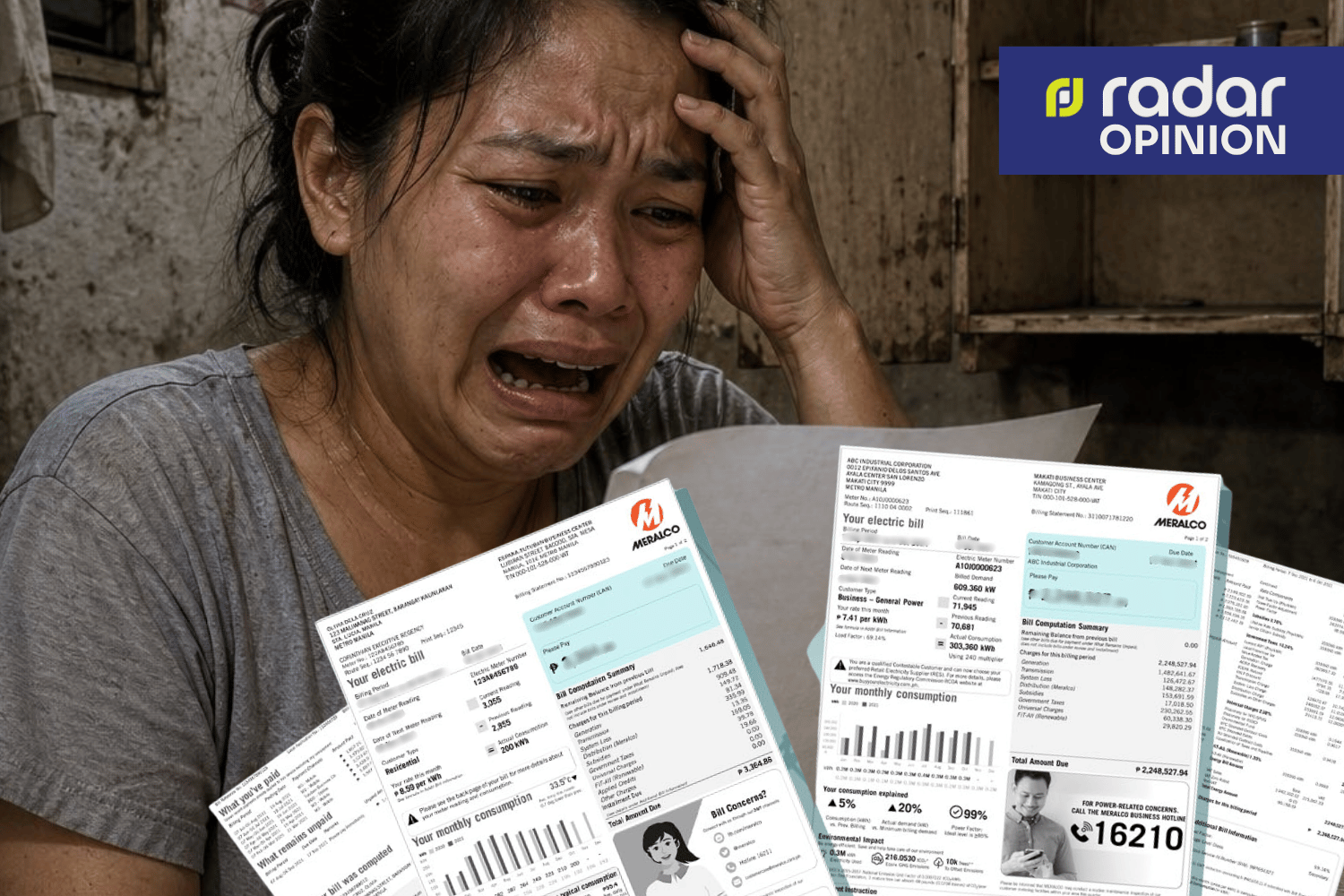
For millions of Filipinos, opening a Meralco bill has become a monthly source of anxiety. Families postpone buying necessities, small businesses tighten their budgets, and workers wonder why electricity seems to consume a bigger share of their income every month.
The frustration is understandable. The Philippines has the second-highest residential electricity rates in Southeast Asia, averaging around ₱12.80 to ₱14.35 per kilowatt-hour, second only to Singapore. Meanwhile, neighboring countries charge significantly less: around ₱7.40 in Thailand, ₱5.30 in Indonesia, ₱5.20 in Vietnam, and below ₱2.00 in Malaysia. For Filipino households already grappling with inflation, every increase in electricity rates is immediately felt.
Against this backdrop, Meralco continues to deliver record-breaking profits. Its Consolidated Core Net Income climbed from ₱37.1 billion in 2023 to ₱45.1 billion in 2024, before reaching an all-time high of ₱50.6 billion in 2025. In just the first quarter of 2026, the company had already earned ₱11.4 billion in core net income, putting it on track for yet another record year.
No one is arguing that Meralco should stop making money. Businesses exist to generate profits, and investors deserve reasonable returns. But when a utility providing an essential public service earns more than ₱50 billion annually while many of its customers struggle to keep the lights on, it is fair to ask whether maximizing profit has begun to outweigh serving the public.
To be fair, Meralco does not determine every peso that appears on an electric bill. More than 55% to 60% of a typical residential bill comes from the generation charge, which is largely a pass-through cost based on power purchased from suppliers. The country also relies on imported coal for more than half of its electricity generation, exposing consumers to global fuel prices and peso depreciation. Unlike Malaysia, Indonesia, or Vietnam, the Philippine government provides little to no subsidy for household electricity, leaving consumers to shoulder virtually the full cost.
Still, those realities should not end the conversation. Meralco is no longer simply a distribution utility. Its unregulated businesses—including power generation and retail electricity supply—now account for a growing share of its earnings. In 2025 alone, Meralco PowerGen contributed ₱16.8 billion, or roughly one-third of the company’s core net income. At the same time, the company invested ₱78.8 billion in expanding infrastructure and renewable energy projects—proof that it has the financial capacity to shape the future cost of electricity.
That is precisely why Meralco can afford to do more. It can accelerate investments in lower-cost renewable energy, negotiate more competitive long-term supply contracts, reduce technical system losses through grid modernization, and improve operational efficiency. Most importantly, it can choose not to maximize every peso of profit if doing so would translate into more affordable electricity for consumers.
Electricity is not a luxury. It powers hospitals, schools, factories, businesses, and homes. Every peso added to a family’s monthly bill is a peso taken away from food, medicine, education, or savings.
Meralco has proven that it knows how to generate record profits. The next challenge is proving that it can exercise restraint. In a country where consumers already pay among the highest electricity prices in Southeast Asia, true corporate leadership is not measured by how high profits can climb, but by how much of that success can be shared with the people who made it possible.
READ: