But when does tourism become poverty porn?
In a world where travelers can book just about anything as an “experience,” poverty has apparently become a tourism product.
It is called slum tourism, where visitors pay to enter impoverished or informal communities and get a firsthand look at how residents live. The practice has become established in cities such as Mumbai, Rio de Janeiro, Cape Town, and Nairobi.
And for better or for worse, Manila has its own version of it.
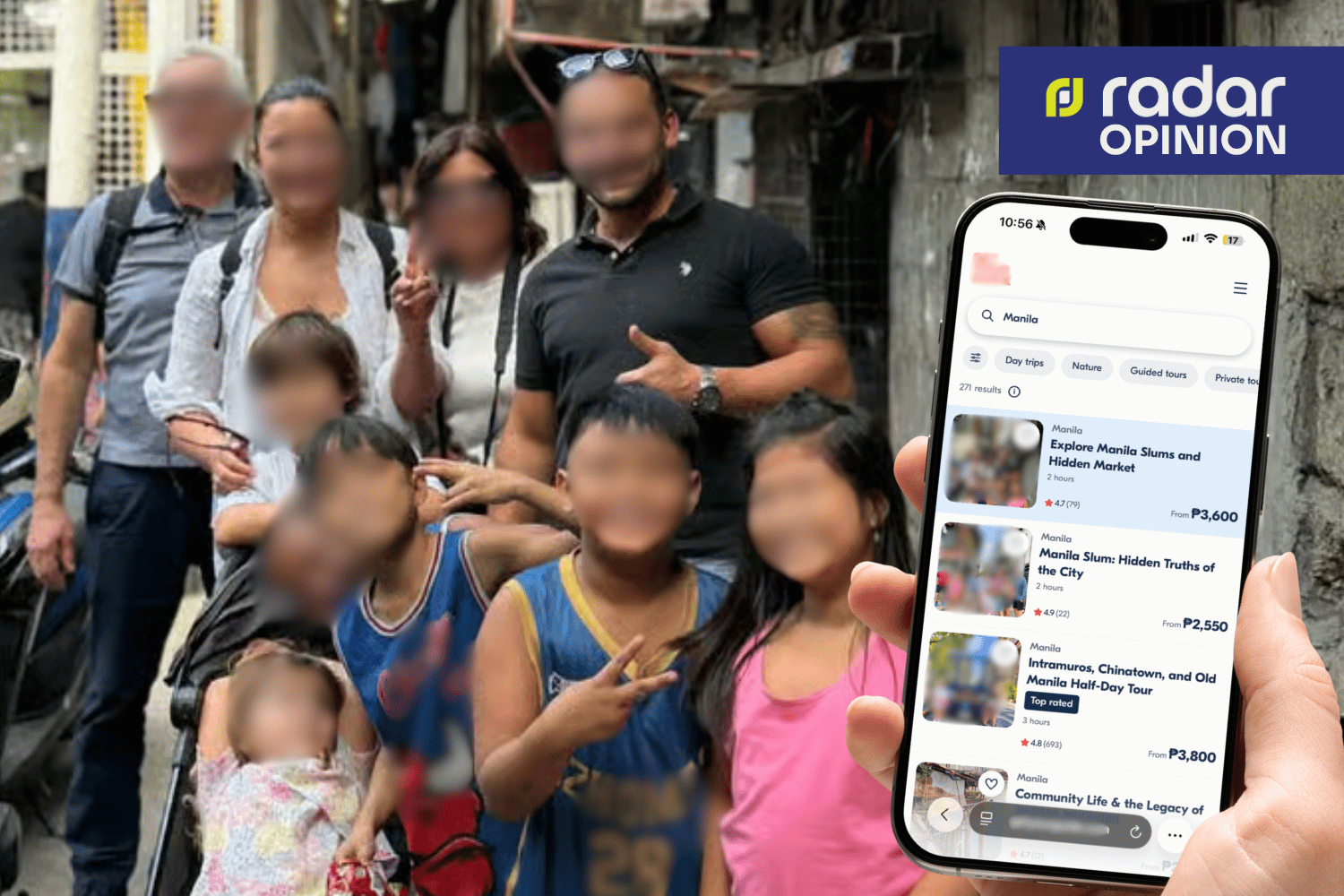
Tourists can book several such experiences through GetYourGuide, a Berlin-based online marketplace for tours and travel activities. Among the listings are “Manila: Intramuros Slum Tour with Local Guide,” “Explore Manila Slums and Hidden Market,” and “Manila: Community Life & the Legacy of Smokey Mountain.”
There is a business logic behind slum tourism. Tours can provide work for local guides, bring money into communities and give visitors a view of a city far removed from its usual tourist attractions. Some operators also deliberately focus on residents’ work, businesses, families and everyday lives rather than portraying them simply as victims of poverty.
That is part of what makes the industry complicated. A tour can attempt to present a community with dignity while still making its poverty part of what tourists are paying to experience.
The GetYourGuide listings use the language increasingly associated with ethical tourism. For instance, there’s one called “From Manila: Guided Tour Inside Urban Slum Communities,” which describes itself as a respectful and socially responsible experience. It’s supposedly a four-hour private tour where visitors can see everyday life in a local community and hear stories from residents.
The attraction, in other words, is not supposed to be misery itself but an intimate encounter with a side of Manila that tourists would otherwise probably never see.
Still, the underlying transaction is difficult to just sweep under the rug. Visitors pay for access to a place where poverty is part of everyday life, spend several hours observing and interacting with residents, and then leave. For the people being visited, the conditions being observed are not an experience or an attraction. They are home.
Slum tourism and poverty porn
This is where the criticism of slum tourism begins to overlap with the idea of “poverty porn,” a term used to describe the presentation of poverty as spectacle for an outside audience. The concern is that even well-intentioned portrayals can turn deprivation into something that can be consumed, photographed and packaged for people who have the privilege of walking away from it.
That does not mean every slum tour is exploitative. The more useful way to examine the industry is to look at who controls the experience and who benefits from it. How much of the tourist’s payment reaches the community? Are residents involved in deciding how their neighborhood is presented? Do they have a say in what visitors see and hear? And does the tour give people a fuller understanding of inequality, or simply offer an unusual afternoon activity?
GetYourGuide’s role also needs to be understood clearly. The company says it is an intermediary between travelers and activity suppliers, rather than the operator of every tour listed on its platform. The actual experience is provided by the supplier, while GetYourGuide facilitates the booking and earns a commission.
That makes the platform one part of a larger commercial chain that can turn a local community into a bookable experience. The operator creates the tour, the platform markets and sells access to it, and the traveler pays for the privilege of seeing a side of the city that normally remains outside the tourist itinerary.
Tourism has always involved selling access to places, people and cultures that visitors want to experience. Slum tourism simply pushes that idea into more uncomfortable territory, because the thing being packaged is not a landmark or tradition but a community’s struggle with poverty.
An immersive tour may give visitors a more complicated and human view of Manila. But there is still a line worth examining between helping outsiders understand a community and turning that community’s hardship into an attraction.
READ:
OPINION: Stop treating tourists like walking ATMs
Top Dagohoy
September 13, 2026
Filipinos face poverty on multiple fronts, new PSA data shows
John Lloyd Aleta
September 1, 2026

OPINION: The gov’t says millions of Filipinos just escaped poverty. Tell that to those still struggling to get by
Kenneth M. del Rosario
August 21, 2026