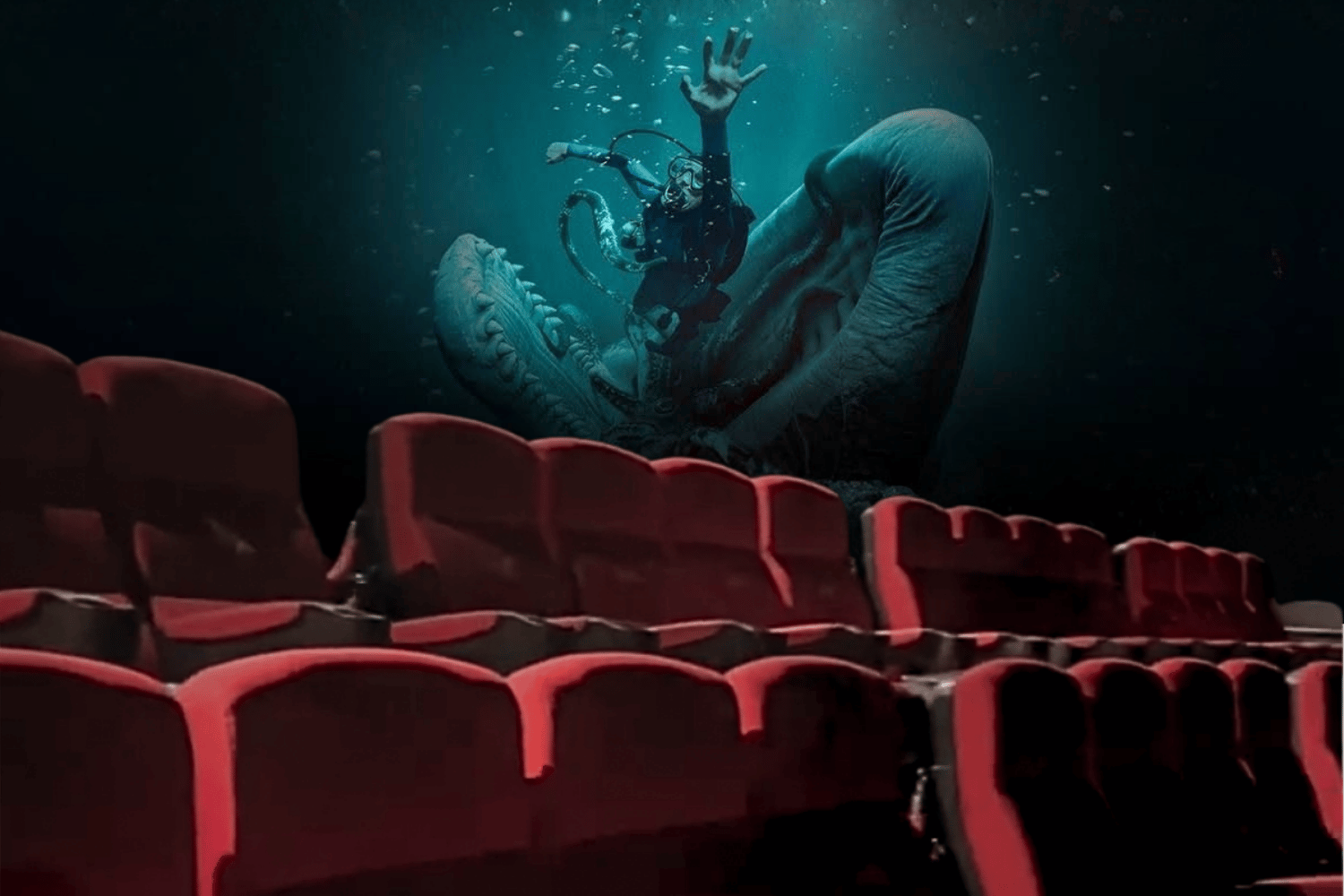
I watched the survival thriller “Whalefall,” starring Austin Abrams and Josh Brolin.
A minivan cruises along the corniche as waves rumble against the shore. A gust of wind brushes my face, and my seat rocks gently with every turn.
But no, I’m not in the minivan. I’m watching “Whalefall” in 4DX.
I’d heard about the tech before. If my memory serves me right, my first taste of 4D effects came during a family trip to Enchanted Kingdom some years ago, when I watched animated shorts in a small theater.
This time around, a press invitation to the new survival thriller gave me a chance to experience 4DX “more properly,” at Greenbelt 3.
I came in blind. No research, no expectations. The curious cat in me had always wanted to try something new.
Before the movie began, I took a moment to inspect the seats. They sat higher than ordinary cinema chairs, with soft cushions and a footrest that could be raised or lowered. Unlike typical cinema seats, these didn’t fold up—something I especially appreciated after a few past “incidents” involving my bags or popcorn boxes.
Then a 4DX trailer gave me and the other invitees a preview of what was to come. The seats bucked and tilted, air rushed past us, strobe lights flashed, and puffs of smoke burst from below. For many of us who are presumably 4DX virgins, we found ourselves screaming and clapping as the effects happened.
Trailer pa lang, pelikula na, I thought. If the preview was already this wild, what would happen when the actual movie started?
“Whalefall,” adapted from Daniel Kraus’ 2023 novel, follows scuba diver Jay (Austin Abrams), who is swallowed by a sperm whale while searching for his father’s remains (Josh Brolin). It was directed by Brian Duffield, who co-wrote the screenplay with Kraus.
The effects came in subtly enough as the movie progressed. When a vehicle turned right, drove off, or came to a sudden stop, my seat moved along with it. There were also the occasional vibrations.
During a motorboat scene, wind machines suspended from the ceiling sent powerful blasts of air our way, making the force and chill of the ride feel almost real.
The movie only got more intense, particularly during the sequences inside the whale. Amid Jay’s ordeal, our seats started jerking and tilting in different directions. Halos ibalibag na kami. It reminded me of my late-night jeepney rides with a kaskasero driver en route to SM Fairview or Cubao.
But the more the balibagan happened, the more I found myself gripping the seat and checking in on how I felt with every jolt. I even caught myself hoping things would let up, just so I could settle back into the movie.
To be sure, it wasn’t necessarily unpleasant. But instead of getting completely absorbed in the movie—as I would during any other big-screen viewing—I became more conscious of my own reactions.
The strobe lights, meanwhile, served a curious purpose. When Jay touched a bioluminescent jellyfish and got stung, a camera-like flash went off. Looking back, though, it felt less like a complement to the interaction and more like a distraction.
“Whalefall” ran for just under two hours, and everybody clapped as the credits rolled.
In writing this, I find myself thinking about how we all have different appetites for sensory experiences. Maybe it’s a little like sex: some want every physical sensation awakened. A lick of heat, a chill against the skin, fingernails trailing down one’s back, maybe even being tossed around a little.
Others prefer to take it nice and slow, keep things quiet, and simply savor the feeling while it lasts, with dim lights or hazy music.
And then there are those who like to move between the gentle and the intense, depending on the mood.
The “Whalefall” screening in 4DX was quite the ride. It offered a little bit of everything, from the gentlest breeze to the wildest balibag.
I’m not sure whether I’d try it again, but I suspect I’ll remember this ride far better than my 4D experience in Santa Rosa.
READ:
‘Filipiñana’ trailer draws Wes Anderson, Yorgos Lanthimos comparisons
Justin Aquino
July 18, 2026
Nolan’s ‘The Odyssey’ might be a half-baked experience for Filipinos
Aldy Celestial
July 17, 2026

BINI teases collab with top Korean production company
Denchelle Castro
July 16, 2026