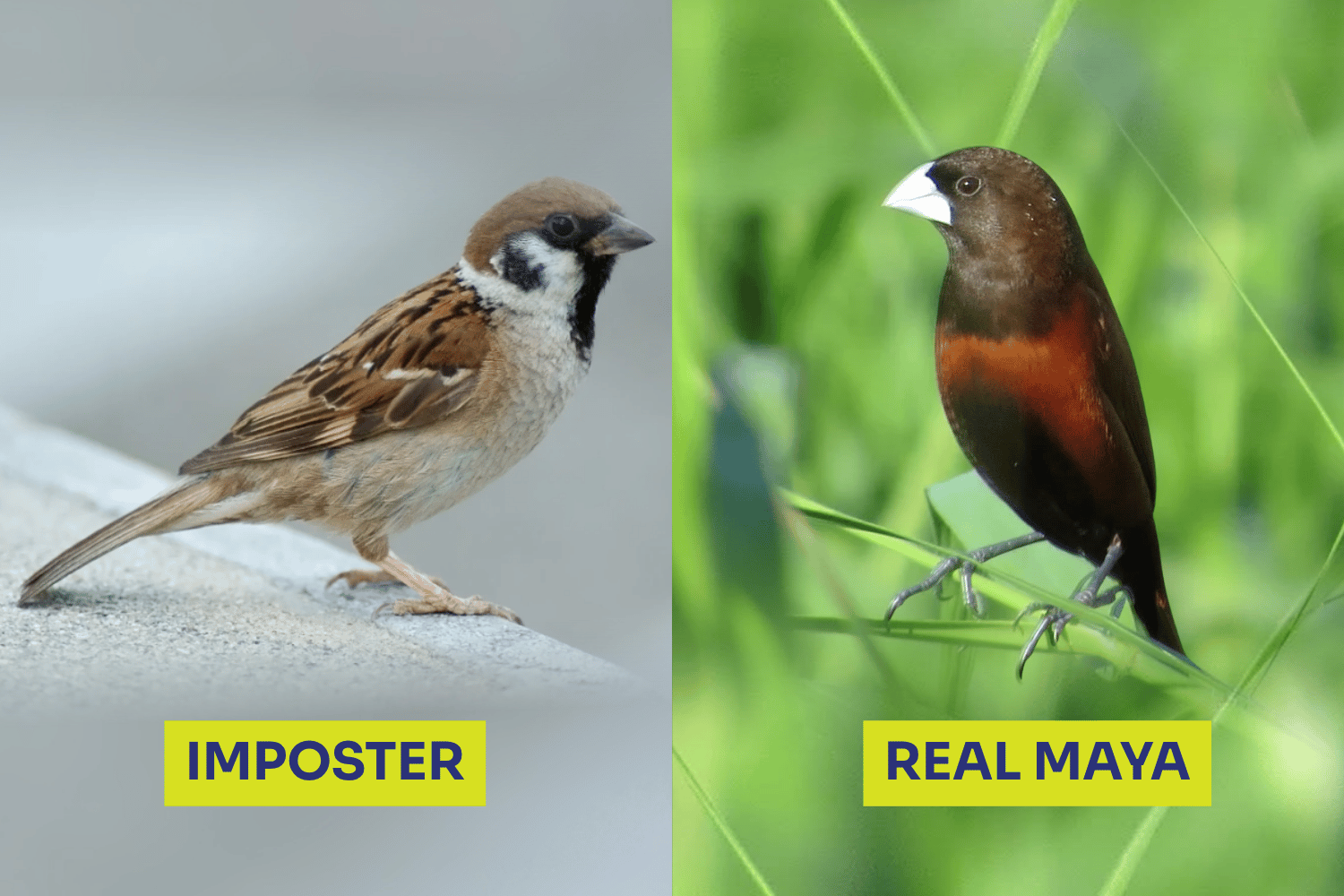
The real mayas live in rice fields, wetlands, and open grasslands.
Every morning, they’re everywhere. Tiny brown birds hop across sidewalks, peck at leftover rice outside eateries, and perch on electric wires as if they own the neighborhood. Ask almost any Filipino what they are, and the answer comes instantly: “maya.”
But here’s a surprising truth: the bird most Filipinos proudly call a maya isn’t actually one.
The familiar city bird is the Eurasian Tree Sparrow, an invasive species that arrived in the Philippines centuries ago. It became so successful that it didn’t just conquer our towns and cities—it stole the identity of the country’s real native mayas.
It’s one of the biggest cases of mistaken identity in Philippine wildlife.
The stowaway that stayed
The Eurasian Tree Sparrow is native to Europe and much of Asia, not the Philippines.
Historians and ornithologists believe it first reached the country during the Spanish colonial period by hitching rides aboard trading ships. Drawn to grain stored in cargo holds, the birds nested on the vessels and simply flew off once they reached ports like Manila.
Over time, more sparrows arrived through different maritime trade routes. Northern populations likely came from Japan, while those in Cebu and Mindanao probably originated from Indo-Malay populations.
What began as an accidental introduction eventually turned into one of the country’s most successful biological invasions.
The perfect place to thrive
The Philippines turned out to be the perfect home for the newcomers.
Rice fields offered an endless supply of food, while towns and cities provided rooftops, church ceilings, bridges, and electrical posts for nesting. Unlike in many other countries, they faced very little competition from other urban birds.
The result was a population boom.
Today, the Eurasian Tree Sparrow is among the most common birds in the Philippines, especially in cities.
How it stole the name “maya”
Long before the sparrow arrived, the Philippines already had its own native mayas.
Among them were the Mayang Pula and the Mayang Paking, both members of the munia family and naturally found in the country’s grasslands and rice fields.
The Mayang Pula was even the Philippines’ national bird before the Philippine Eagle assumed the title in 1995.
As the imported sparrow spread through towns and cities, however, generations of Filipinos began calling every small brown bird “maya.” Eventually, the foreign bird inherited not just the name, but also the affection, nostalgia, and cultural significance originally associated with the native species.
The impostor became the face of the Philippine maya.
Spotting the impostor
The differences become obvious once you know what to look for.
The Eurasian Tree Sparrow has a gray crown, white cheeks marked by a distinctive black spot, a black bib, and a patterned brown back.
The real Mayang Pula looks completely different. It has a rich chestnut-brown body topped by a glossy black head, with none of the sparrow’s white cheeks or black cheek spots.
The Mayang Paking is equally distinctive, with its beautifully scaled breast and belly that resemble tiny fish scales.
Despite their similar size, the native mayas and the Eurasian Tree Sparrow belong to entirely different groups of birds.
The real mayas never left
The good news is that the real mayas are still here.
They’re simply living where they have always belonged—in rice fields, wetlands, and open grasslands rather than busy city streets.
Meanwhile, the Eurasian Tree Sparrow continues to dominate urban landscapes, making it easy for many Filipinos to grow up without ever seeing the native birds that gave the country its beloved “maya.”
The little brown bird outside your window is an extraordinary survivor and one of the world’s most successful invasive species. But it isn’t the original Philippine maya.
That title still belongs to the country’s native munias—the real mayas that quietly lost their identity to an immigrant that arrived centuries ago and never left.
READ:
Four Philippine birds with names that sound X-rated
Top Dagohoy
August 4, 2026
Tigmamanukan: The breathtaking blue bird believed to carry Bathala’s messages
radar Lifestyle
June 14, 2026
UP Wild announces bird walk around UP Diliman, opens registration for nature enthusiasts
radar Lifestyle
June 6, 2026