Today is Friday the 13th — and the end of the world. Supposedly
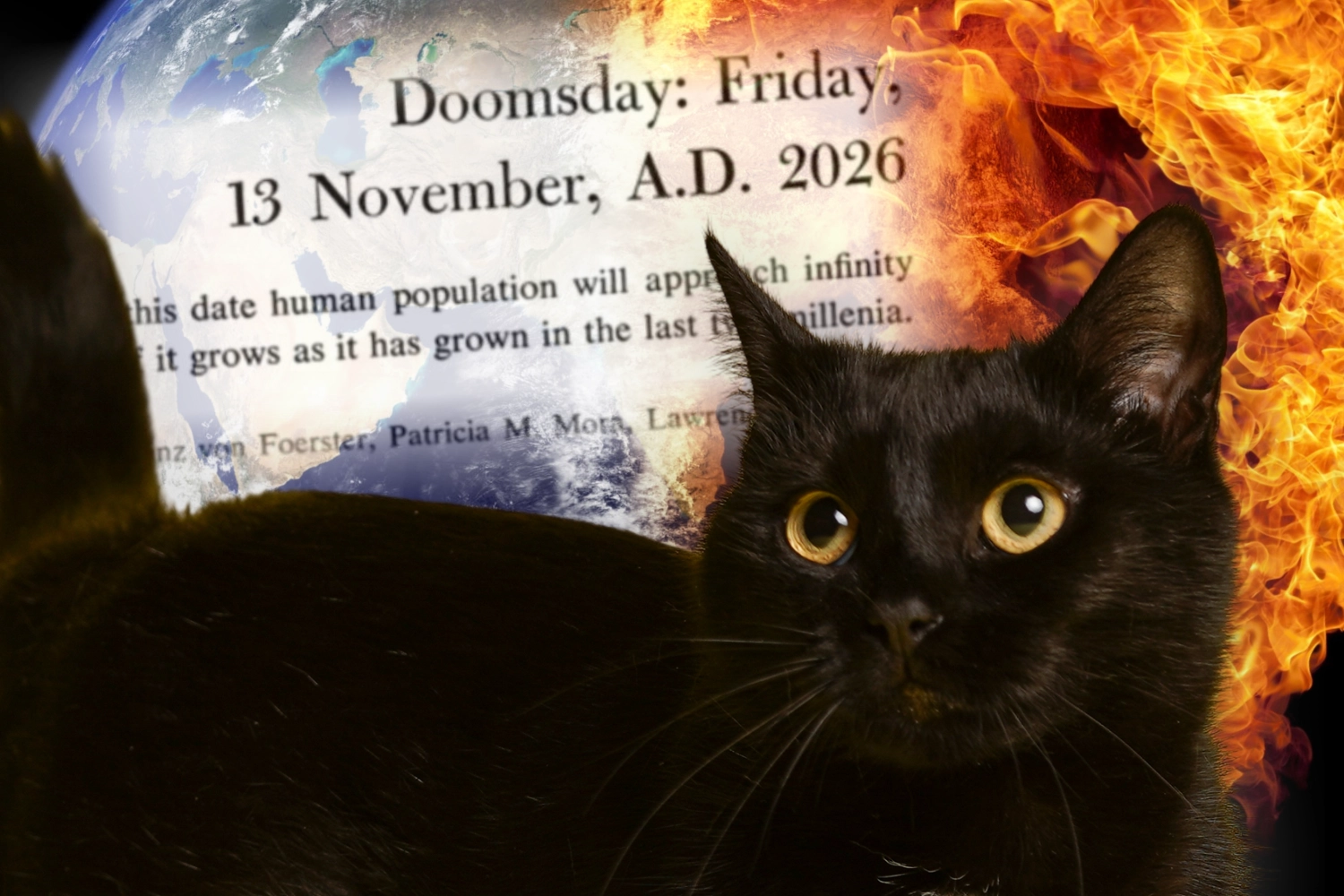
Back in 1960, Austrian-American physicist Heinz von Foerster and two colleagues published a paper in Science titled “Doomsday: Friday, 13 November, A.D. 2026.”
The New York Times took notice. In a Nov. 4, 1960, report, it opened with an equally ominous declaration: “A physicist has put a definite date on Doomsday. He calculates that it will come on Friday the Thirteenth in November, 2026 A. D. On that date, or thereabouts, the human population will have expanded so far as to approach infinity and thus will automatically annihilate itself.”
The theory was based on a trend the researchers spotted in population figures: Humanity was multiplying at an increasingly rapid rate. The time it took for the global population to double kept getting shorter, leading them to conclude that the numbers would eventually spiral out of control.
Their formula projected that the world’s population would exceed 25 billion by 2020. Keep that trend going, and the numbers would eventually shoot toward infinity.
Welp, this wasn’t quite the kind of apocalypse you’d see in “The Day After Tomorrow” or “2012.” The threat, according to the researchers, was a world so crowded that people would be crushed by their own numbers.
“Our great-great-grandchildren will not starve,” the researchers wrote. “They will be squeezed to death.”
But the math isn’t mathing. Their calculation pointed to 2026.87, with a margin of 5.5 years in either direction.
Von Foerster reportedly picked a Friday the 13th near the middle of that window because, hey, it’s more ominous that way. It was convenient, too, that Nov. 13 was his birthday.
For a while, the numbers seemed to cooperate. By 1975, the global population had reached around 4 billion, already exceeding the formula’s projection of roughly 3.6 billion.
Then the trend changed. Birth rates began falling in wealthier countries and China, and population growth slowed. By 2000, the world had about 6 billion people, not the projected 7 billion. By 2010, it had around 7 billion, instead of the predicted 11 billion.
Today, there are more than 8 billion people on Earth. That’s a far cry from the hundreds of billions implied by the doomsday scenario. The United Nations now projects that the global population will peak at around 10.3 billion in the mid-2080s.
So, it seems we’ll live to see another day. Besides, these dates are already booked—and we’re not taking cancellations.
My Chemical Romance is playing in Bulacan on Nov. 14. We can’t miss our chance to scream “I AM NOT AFRAID TO KEEP ON LIVING” one more time.
From Nov. 16 to 18, Metro Manila gets a nationwide “PAASCU accreditation.” Poor communities are getting boarded up, temporary barriers are turning into galleries of National Artists’ works, and Makati’s Jollijeeps are disappearing. Wait, that’s the ASEAN Summit!
Then, on Nov. 30, former president Rodrigo Duterte’s trial at the International Criminal Court is scheduled to open. No doomsday can make us miss that, duh.
On Dec. 9, IV of Spades is dropping its third studio album, “Tropical Dream”—its second one since reuniting in 2025. It just goes without saying.
And if we’re talking about doomsday, Marvel still has “Avengers: Doomsday” coming on Dec. 16. Surely we can make it to that Doomsday.
Most importantly, how are we supposed to root for Jeo Ong and Gehlee Dangca if the world ends today? JeoLee >>> doomsday.
We’ve got plans. Von Foerster’s Doomsday will have to reschedule.
READ:
What is Mercury retrograde?
Miguel Montemayor
February 28, 2026

Are your love life, money, and secrets in trouble?
Top Dagohoy
October 23, 2026

2026 in astrology: shifting your energy from the ‘Ending’ to the ‘Beginning’ era
Gel G. Galang, RPsy
January 9, 2026
Tags: ASEAN SummitAssociation of Southeast Asian NationsAvengers: DoomsdayBulacanChinaDoomsdayFriday the 13thGehlee DangcaHeinz von FoersterInternational Criminal CourtIV of SpadesJeo OngMakati cityMarvelmetro manilaMy Chemical RomancePhilippine Accrediting Association of Schools Colleges and UniversitiespopulationRodrigo DutertescienceThe New York TimesUnited Nations