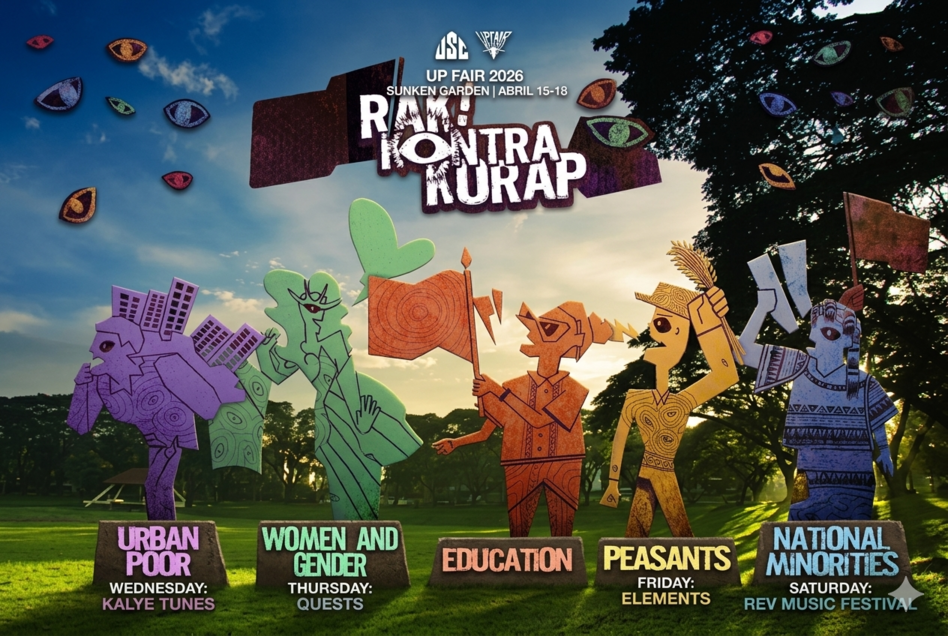
Wednesday: Kalye Tunes (April 15)
Presented by EMC² Fraternity, the week opens with the pulse of the streets. Local hip-hop artists take the stage, their verses cutting through the night with stories of survival, inequality, and everyday resistance.
Thursday: Quest (April 16)
Under the banner of empowerment, this night, led by UP JFA, centers women and the queer community. Performances become declarations: of identity, of resilience, of existence in spaces that have long denied both.
Friday: Elements (April 17)
The narrative shifts to the countryside. Organized by UP JPIA, NNARA Youth, and UP Sinagbayan, the night amplifies the voices of farmers and peasants. Visuals flash across screens—fields, protests, faces marked by labor. Songs carry the weight of land struggles, of calls for reform, of a system that continues to fail those who feed the nation.
Saturday: REV (April 18)
The final night arrives with urgency. Led by Sigma Kappa Pi Fraternity and Sigma Delta Pi Sorority, REV calls for the defense of ancestral lands. Indigenous struggles take center stage, reminding the audience that history is not past—it is ongoing.
Across all four nights, one thing remains constant: the stage is never just a stage.
It is a platform. A protest. A mirror.
In between booths and barricades
Beyond the music, UP Fair thrives in its in-betweens.
Food stalls, independent vendors, and advocacy booths line the grounds—each one part of a larger ecosystem. A meal leads to a conversation on labor rights. A purchase becomes support for a cause. A moment of leisure turns into awareness.
UP Fair becomes a living ecosystem—one where every participant, whether performer, vendor, or attendee, contributes to a shared narrative.
It is in these moments—between songs, between conversations—that the fair reveals its true scale. Not just in numbers, but in impact.
As the final night winds down and the last set fades into cheers, the grounds begin to empty. Trash bags fill, lights dim, and the temporary city slowly dismantles itself.
What remains is not just memory, but momentum.
UP Fair is called the biggest not only because it gathers thousands, but because it dares to merge celebration with confrontation. It asks its audience to enjoy but also to engage. To sing, but also to speak. To witness, but also to act.
And so the lingering question returns: Will UP Fair 2026 meet expectations?
Perhaps the better question is this: Will it move you enough to do something after the music ends?
Because UP Fair has never been just a concert.
It is an advocacy. It is a call, steady, persistent, and loud, urging everyone who enters its gates to look beyond the stage and into the realities that demand change.