

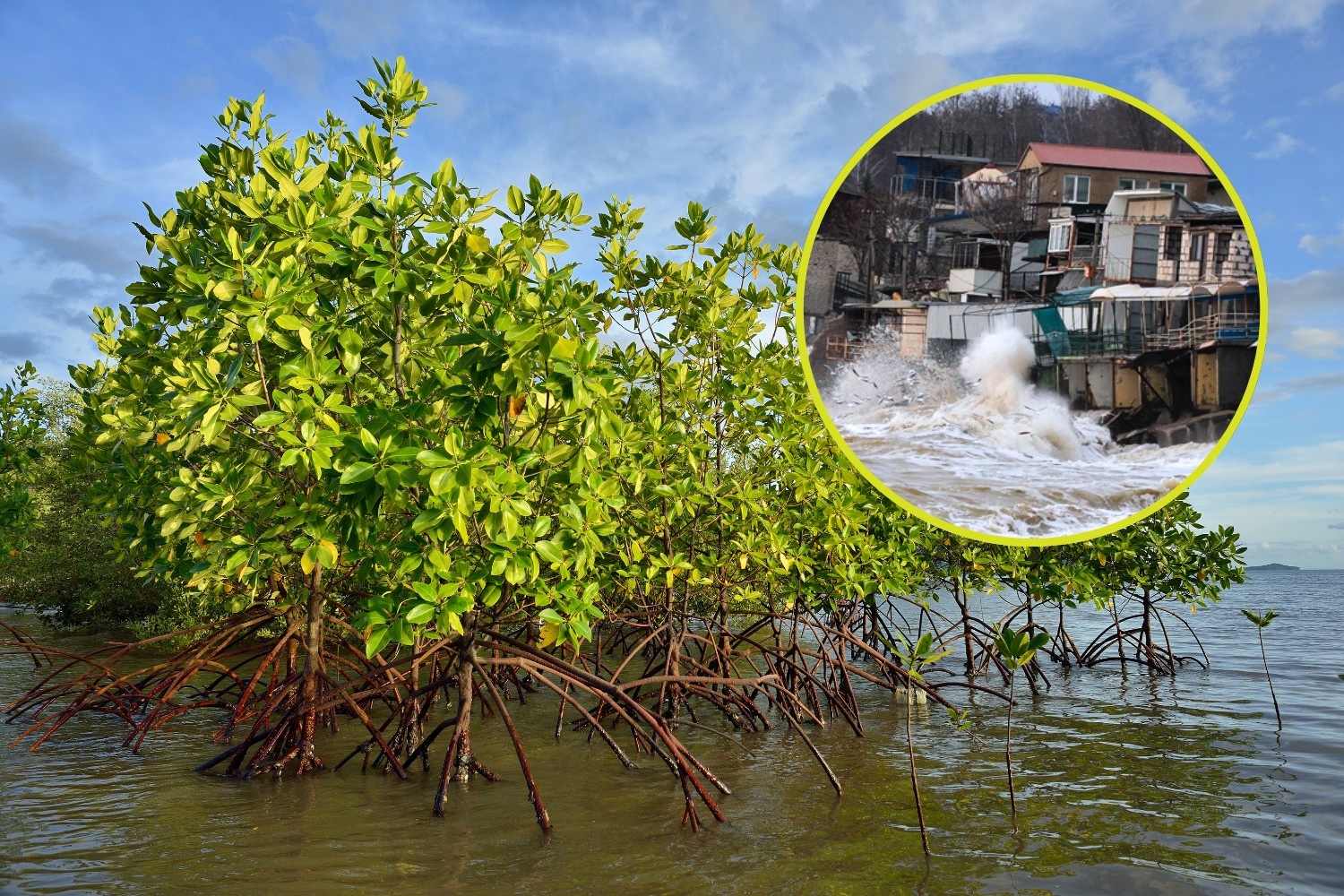
The silent defenders of our shorelines face an existential threat.
Imagine waking up tomorrow and discovering that every mangrove forest in the Philippines has vanished.
The fish catch in coastal communities begins to dwindle. Shorelines become more vulnerable to erosion. Storm surges travel farther inland. Carbon that would have been locked away remains in the atmosphere. Entire ecosystems begin to unravel.
That unsettling scenario is the focus of a social media campaign by Mangrove Matters PH ahead of World Environment Day. Through a series of striking art cards, the organization asks a simple but powerful question: What if mangroves disappear tomorrow?
The answer is far more alarming than most people realize.
What if they disappeared tomorrow?
Mangroves are among the most important yet overlooked ecosystems in the Philippines.
Found along coastlines, estuaries, and river mouths, these salt-tolerant trees serve as a natural bridge between land and sea. Their tangled roots create a protective barrier that supports marine life, shields communities, and helps stabilize fragile coastlines.
But despite their importance, mangrove forests continue to face threats from land conversion, urban development, pollution, and illegal cutting.
The consequences extend far beyond the shoreline.
The shield against storms
For a country battered by some of the world’s strongest typhoons, mangroves serve as nature’s frontline defenders.
Their dense root systems absorb wave energy, reduce the force of storm surges, and help prevent coastal erosion. Studies have shown that mangrove forests can significantly reduce wave heights before they reach communities.
One of Mangrove Matters PH’s campaign materials warns that without mangroves, coastal communities would lose an important layer of protection against typhoons and storm surges.
Long before seawalls and flood-control projects existed, mangroves were already performing this role for free.
And unlike concrete structures, they grow stronger over time.
The source of food and livelihoods
Mangroves are often called the nurseries of the sea.
Beneath their roots, young fish, crabs, shrimp, and countless marine species find shelter from predators while they grow.
Without these safe habitats, many species struggle to survive.
Mangrove Matters PH highlights this reality in one of its posters, noting that fish, crabs, and other marine species depend on mangrove forests as breeding and nursery grounds.
For fishermen and coastal communities, fewer mangroves can translate to smaller catches, reduced income, and increased food insecurity.
The connection may not always be visible, but healthy mangrove forests help sustain the seafood industry that feeds millions of Filipinos.
The climate warriors beneath the mud
Mangroves are also among the planet’s most effective weapons against climate change.
Scientists classify them as “blue carbon” ecosystems because they capture and store enormous amounts of carbon dioxide. In fact, mangroves can hold up to four or five times more carbon than many terrestrial forests.
Much of that carbon remains trapped beneath waterlogged soils for centuries.
That is why Mangrove Matters PH describes mangroves as a crucial climate ally.
Every hectare preserved helps remove greenhouse gases from the atmosphere while protecting communities from climate-related disasters.
In a warming world, few natural solutions deliver as many benefits simultaneously.
More than just trees
Mangroves do far more than protect coastlines and store carbon.
They filter pollutants before they reach the ocean. They trap sediments that might otherwise smother coral reefs and seagrass beds. They provide habitat for birds, crustaceans, reptiles, and countless other species.
Most importantly, they support people.
A mangrove forest is connected to the fisherman preparing his boat before sunrise, the family depending on seafood for income, and the coastal resident hoping the next typhoon spares their home.
When mangroves disappear, entire communities feel the impact.
The future is still ours to protect
The Philippines has already lost a significant portion of its original mangrove cover over the decades.
Environmental groups warn that protecting what remains is no longer simply a conservation issue. It is a matter of food security, disaster preparedness, economic survival, and climate resilience.
That is why the final message of the Mangrove Matters PH campaign resonates so strongly: “The Future Is Still Ours To Protect.”
Mangroves may stand quietly along the country’s coastlines, but their role could not be louder.
They feed communities. They shield lives. They fight climate change.
And if they disappear tomorrow, the price will be paid by all of us.
READ:
EXPLAINER: What one mature tree actually does for city roads?
radar Lifestyle
May 27, 2026
Students, environmentalists seek court order vs. SMC over Manila tree-cutting project
radar Business
June 1, 2026

Agri-food sector under pressure as climate risks and global shocks intensify
John Lloyd Aleta
May 20, 2026


