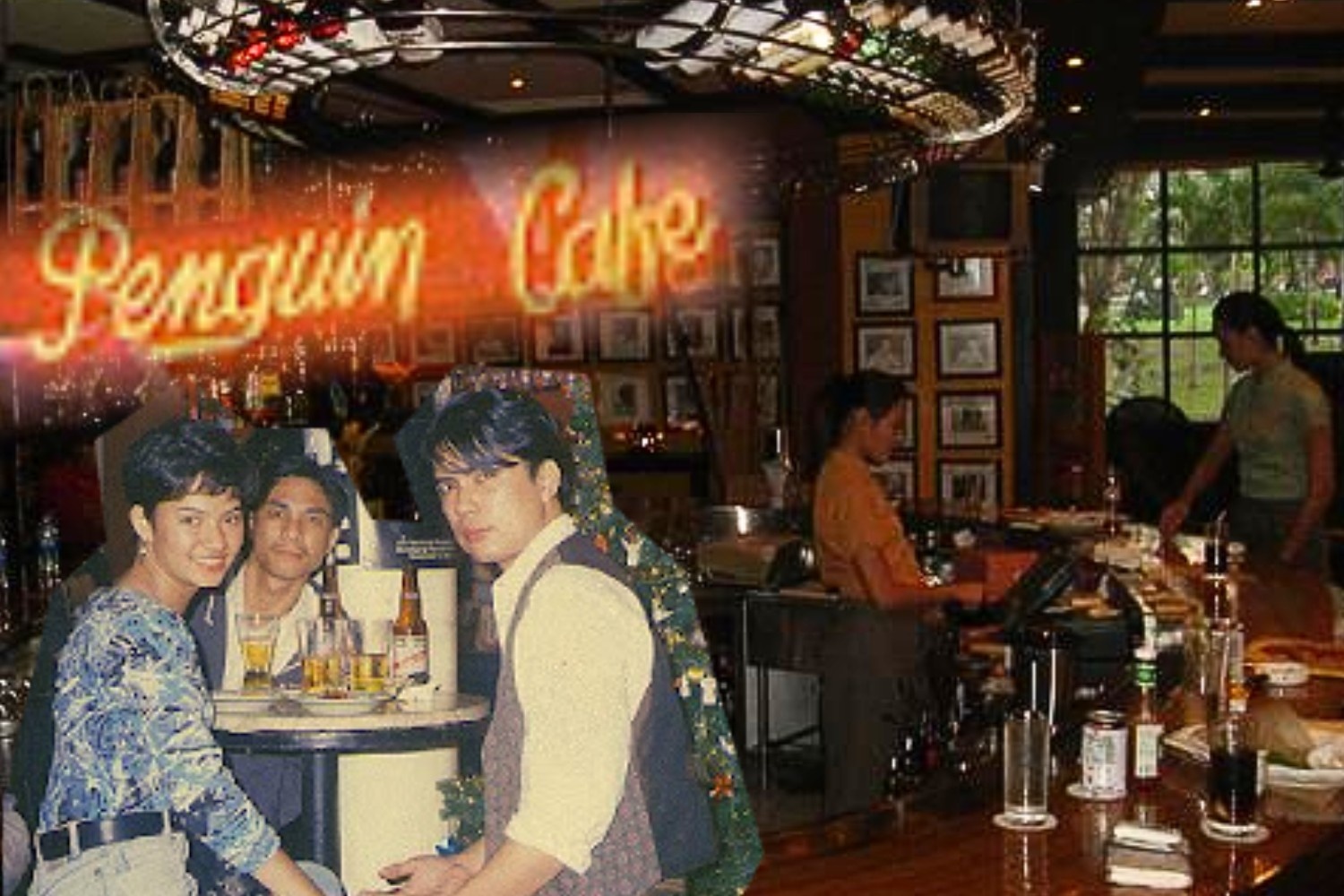
A forest green sanctuary where national artists and broke writers shared the same table and a single, endless bottle of beer.
The year was 1994, and you just walked into Penguin Café Gallery on Remedios Street. You’re sitting at a dark, mismatched wooden table next to a young, broke writer who only has enough for one beer. Suddenly, a legendary national artist at the bar signals the owner Ami Miciano, to “keep the kid’s beer coming” on his tab. They spend the next four hours arguing over a single stanza of poetry.
On a few nights, members of the Philippine Philharmonic Orchestra or Ballet Philippines would show up still wearing traces of their stage makeup.
Sometimes, a musician would pull out a violin or a flute and start playing an avant-garde piece in the middle of the crowded bar. No one clapped politely like they did at the Cultural Center of the Philippines, which was just a few blocks away. Everyone kept drinking, talking, laughing, treating a world-class solo like it was the most natural background music in the world.
This was Penguin: a place where status didn’t exist, but ideas were currency. It was housed in a modest, two-story structure painted in a deep, forest green that eventually faded into a weathered patina, a typical Malate residential house from the mid-20th century. You entered through a small gate with a simple, hand-painted wooden board with a penguin on it.
Outside, there were usually a few wrought-iron chairs and tables tucked under the foliage. This was the “smoking section” before the term existed, where you could watch the colorful characters of Remedios Street pass by—pedicab drivers, street vendors, and drag queens from nearby clubs.
If Café Adriatico was Malate’s sophisticated drawing room, Penguin was its gritty, intellectual heart. It wasn’t your average bar; in fact, it looked more like an artist’s cluttered attic with the owner’s personal collection of penguin memorabilia that dotted the interiors, which the cafe got its name from when it opened in the early ‘80s.
The air was a heavy, comfortable haze of clove cigarettes and stale San Miguel. The walls were teeming with art—murals, sketches, and stickers that evolved every week.
Don’t expect America’s Top 40 hits playing here. Instead, you’d hear the experimental plucking of the late Noli Aurillo, the guitar god of Malate, who could do complex covers that shouldn’t be possible on one guitar, such as The Beatles‘ “A Day in the Life” or Steely Dan medleys.
There was Lirio Salvador, who passed on early this year. The “sculptor-musician” who blurred the lines between visual art and experimental noise often played his unique handcrafted instruments on what can be considered ethno-industrial sound.
In the mid to late 2000s, there was Lourd de Veyra and his band Radioactive Sago Project and their hallucinogenic jazz.
Penguin was the third space for the Philippine intelligentsia. On any given night, the hierarchy of Manila society vanished. You’d see giants like mixed-media artist Santi Bose and sculptor Agnes Arellano debating aesthetics in the corner.
Filmmakers like Lav Diaz and Tikoy Aguiluz plotted their next indies, while a young Carlos Celdran held court like a bohemian prince, honing the storytelling style that would later define his “Walk This Way” tours.
Penguin’s influence was so etched in creative culture that it eventually leaked into global popular media. Before he became the visionary director of Ex Machina and Civil War, Alex Garland immortalized the café in his 1998 Manila noir novel, “The Tesseract,” using it as the definitive landmark for the city’s intellectual pulse.
Locally, the café was the centerpiece of the Palanca-winning 2001 play, Last Order sa Penguin by Chris Martinez. Its story revolves around the conversations that take place in one night at the Penguin Cafe, which revolve around love, life, sex, relationships, society, and turning thirty.
If you were interesting, you stayed. If you were a social climber, you eventually drifted away because no one cared about your title—only your take on the world.
For 25 years, Penguin was the last piece of yarn holding Malate’s creative spirit together. But by the mid-2000s, the tides began to turn with new watering holes in Makati, Quezon City, and BGC. In 2009, the building at 604 Remedios was sold to developers, which turned it into a Korean BBQ place.
For those who saw and came to Penguin, it was a veritable symbol of a time when Malate was the true beating heart of the Philippine soul. They said its spirit migrated to The Bar@1951 on Adriatico Street, run by Butch Aldana.
This was Penguin: a place where status didn’t exist, but ideas were currency. It was housed in a modest, two-story structure painted in a deep, forest green that eventually faded into a weathered patina, a typical Malate residential house from the mid-20th century.
READ:

From classical to modern: masterpieces by Juan Luna, H.R. Ocampo, and Zobel at León Gallery auction
Rommel Earl V. Digo
December 6, 2025
Finding beauty in the folds at Conrad Manila’s Creases art gallery exhibition
Kenneth M. del Rosario
April 7, 2026
LRT-1 concourse transforms into an art hub and gallery
Mianne Cudal
May 5, 2026