Historians and anthropologists here and abroad have long asserted that Filipino cuisine is shaped by multiple cultures.
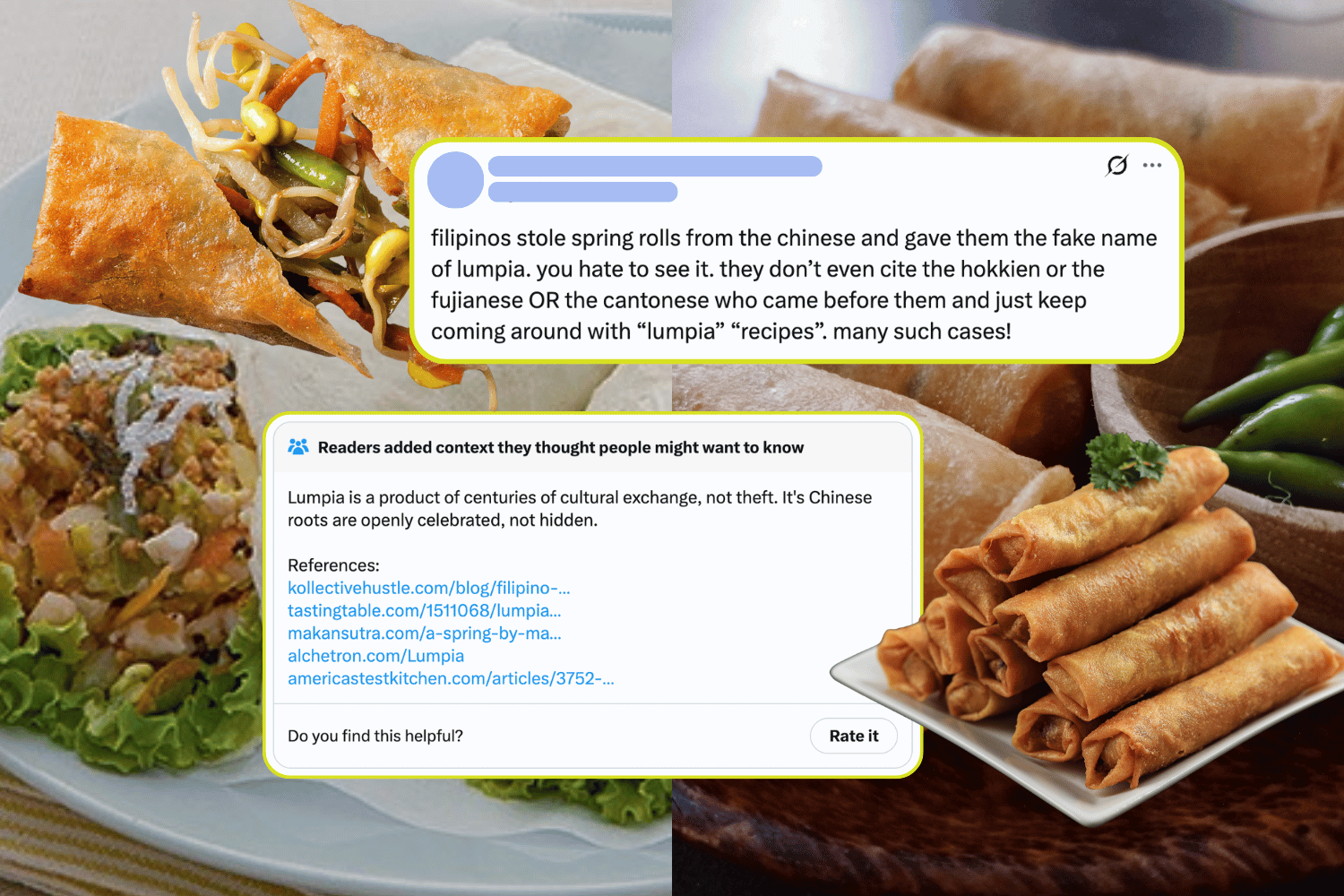
An X user sparked backlash after falsely claiming that Filipinos “stole” China’s spring roll and named it lumpia—a take that ignores decades of historical research.
“filipinos stole spring rolls from the chinese and gave them the fake name of lumpia. you hate to see it,” the user wrote in a post that was later “ratioed,” where replies or quotes outnumber the original amid backlash or inaccuracy.
“they don’t even cite the hokkien or the fujianese OR the cantonese who came before them and just keep coming around with ‘lumpia’ ‘recipes’. many such cases!”
Grok, the platform’s chatbot that fact-checks a post’s claims, notes that lumpia “is a product of centuries of cultural exchange, not theft. Its Chinese roots are openly celebrated, not hidden.” It also linked to several non-Philippine sources to support the correction.
The user’s real identity remains unclear. The claim appeared as a non sequitur response to a thread traced to a now-private post about “vegan ube ice cream” for Asian American communities. Native to the Philippines, ube has since become a global food trend.
Lumpia’s History
Historians and anthropologists here and abroad have long asserted that Filipino cuisine is shaped by multiple cultures.
In “Culture Ingested: Notes on the Indigenization of Philippine Food,” published in Philippine Studies, Doreen Fernandez noted that Filipino food reflects Philippine history and society—including influences from China and India through trade, Spain, and America through colonization, and the rest of the world through global cultural communication.
The process of indigenization “brought in, adapted, and then subsumed foreign influences into the culture.” As Fernandez explained, indigenization of Filipino food “ends with a dish that can truly be called part of Philippine culture.”
In her essay “The Lumpia of Silay” in “Tikim: Essays on Philippine Food and Culture,” Fernandez noted that lumpia is “a Southeast Asian phenomenon obviously derived from the Chinese spring roll.” (“Lumpia” comes from the Hokkien term “lun bnia” or “lun pia”—with “lun” meaning “wet, moist, or soft,” and “bnia” or “pia” meaning “cake or pastry.”)
The Filipino take has several forms: 1) sariwa, with sautéed vegetables like ubod, togue, garbansos, singkamas, and green beans wrapped in a white flour-and-water wrapper—often lined with a leaf of native lettuce; 2) prito, typically filled with vegetables or pork; and 3) hubad, served without a wrapper and garnished with ground peanuts or sauce.
No purely local or foreign food
With such indigenization, Filipino food cannot be strictly classified as purely local or foreign.
In his essay “What is local food, anyway?” in “The Gullet: Dispatches on Philippine Food,” Clinton Palanca argued that this is an “illogical contradiction,” since “to be truly Filipino is to love what is foreign” and “what is most local might be what is imported.”
“Celebrating the local ends up celebrating what’s foreign as well, simply because it’s here and present and available to us, which is what local means, after all,” Palanca said.