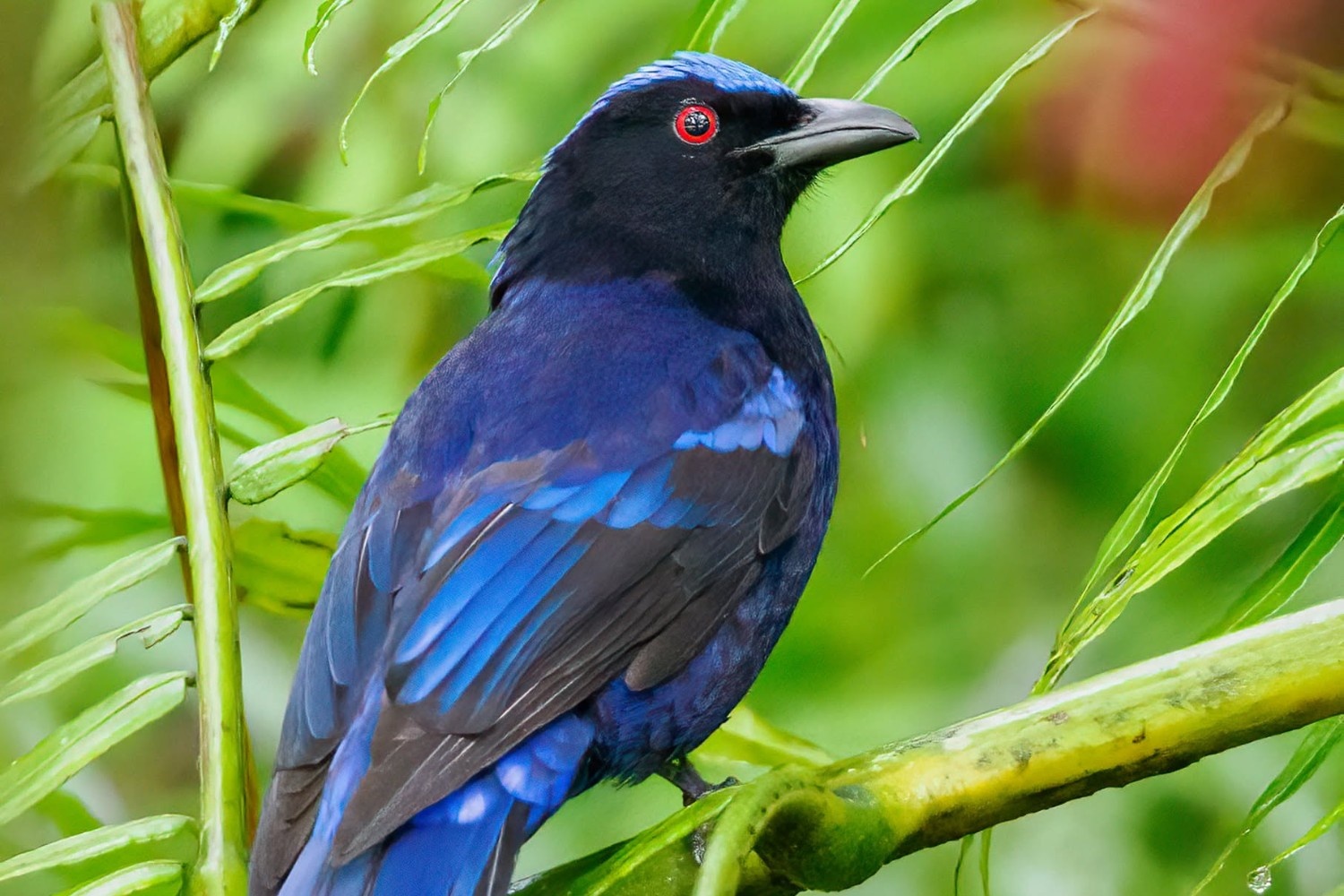
For a fleeting moment, it looks almost unreal.
A flash of deep sapphire blue glides through the forest canopy, catching sunlight like a living gemstone. Its crimson eyes seem to glow against its dark plumage before it disappears among the trees as quickly as it appeared.
Today, birdwatchers know it as the Philippine Fairy-Bluebird. But long before field guides and scientific names existed, our ancestors knew it by a far more magical title: the Tigmamanukan.
To the ancient Tagalogs, this was no ordinary bird. It was a sacred messenger of Bathala, the supreme creator deity, and one of the most important creatures in Philippine mythology.
The bird of destiny
In pre-colonial times, the Tigmamanukan was believed to possess the power to reveal the future.
Travelers preparing for a journey would watch the skies carefully. If the bird crossed from left to right, a sign known as labay, it meant the road ahead would be safe and prosperous. If it flew in the opposite direction, it was considered a warning of danger, misfortune, or even death.
For many ancient Filipinos, the appearance of the bird was not mere coincidence—it was a message from the divine.
Its guidance was so respected that people would postpone journeys and major undertakings based on the omen it delivered.
A role in creation itself
The Tigmamanukan’s importance went beyond predicting the future.
In one version of the Tagalog creation story, Bathala ordered the bird to peck at a giant bamboo stalk floating upon the primordial sea. The bird obeyed, splitting the bamboo open.
From within emerged Malakas and Maganda—the first man and woman.
In this way, the Tigmamanukan became woven into the very origin of humanity, making it one of the most significant animals in Philippine folklore.
Too sacred to harm
Ancient hunters treated the bird with extraordinary respect.
Historical accounts suggest that if a hunter accidentally captured a Tigmamanukan, it was not killed. Instead, it was released back into the wild after a ritual asking it to continue bringing favorable omens.
Such reverence reflects how deeply connected early Filipinos were to the natural world. Animals were not simply resources; some were seen as bridges between the human and spiritual realms.
The real bird behind the legend
Many historians and ornithologists believe the mythical Tigmamanukan was inspired by the Philippine Fairy-Bluebird, a species found only in the Philippines.
The match is striking. Early descriptions mention a bird with brilliant blue and black feathers, exactly the characteristics that make the fairy-bluebird one of the country’s most beautiful forest dwellers.
Even today, seeing one in the wild feels almost mythical.
Its electric-blue coloration appears painted rather than natural, standing out dramatically against the greens and browns of the rainforest.
A symbol worth remembering
While dragons, phoenixes, and griffins dominate the myths of other cultures, the Philippines found wonder in a bird that actually exists.
The Tigmamanukan reminds us that our ancestors saw magic not in distant fantasy worlds but in the forests around them.
Perhaps that is why the legend has endured for centuries.
Because somewhere in the country’s remaining rainforests, a flash of sapphire blue still darts between the trees—just as it did when our ancestors looked to the sky and believed that Bathala was sending them a sign.
READ:
Bird masturbation is common
Nikko Miguel Garcia
June 4, 2026

UP Wild announces bird walk around UP Diliman, opens registration for nature enthusiasts
radar Lifestyle
June 6, 2026
Las Piñas resident discovers helpless Philippine Scops Owl in backyard
Nikko Miguel Garcia
June 5, 2026