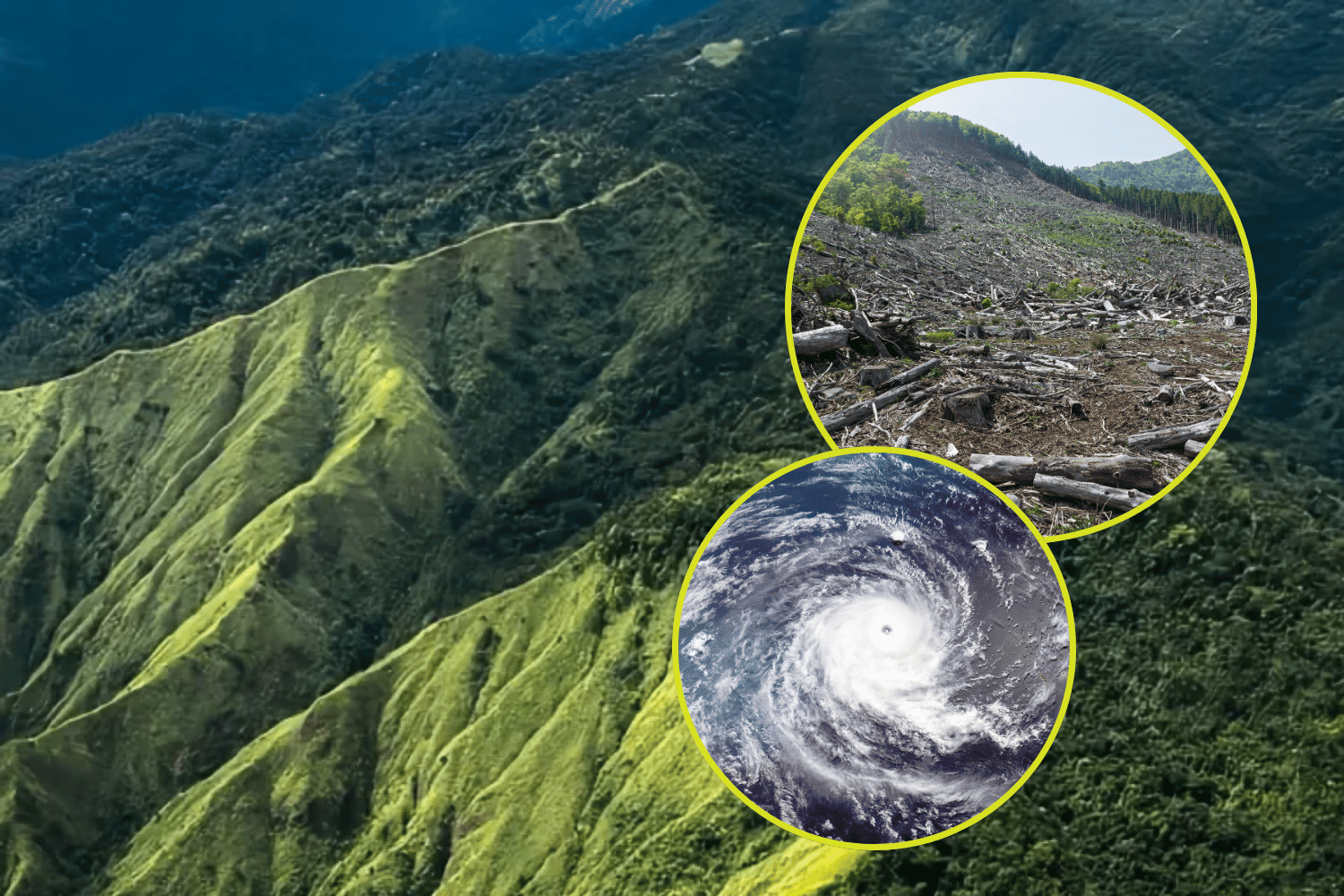
Sierra Madre loses around 9,000 hectares of forest cover annually—roughly the size of 12,600 football fields.
Every rainy season, Filipinos once again look toward the east.
As dark clouds gather over the Pacific and PAGASA begins tracking another approaching tropical cyclone, one name inevitably returns to public conversation: Sierra Madre.
For much of the year, the country’s longest mountain range quietly fades into the background. But when powerful typhoons threaten Luzon, Sierra Madre suddenly becomes the unsung hero that stands between millions of Filipinos and nature’s worst fury.
Stretching more than 500 kilometers along Luzon’s eastern coast, Sierra Madre serves as the country’s first natural line of defense against storms coming from the Pacific Ocean. It does not magically stop typhoons, but it does something equally important—it weakens them.
As a typhoon crashes into the mountain range, its powerful winds encounter rugged terrain instead of open sea. The mountains create friction that disrupts the storm’s circulation, reducing wind strength before it reaches the heavily populated plains of Central Luzon and Metro Manila.
The mountain range also forces moisture-laden air to rise. This process, known as orographic lifting, causes much of the rain to fall over the mountains instead of carrying its full force farther inland. While eastern provinces still endure the harshest impact of landfall, communities farther west are often spared from even stronger winds and heavier rainfall because Sierra Madre has already absorbed part of the storm’s energy.
Its forests perform another equally vital job.
The dense canopy, thick undergrowth, and extensive root systems act like a giant natural sponge. Instead of allowing rainwater to rush directly into rivers, healthy forests absorb and slow the flow of water, reducing flash floods and stabilizing mountainsides against landslides.
But that protection is becoming weaker every year.
According to the Haribon Foundation, Sierra Madre loses around 9,000 hectares of forest cover annually—roughly the size of 12,600 football fields disappearing every year. Illegal logging, quarrying, mining, land conversion, and forest encroachment continue to strip the country’s longest mountain range of the trees that make it an effective natural barrier against storms.
Without trees, rainwater no longer seeps gradually into the soil. Instead, it races downhill, carrying mud and debris into rivers already struggling with siltation. The result is more severe flooding in downstream communities, including parts of Rizal, Marikina, Pasig, Quezon City, and nearby provinces.
Scientists also caution against believing the popular myth that Sierra Madre is an impenetrable shield. It cannot eliminate typhoons, nor can it completely prevent disasters. Provinces facing the Pacific continue to absorb the full force of every landfall, while mountain valleys can even experience intensified rainfall as storms unload enormous amounts of moisture over the slopes.
What Sierra Madre gives us is something no concrete seawall or engineering project can fully replace: time, protection, and reduced intensity.
And yet we continue to weaken the very ecosystem that has quietly protected generations of Filipinos.
Perhaps that is why we only remember Sierra Madre when another storm enters the Philippine Area of Responsibility. Once the skies clear, so does our attention.
But the mountain range protects us every rainy season, whether we notice it or not.
If we truly want safer communities in the years ahead, protecting Sierra Madre cannot begin only when the typhoon warnings are raised. It begins with protecting its forests, stopping destructive activities that scar its slopes, supporting reforestation, and recognizing that our strongest shield against nature is, in many ways, nature itself.
Because every tree standing in Sierra Madre is not just part of a forest.
It is part of our country’s first line of defense.
READ:

EXPLAINER: Why foreign retirees are choosing the Philippines over the rest of the world
radar Lifestyle
June 20, 2026

Five wild Philippine berries that are worth discovering
radar Lifestyle
May 31, 2026
This summer, go glamping in this stylish villa in Antipolo
Nikko Miguel Garcia
April 10, 2026