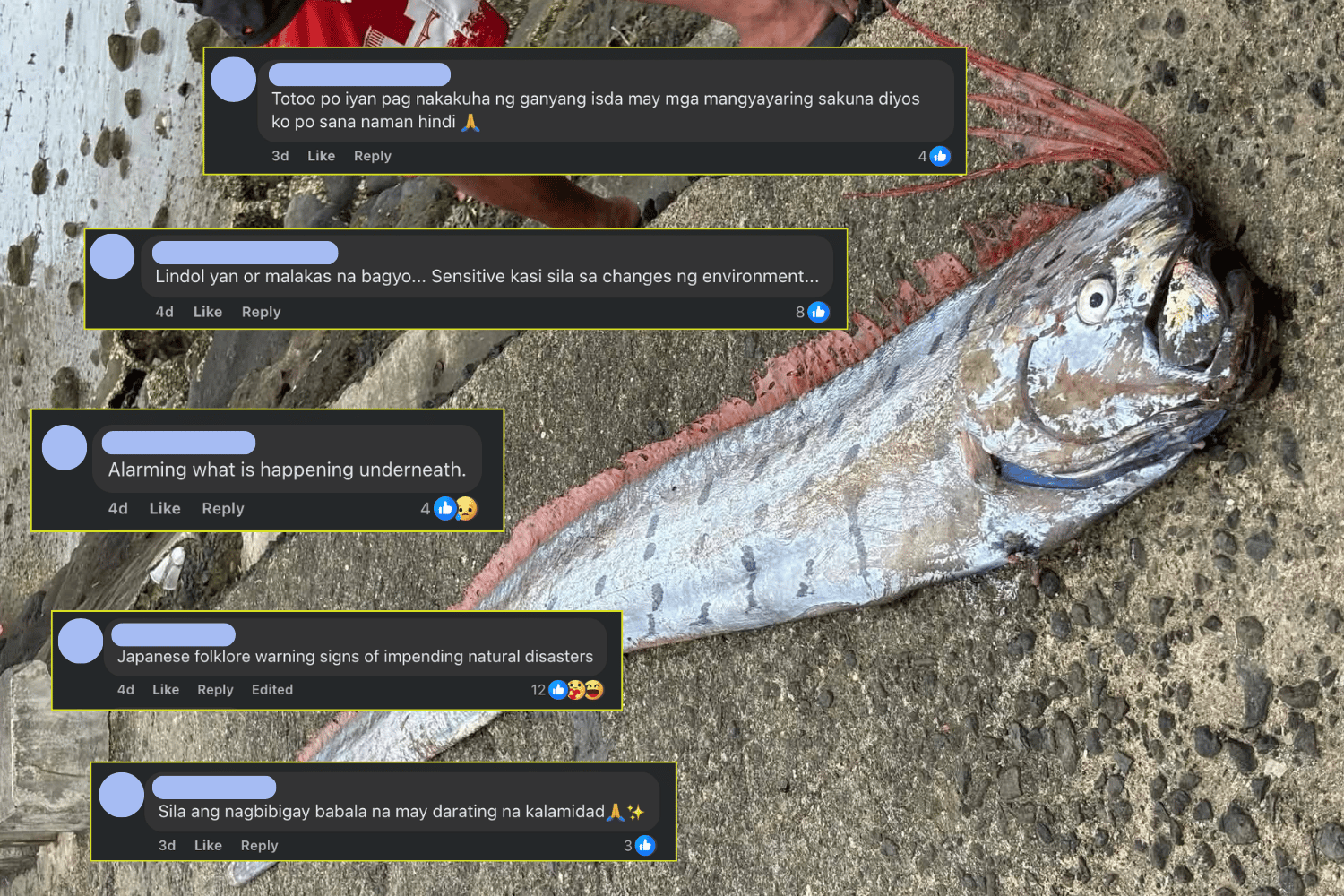
The oarfish is known as Ryugu no Tsukai or the Messenger from the Sea God's Palace. Photo by Marlon Macayan Butardo
Many believe its presence is a bad omen.
An 11-foot (3.59 meters in length) oarfish was spotted dead afloat on the shore of Guinayangan Municipal Fishport in Quezon Province on February 4. While it may just be another report of a lifeless sea creature, some netizens can’t help but worry about the impending doom that surrounds it, especially that it came in the middle of Tropical Storm Basyang.
This all traces back to Japanese mythology. The oarfish, known as Ryugu no Tsukai or the Messenger from the Sea God’s Palace, rises above the sea and warns those on the surface of an upcoming earthquake and tsunami. It sounds far-fetched, but it shouldn’t be ignored. Before Tōhoku experienced a massive earthquake claiming about 20,000 lives back in 2011, over 20 cases of oarfish were discovered in nearby beaches.
So does this mean that the Philippines is on the brink of danger?
Not entirely. In a 2019 study published in the Bulletin of the Seismological Society of America, researchers and historians analyzed 336 fish sightings and 221 earthquakes over 90 years. They found no statistical correlation in these events and have ruled them as coincidences.
Philippine Institute of Volcanology and Seismology Director Dr. Teresito Bacolcol also shared his expertise in the mix repeatedly stating that no such animals, not even an oarfish, can predict certain earthquakes and tsunamis. Bacolcol emphasized illnesses and environmental changes most likely cause these unusual behaviors and scenarios in animals.
Writer, storyteller, explorer... all in one: Rei is in pursuit of tales that offer inspiration and shape different perspectives. Beneath his quiet and reserved persona is an optimistic and carefree soul with a desire to form long-lasting bonds with everyone he meets.