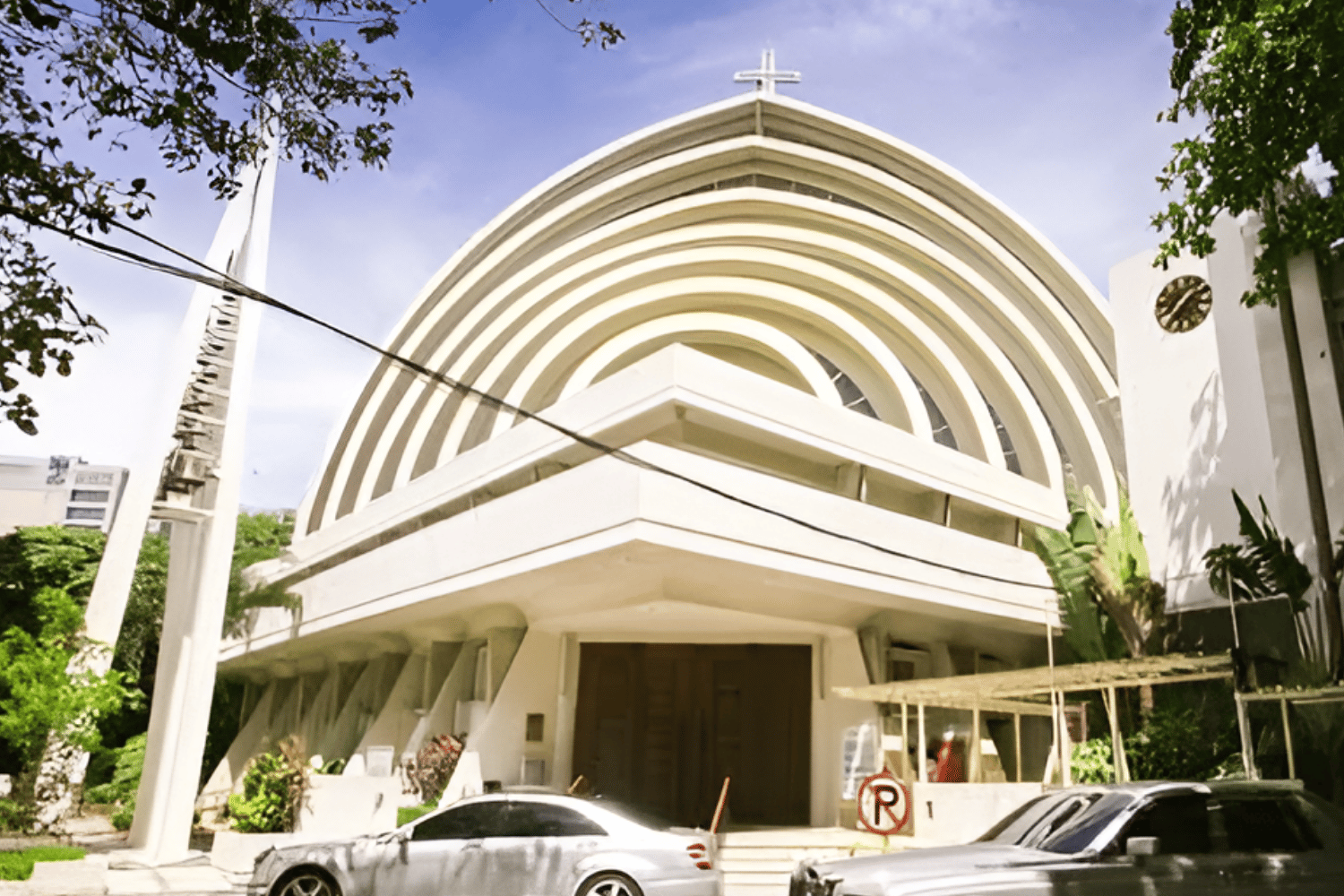
But what rose from the ashes made the Magallanes Church even more stunning.
One of the most recognizable sights along the South Luzon Expressway isn’t a skyscraper or a billboard. It’s the sharp, soaring roof of a church rising above the trees in Magallanes.
Thousands of motorists pass it every day. Some glance at it while stuck in traffic and wonder what it looks like inside. Curiosity eventually wins. Step through its doors and you’re greeted by an awe-inspiring sight: an immense sanctuary flooded with warm light, dramatic stained glass, towering concrete walls, and a ceiling that seems to stretch endlessly toward the sky.
It’s hard to imagine that this architectural masterpiece was once nearly reduced to rubble.
The St. Alphonsus Mary de Liguori Parish Church—more popularly known as the Magallanes Church—is one of Metro Manila’s finest examples of modern Filipino church architecture. Located inside Magallanes Village in Makati City, it has become a favorite venue for weddings, baptisms, and quiet moments of prayer. But beyond its striking appearance lies a remarkable story of destruction, resilience, and rebirth.
A masterpiece by Leandro Locsin
The parish was established in 1967, with its original church completed the following year.
The building was designed by Leandro V. Locsin, who would later be proclaimed National Artist for Architecture. Known for iconic landmarks such as the Cultural Center of the Philippines, Locsin envisioned the Magallanes Church as a minimalist place of worship that emphasized intimacy over grandeur.
His original design sat on a perfectly square footprint, with the main aisle leading diagonally toward the altar. The roof rested on 28 massive concrete buttresses, while the relatively low six-meter ceiling created a peaceful, contemplative atmosphere that brought worshippers closer to the sacred space.
It was a masterpiece of modern Philippine architecture.
The fire that changed everything
Then tragedy struck.
In September 2004, a massive fire engulfed the church, destroying nearly everything inside. The roof collapsed, the interiors were devastated, and one of Metro Manila’s architectural gems appeared to be lost forever.
Miraculously, the massive concrete buttresses survived.
Those weathered structures became the only remaining link to Locsin’s original masterpiece—and the key to giving the church a second life.
Rising from the ashes
Instead of simply replicating the old church, architect Dominic Galicia was commissioned to create a new vision while preserving Locsin’s legacy.
He retained the surviving concrete buttresses and built an entirely new structure around them.
The result is the breathtaking church seen today.
The soaring roof dramatically raised the interior height from just six meters to an astonishing 28 meters, transforming the once intimate sanctuary into a vast, light-filled space. An open mezzanine expanded the seating capacity from around 300 to nearly 900 parishioners, allowing the church to serve a growing community without sacrificing its architectural identity.
Rather than replacing Locsin’s work, Galicia created a respectful conversation between the old and the new.
A sanctuary filled with art
The beauty of the Magallanes Church extends beyond its architecture.
Its enormous wooden entrance doors, hand-carved by artisans from Betis, Pampanga, depict scenes from the life and Passion of Jesus Christ, inspired by the early Renaissance works of Giotto.
Behind the altar, brilliant stained-glass windows glow with fiery shades of red, orange, and gold, symbolizing the burning bush from the Old Testament. Throughout the day, sunlight pours through the glass, filling the sanctuary with constantly shifting colors.
The church also features distinctive drum-shaped confessionals, reflecting the spiritual teachings of St. Alphonsus Maria de Liguori, who is regarded as one of the Church’s greatest moral theologians.
Outside, visitors can find another peaceful retreat in the Garden of the Risen Christ, where a sculpture rises above a reflective pool, offering a quiet place for prayer amid the bustle of Makati.
A symbol of resilience
Today, the Magallanes Church is admired not only for its beauty but also for what it represents.
The devastating fire of 2004 could have erased one of Metro Manila’s most beautiful churches forever. Instead, it became the turning point that transformed it into an even more extraordinary landmark.
Every day, thousands of commuters continue to catch a glimpse of its dramatic roofline from SLEX without knowing the remarkable story behind it.
But for those who take the time to step inside, the Magallanes Church offers more than breathtaking architecture. It stands as a reminder that even after immense loss, something even more beautiful can rise from the ashes.
READ:
St. Frassati draws Filipino Gen Z Catholics to Manila Cathedral festival
radar Lifestyle
June 22, 2026

Heath Jornales eyes building a church for mom, dreams big for family after PBB win
Kiko Escuadro
April 8, 2026
These six iconic Philippine landmarks are gone forever
Top Dagohoy
July 24, 2026