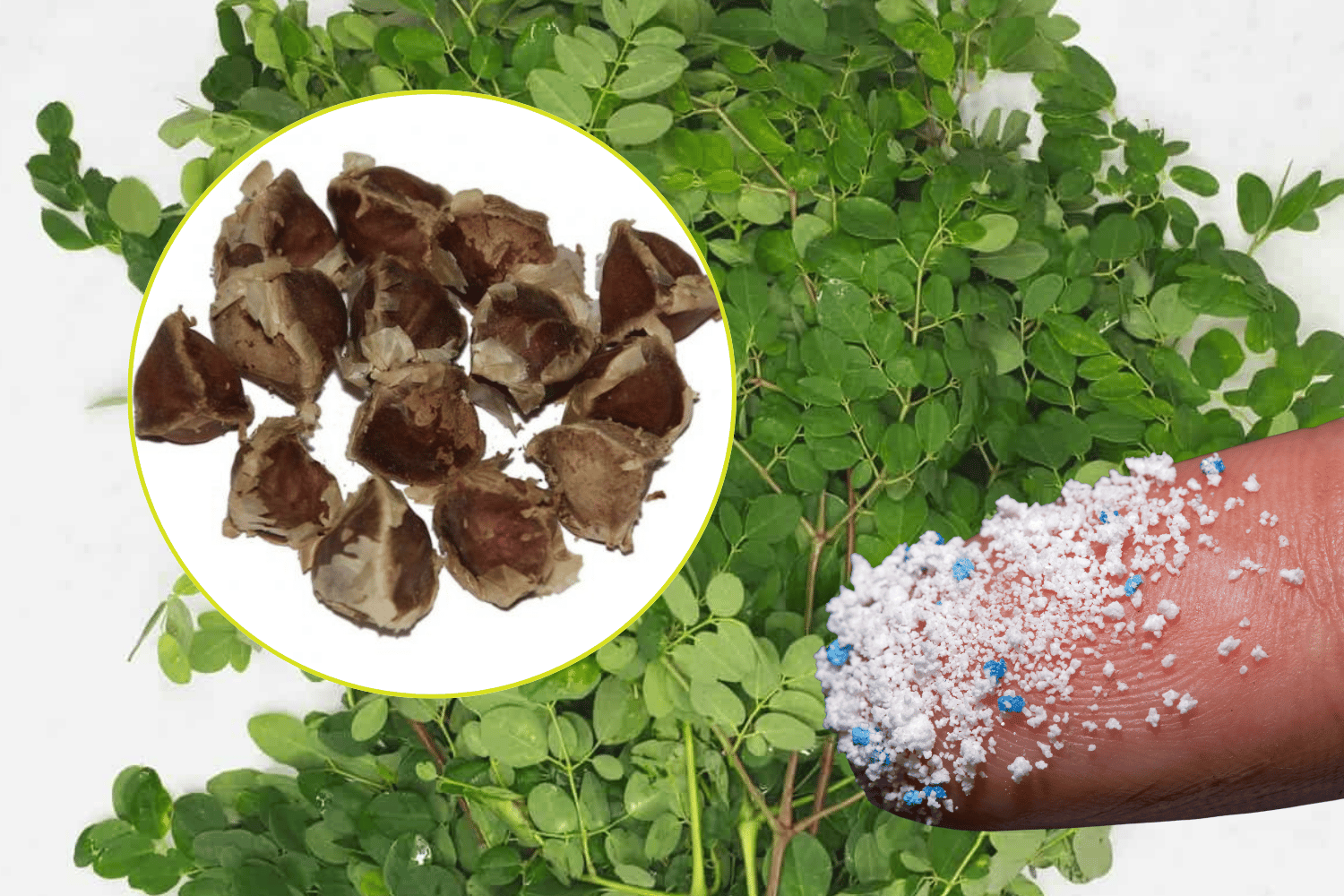
The latest study makes malunggay a promising, eco-friendly tool for future water purification.
A viral Facebook post claiming that malunggay seeds can remove microplastics from drinking water sounds almost too good to be true.
But this time, the science backs it up.
The viral post circulating online is accurate, properly sourced, and consistent with findings from a peer-reviewed study published in 2026 in the scientific journal ACS Omega. Conducted by a team of biochemical engineers, the research found that extracts from malunggay (Moringa oleifera) seeds removed up to 98.5% of aged PVC microplastics from water under laboratory conditions.
Even more remarkable, the natural extract performed almost identically to aluminum sulfate (alum)—the conventional chemical coagulant widely used in water treatment—which achieved a 98.7% removal rate under the same test conditions.
Why malunggay works
The secret lies in the proteins naturally found inside malunggay seeds.
These proteins carry a positive electrical charge, while many microplastic particles carry a negative charge. When mixed together, the proteins bind to the plastic particles, neutralizing their charge and causing them to stick together into larger clumps called flocs.
Once clumped, the particles become heavy enough to be trapped by ordinary sand or granular filtration systems, allowing much cleaner water to pass through.
This process, known as coagulation, is already a standard step in water treatment. The study simply showed that a natural plant extract can perform nearly as well as a widely used chemical alternative.
A surprising discovery
Researchers also discovered that the malunggay extract worked effectively in an in-line filtration system, where it is added immediately before filtration.
That means the traditional and more energy-intensive flocculation stage may not always be necessary, potentially simplifying future water-treatment systems—particularly in rural or decentralized communities where sophisticated facilities are unavailable.
But don’t start filtering water at home yet
The findings are promising—but they are not a signal for people to start using crushed malunggay seeds in household drinking water.
The experiments were conducted under carefully controlled laboratory conditions using aged PVC microplastics suspended in prepared low-turbidity water.
Real rivers, lakes, and groundwater contain different types of plastics, sediments, microorganisms, and organic contaminants that could affect performance.
Researchers also found that the seed extract leaves behind residual dissolved organic matter, which could encourage bacterial growth if not properly removed during treatment.
In other words, the technology still requires further testing and refinement before it can be safely adopted for municipal or household water systems.
A promising Filipino plant
Malunggay has long been celebrated in the Philippines for its nutritional and medicinal value. It is rich in vitamins, minerals, antioxidants, and plant proteins, earning its reputation as one of the country’s most important “superfoods.”
This latest study adds another potential role to that list—not as a miracle cure, but as a promising, eco-friendly tool for future water purification.
The verdict
The viral post gets the science right.
It does not exaggerate the study’s findings, correctly identifies Moringa oleifera as malunggay, accurately reports the 98.5% microplastic removal rate, and acknowledges that the research was conducted under laboratory conditions.
While more studies are still needed before the technology reaches real-world water systems, the research offers compelling evidence that one of the Philippines’ most familiar backyard plants could someday help tackle one of the world’s fastest-growing pollution problems.
READ:
The beautiful flowers in your garden could be the secret ingredients in your next meal
radar Lifestyle
June 14, 2026
Malunggay leaves can generate electricity, laboratory tests show
radar Lifestyle
June 19, 2026
Tawa-tawa: The humble weed helping Filipinos fight dengue
Top Dagohoy
July 31, 2026