The policy, however, does not specify which AI uses constitute violations.
The University of Santo Tomas has added generative AI to its academic integrity rules in its updated student handbook, but the new provision doesn’t spell out which uses of the technology constitute violations.
UST released the revised handbook this year, its first update since 2018. It’s available for download on the university’s website.
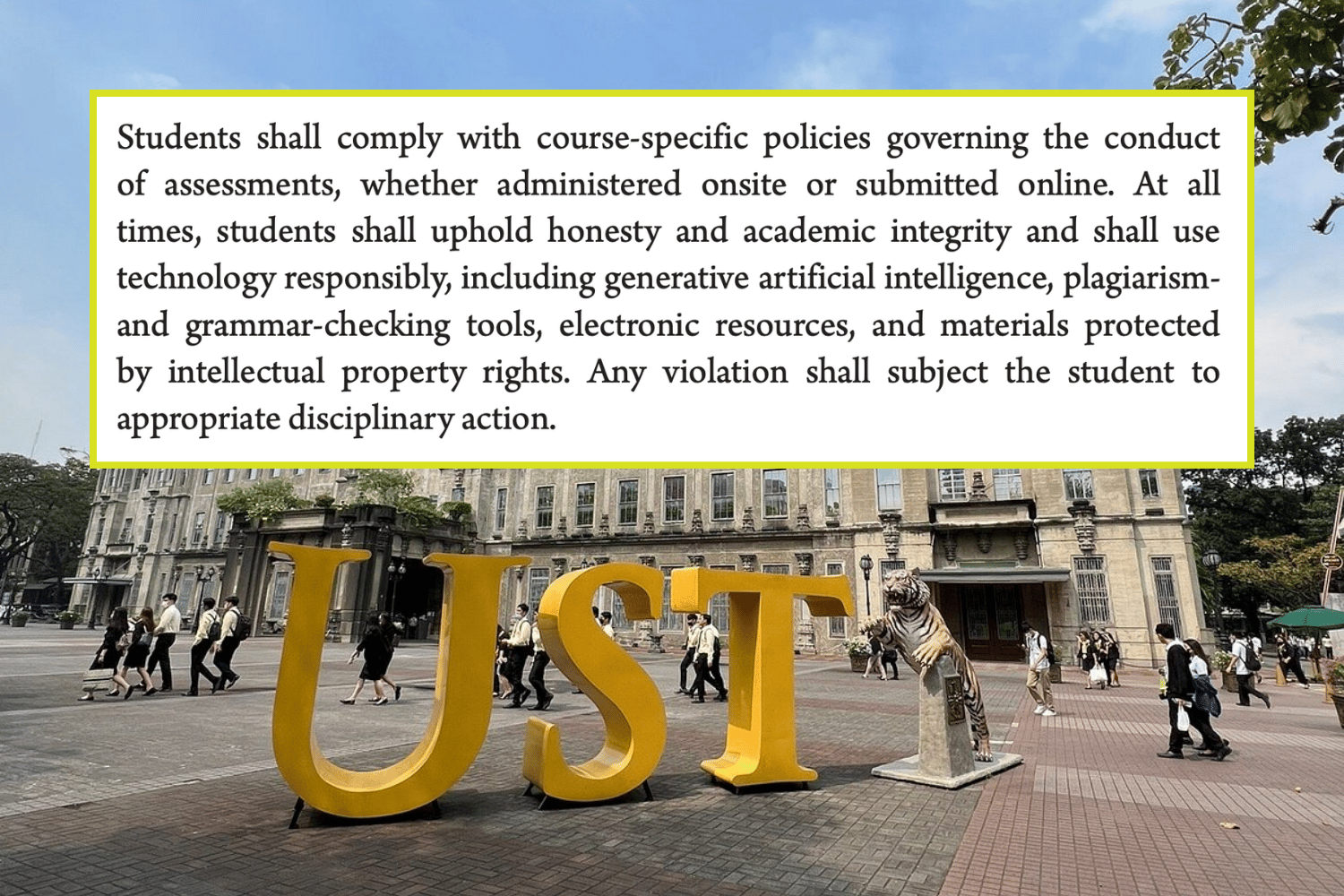
The updated Policies, Procedures and Standards No. 1018 now covers violations involving generative AI, plagiarism, grammar-checking tools, electronic resources, and materials protected by intellectual property rights.
“At all times, students shall uphold honesty and academic integrity and shall use technology responsibly, including generative artificial intelligence, plagiarism and grammar-checking tools, electronic resources, and materials protected by intellectual property rights. Any violation shall subject the student to appropriate disciplinary action,” Item 2 of PPS No. 1018 reads.
The provision, however, doesn’t specify which uses of generative AI would constitute violations, leaving the boundaries of acceptable use unclear.
UST’s updated AI policy comes after it faced criticism earlier this year over materials that appeared to use AI-generated visuals.
In March, the university posted a doodle of a tiger taking an exam, which some users called “AI slop.” Posters near campus drinking fountains also prompted messages opposing AI-generated art and urging the university to tap its College of Fine Arts and Design.
In a June report by The Flame—the official publication of the UST Faculty of Arts and Letters—Philippe Hernandez of the university’s communications bureau defended the use of AI-assisted tools in “contemporary communication work,” saying they form part of a broader “human-led process of conceptualization, review and approval.” He said such tools are not intended to replace human judgment, artistic discernment, or institutional accountability.
In 2025, UST also issued separate AI guidelines for academic research and publication, according to The Flame. The guidelines don’t prohibit generative AI use but include rules for its ethical application, including disclosure by students and researchers when AI is used and a prohibition against copying AI-generated output.
The changes come as Philippine schools take different approaches to generative AI. While some are setting boundaries around its use, others are incorporating AI into the curriculum as a skill students will need beyond school.
Recently, Mapúa Malayan Digital College has taken a more integration-focused approach, building AI fluency into its curriculum to prepare students for workplaces where the technology is increasingly used.
According to Jobstreet by SEEK’s “Hiring, Compensation & Benefits Report” released in August 2025, 72% of businesses in the Philippines factor an applicant’s AI knowledge into their hiring decisions.
READ: