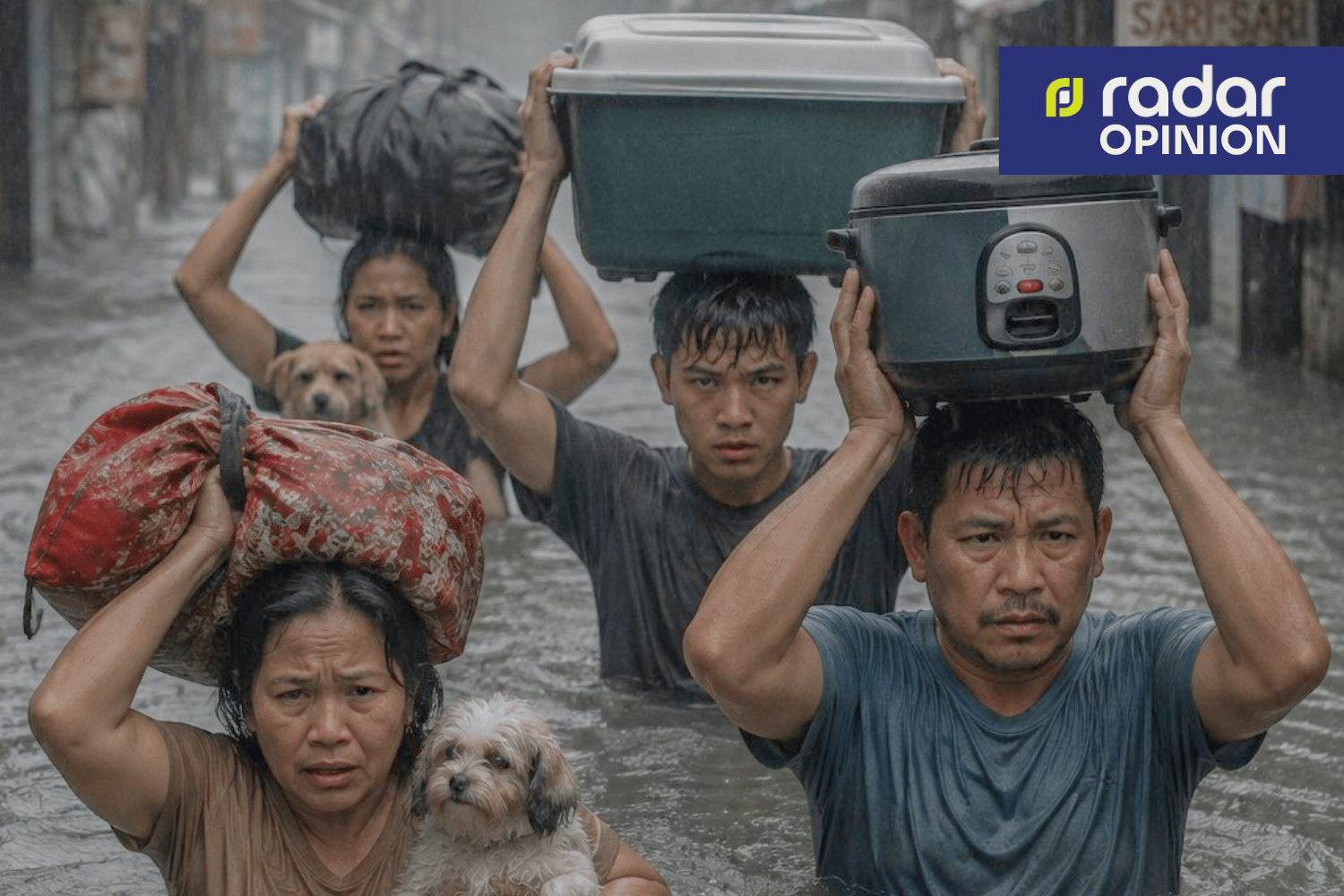

Manila’s floods force people to walk along gutters, avoid flooded streets and improvise their way home, exposing the city’s problems with drainage, green spaces and rainwater management.
Floodwater has a funny way of making ridiculous things look perfectly reasonable. People suddenly become amateur long jumpers, hopping from one dry patch to another, stepping onto stones, curbs, bits of pavement or anything else that sits a few inches above the water, all in the hope of making it from one side of the street to the other without getting their feet wet.
A woman walking carefully along the gutter along EDSA, for instance, might look completely ridiculous on an ordinary day. During a flood, however, the gutter can become the more sensible route if it happens to sit a few inches higher than the road. It is the kind of thing you begin seeing everywhere once the water rises, as people find whatever way they can to keep themselves out of it.
And perhaps that is what floodwater takes from people that we don’t talk about enough. Getting soaked is one thing. Being forced to contort yourself, improvise and sometimes look ridiculous just to stay dry is another.
There is something deeply undignified about having to walk along a gutter because it is the driest path available, or carry your shoes because you cannot afford to ruin them. None of these things would enter anyone’s mind on a normal day, yet flooding can make them feel like perfectly reasonable choices.
The people doing these things are not the ones who should feel embarrassed. They are responding to the circumstances in front of them, doing whatever they can to protect themselves and what they own. The uncomfortable part is that a city can put its residents in a situation where this kind of improvisation becomes necessary.
Yet every time heavy rain arrives, we seem to accept these things as inevitable consequences of bad weather.
The weather, of course, is part of the problem. A typhoon or a particularly heavy downpour can dump enormous amounts of water over Metro Manila in a short period, and no drainage system can make the rain disappear.
But perhaps we have become too willing to blame the rain and leave it at that. The rain is what falls from the sky. What happens to it after it reaches the ground is something we have far more control over.
Treating rain water as resource
That brings us to drainage, waterways and the amount of land we have allowed to become concrete. It also means asking how many trees and green spaces have been sacrificed in the name of progress, whether for private developments or government projects.
We pave over land, clear trees, and reduce the places where rainwater can seep into the ground, then wonder why the water ends up on the streets when the drains can no longer keep up.
But what if we stopped treating rainwater as something that simply needs to be drained away? What if we treated it as a resource that can be captured, stored, and used? Imagine if Metro Manila had functioning rain catchment systems built into homes, buildings, schools and other public spaces, allowing at least some of that water to be collected instead of immediately rushing into already overwhelmed drains and canals.
This is why flood control cannot simply be about building bigger pumps or clearing drains after the water has already risen. It has to include the way we design the city itself, including how much space we leave for water to be absorbed, captured or temporarily stored.
It all ends in indignity
Because the goal should not be to make people better at avoiding floodwater. It should be to build a city where they don’t have to perform these little acts of desperation every time the rain comes down hard.
The problem is not that Filipinos have failed to figure out how to cross flooded streets. The problem is that we have become accustomed to expecting ordinary people to figure it out themselves, while treating their resourcefulness as a normal part of surviving Manila’s weather.
So yes, floodwater soaks people. That is the most obvious part of the problem. But perhaps we should pay more attention to what people are forced to do to keep themselves dry, because there is a point at which improvisation stops being amusing and starts becoming an indignity.
Heavy rain will always be part of life in Manila. Having to navigate around it this way does not have to be. That’s the point.
READ:
OPINION: Lola Lolita’s story is inspiring. DepEd’s spin on resilience is bullsh*t
Nikko Miguel Garcia
August 14, 2026

OPINION: Stop buying dogs for content and clout
Mianne Cudal
August 14, 2026

OPINION: Gen Z workers are not lazy for choosing WFH during floods
John Lloyd Aleta
August 12, 2026