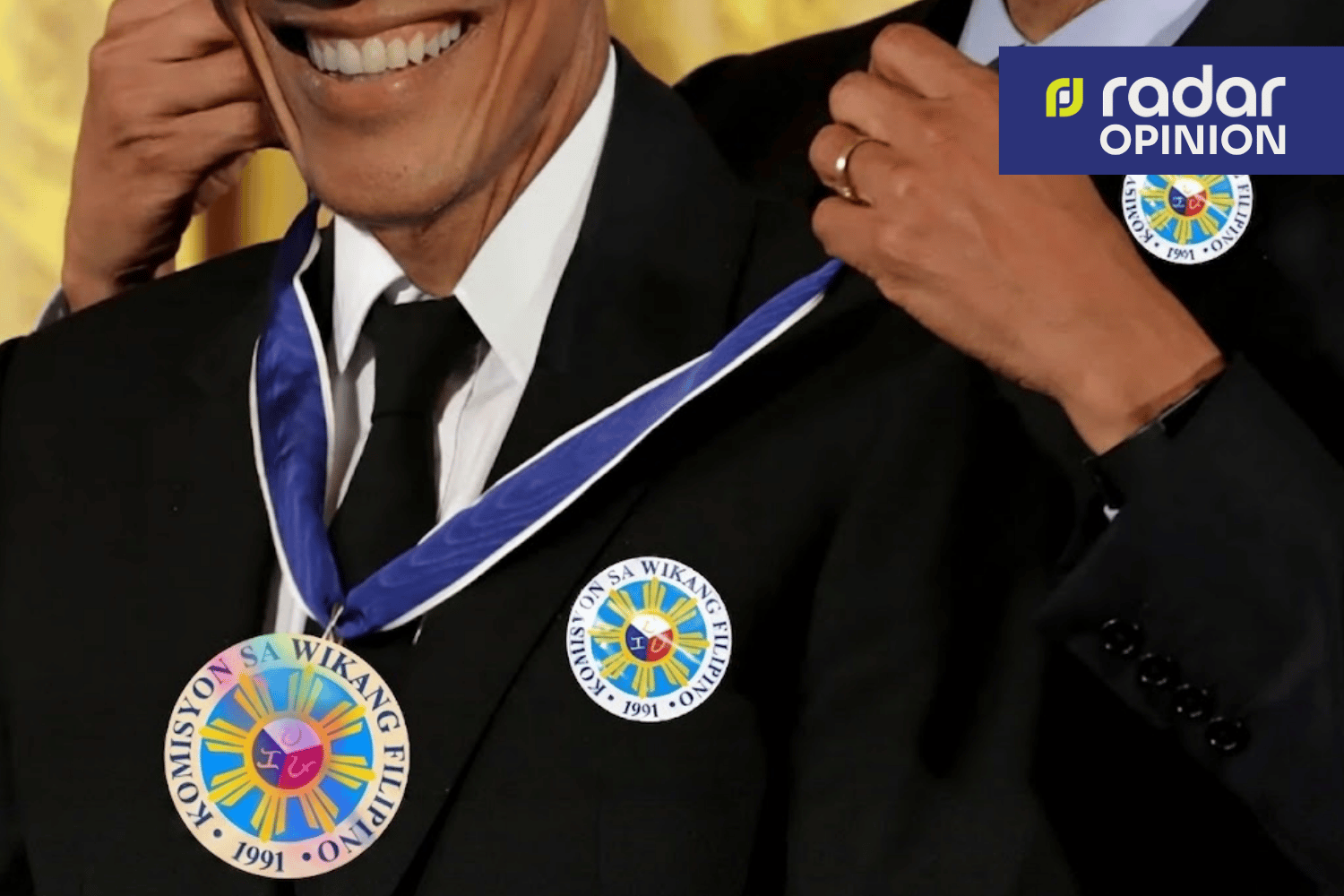

What could be more vulgar than public officials using a public institution, public resources, and a public award to honor themselves?
On Aug. 17, torrential habagat rains sent floodwaters spilling across Metro Manila and nearby provinces all day. But on the evening of Aug. 18, there was another kind of flooding at the Komisyon sa Wikang Filipino: narcissism.
That night, the KWF announced six of its commissioners as recipients of its very own 2026 Kampeon ng Wika awards: Carmelita Abdurahman (Samar-Leyte); Benjamin Mendillo Jr. (Ilokano), Alain Russ Dimzon (Hiligaynon), Christian Aguado (Katimugang Pamayanang Kultural), Reggie Cruz (Kapampangan), and Evelyn Oliquino (Bikol).
Six KWF commissioners receiving the KWF’s own award? Talk about a Rufa Mae Quinto moment: “I dedicate this to myself. Hope I like it!”
It’s a rather unusual move for a recognition meant for “mga indibidwal, institusyon, o samahang may ambag sa pagtataguyod, pagpapaunlad, at preserbasyon ng wikang Filipino at mga katutubong wika ng Filipinas sa iba’t ibang larangan o disiplina.”
Previous recipients include National Artists Resil Mojares and Nora Aunor, as well as writers and scholars such as Merlie Alunan, Alicia Magos, Leoncio Deriada, Eliza Uy-Grino, Galileo Zafra, Mario Miclat, and Michael Coroza. Supreme Court Associate Justice Serafin Cuevas, priests Immanuel Sison Escano and Wilmer Joseph Tria, and the Muntinlupa government have also received the award.
To be fair, there’s nothing in the KWF rules that explicitly prohibits its commissioners from becoming Kampeon ng Wika. But that begs the question: Why would an award-giving body choose to award its own members?
Veteran screenwriter Jerry Gracio, a former KWF commissioner, had the same question, albeit more bluntly: “Hindi ba self-serving ‘yun, buhat ng sariling bangko?”
Gracio doubled down in a follow-up Facebook post on Aug. 19: “Puwedeng hindi ilegal pero alam nating walang delicadeza mga gagawa nito.” He laid out the absurdity himself: “Sino magbibigay ng award sa sarili mo? Ikaw. Sino pipirma sa award mo? Ikaw. Sino kakamay sa ’yo? Ikaw. Sino magsasabi sa iyong magaling ka? Ikaw.”
Inside the KWF, the reaction was reportedly just as damning. A KWF employee who anonymously spoke to radar said, “Nakakahiya. Marami ang galit at nahihiya sa amin.” Asked why employees weren’t speaking out publicly, the employee replied, “Kapag nagsalita kami rito, kaso agad.”
The employee also said three commissioners declined the award out of “delicadeza.”
The awkwardness is not purely symbolic, either. While the Kampeon ng Wika doesn’t come with a cash prize, it’s a government-funded program. Taxpayers’ money goes toward the plaques, awards night, event production, and administrative work behind the nominations and selection.
The KWF employee said the commissioners themselves deliberated as a board on giving the awards, although the selection process wasn’t fully disclosed to employees because it was a board matter. The employee also said the move had been planned in advance.
The optics were hard to defend outside the agency, too. Louie Jon Sánchez, a UP College of Media and Communication professor and three-time KWF Makata ng Taon, likened the move to Napoleon Bonaparte crowning himself in 1804. He called the “temerity” of it “unspeakable” and “really shameful,” noting that it was done “at our expense as tax payers.” His verdict: “Nalubog na sa baha ang dangal.”
Sánchez also commented on the KWF’s announcement, calling it “nakakahiya” to have the commission honor its own administrators, whereas “ang dami-dami namang puwedeng kilalanin.” The comment was later deleted after the KWF limited comments on the post amid the backlash.
Sociopolitical columnist Tonyo Cruz, meanwhile, said the KWF had no shortage of people more deserving of the distinction, pointing to Filipinos in the country and abroad, as well as “halfies” and even foreigners who actively promote Philippine languages. He called the KWF’s decision a “lantarang paglapastangan” of the Code of Conduct and Ethical Standards for Public Officials and Employees, and possibly an “abuse of power.”
Cruz offered names of people and institutions the KWF could’ve considered. Among them were Andrei Clyde Chua Arellano, who wrote the first mathematics thesis at UP Diliman in Filipino; the International Criminal Court, which appointed Filipino and Cebuano interpreters for the trial of former president Rodrigo Duterte; and Associate Justices Apolinario Bruselas Jr. and Maria Filomena Singh, who have written decisions in Filipino.
Notice how “nakakahiya” keeps surfacing in the reactions to the KWF’s decision. Perhaps that’s because what happened is precisely that: kawalang-hiyaan.
If there’s a word for KWF’s act, it’s mast*rbation. Vulgar? Sure. But what could be more vulgar than public officials using a public institution, public resources, and a public award to honor themselves? At least mast*rbation is supposed to be private.
READ:
QC trial court uses Filipino in hearing during Buwan ng Wika
Kiara Gorrospe
August 15, 2026
‘Ang mga translation app ng AI ay salat pa rin’
Kiara Gorrospe
July 25, 2026
KWF defends AI use in preserving indigenous languages, says katutubos won’t be displaced
Kiara Gorrospe
July 25, 2026
Tags: Alain Russ DimzonAlicia MagosAndrei Clyde Chua ArellanoApolinario Bruselas Jr.Benjamin Mendillo Jr.Buwan ng WikaCarmelita AbdurahmanChristian AguadoCity Government of MuntinlupaCode of Conduct and Ethical Standards for Public Officials and EmployeesEliza Uy-GrinoEvelyn OliquinoGalileo ZafraImmanuel Sison EscanoInternational Criminal CourtJerry GracioKampeon ng WikaKomisyon sa Wikang FilipinolanguageLeoncio DeriadaLeyteLouie Jon SanchezluzonMaria Filomena SinghMario MiclatMerlie Alunanmetro manilaMichael CorozaMindanaoNapoleon BonaparteNora AunorReggie CruzResil MojaresRodrigo DuterteRufa Mae QuintoSamarSerafin CuevasSupreme Court of the PhilippinesTonyo Cruzuniversity of the philippinesUP College of Media and CommunicationVisayasWilmer Joseph Tria