
Porvenir’s localized adaptation of Tennessee Williams classic returns to Sine Pop for limited run.
There is good reason why the return of “El Fuego del Alma”—Porvenir’s found-space adaptation of Tennessee Williams’ “Summer and Smoke”—to Sine Pop this September and October is being met with such eager anticipation.
Judiciously condensed into a lean and briskly paced 90 minutes, the production, localized for the Philippine setting by Eljay Castro Deldoc and shaped with deliberate care by director Mark Mirando, has been earning steady praise from theater insiders and enthusiasts alike.
This runtime makes the Filipino version even tighter than the 1961 Hollywood adaptation, which earned acting honors for lead actress Geraldine Page at the Golden Globes and the Venice Film Festival before she faced a tough—and losing—Oscar battle against formidable movie stars like eventual Best Actress winner Sophia Loren (for “Two Women”), Audrey Hepburn (“Breakfast at Tiffany’s”), Natalie Wood (“Splendor in the Grass”) and Piper Laurie (“The Hustler”). Page finally clinched her first and only Oscar in 1986 for “The Trip to Bountiful” at age 61, following eight career nominations—but we digress.
Why the comparison between a current theater production and a film classic, you ask? Well, 65 years later, Page’s performance offers an elegant lesson in the nuanced transition from stage to screen.
All too often, theater-trained actors fail to modulate their flailing energy for the camera—a trend we noted in our recent movie reviews for Cinemalaya. Even Page fell into this trap, leaving her Alma “impeccable but outsized” in some critics’ estimation. Still, turning in a heightened characterization without going over the top can be tricky.
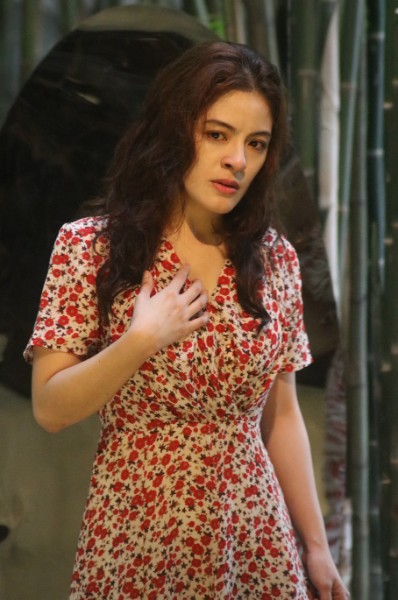
Where the movie falters by trying to translate a delicate, inherently theatrical tone into cinematic realism, “El Fuego” deftly illustrates why such scaling only dilutes the narrative impact. In Sine Pop’s intimate space, the scorching tension between the beleaguered heroine’s puritanical repression and the reckless narcissism of the untamed object of her desire fuels the near-miss romance of the play’s star-crossed lead characters, Alma Ortega (Hariette Mozelle, as luminous as she is emotionally fragile) and Juanito Yago (the potently charming Sandino Martin)—and what a devastatingly compelling drama it unfolds!
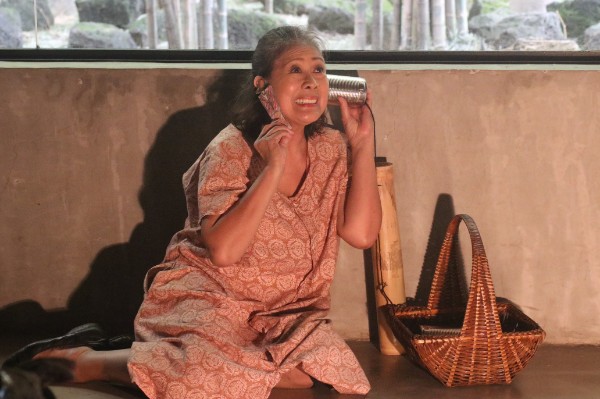
Like Romeo and Juliet, Alma and Juanito’s opposing archetypes clash in what Shakespeare famously calls a “misshapen chaos of well-seeming forms.” She is a preacher’s daughter whose smoldering inner desires are stifled by her father’s rigid social propriety and the unraveling mental illness of her mother (Madeleine Nicolas, vividly channeling the production’s thematic undercurrents), while the young hedonistic physician represents physical indulgence and raw carnal desire. Their paths constantly cross but never actually meet in the middle.
The production strikes deep at a classic Tennessee Williams conflict: the brittle nature of the female psyche. It draws a direct line from Alma’s raw anxiety to Blanche DuBois’ fading grip in “A Streetcar Named Desire,” and the manic emotional neglect that drives Maggie the Cat in “Cat on a Hot Tin Roof.”
Another tantalizing convention executed with flair is the rotating cast, which inherently collapses the boundary separating the lead actors from the ensemble. Yet, we would also have loved to see the alternative dimensions brought by rising young actress Nour Hooshmand (“Cinemartyrs,” “Filipiñana”), Vincent Pajara and Rolando Inocencio, who alternate in the roles of Alma, the uninhibited Rosa and Dok Yago, respectively.
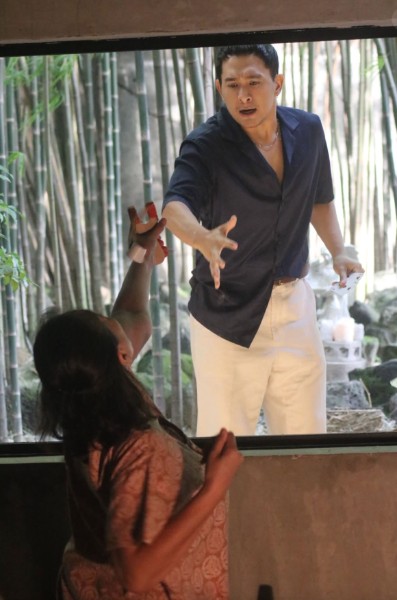
Beyond the script, El Fuego manages to transform its intimate venue into an active narrative partner. The space itself stokes the tension. The backyard bamboo garden adds physical depth to the staging, while muffled chaos from the floor above perfectly echoes the escalating psychological friction below—a visceral use of space that amplifies the play’s emotional stakes.
Yet, a curious omission demands scrutiny: the choice to excise the original text’s cockfighting motifs. On screen, this bloody backdrop stood as a potent symbol of man’s untamed nature, unforgettable in the moment Alma’s pristine outfit is splattered with blood from a losing rooster. Framing this elemental clash of purity and violence within a distinctly Pinoy setting would have added a rich cultural context to the Filipino adaptation.
The Philippines, after all, is the global heartland of “sabong”—a multibillion-peso industry whose deep-seated domestic roots stand in sharp contrast to its international notoriety. While the cockpit represents the brutal reality of the physical world, Juanito’s love for Alma remains akin to smoke—an intangible, fleeting specter that can be seen, but never truly captured.