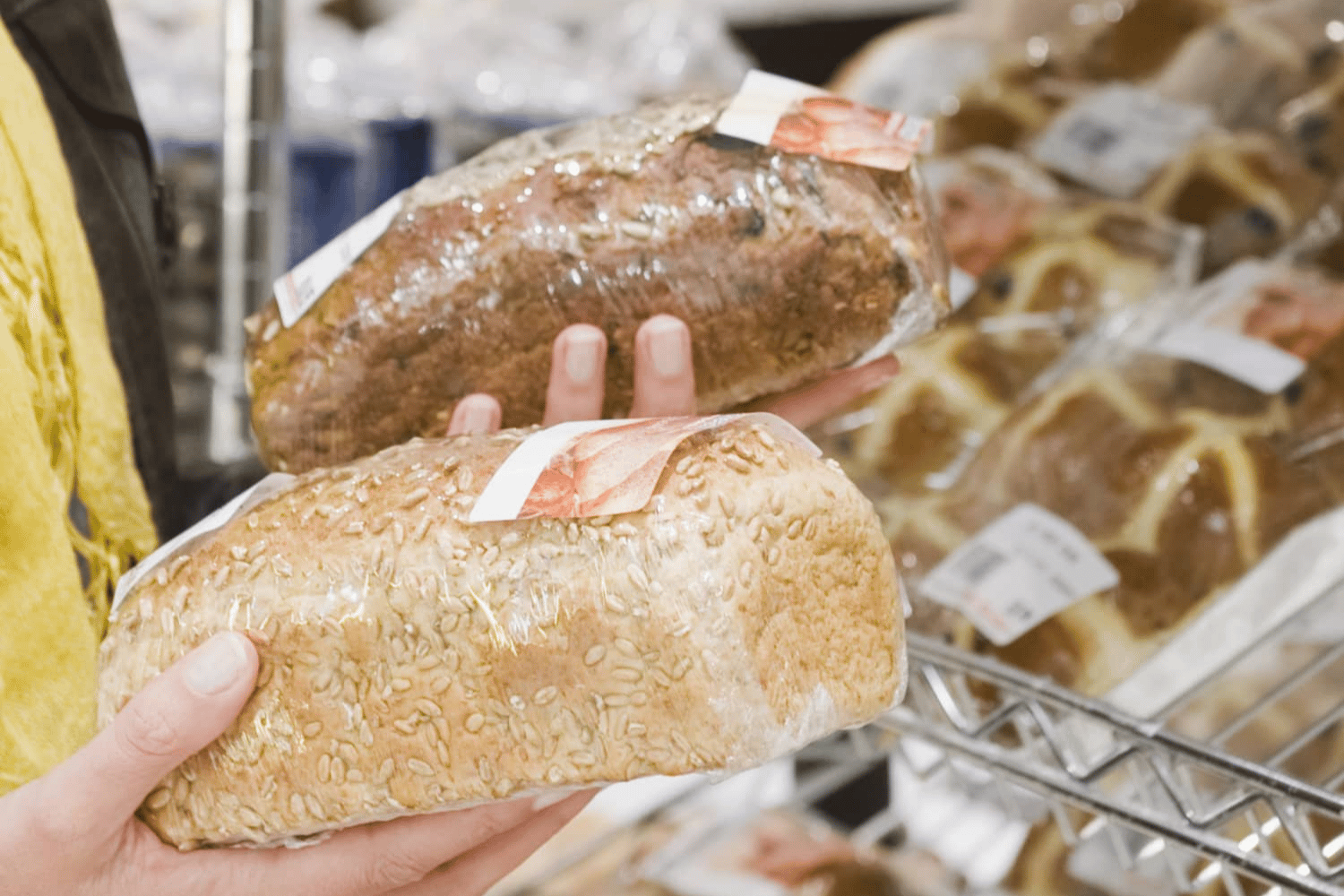
Understanding the food science and ingredient lists behind commercial bread shelf life.
A viral Threads post has Filipinos talking after a user in the United States noticed something unusual about supermarket food.
“Dito talaga sa US ang daming shelf stable-foods,” the post reads. “Sa Pinas ang shelf life ng mga breads and cakes maximum if 10 days lang usually dito umaabot ng months.”
One reply quickly went viral: “Girliepop, this ain’t the flex you think it is.”
Behind the joke is a legitimate question: Why can some packaged American bread remain soft and apparently mold-free much longer than freshly baked bread?
The answer is less sinister than some social media claims—but still worth examining.
It’s designed to last
Fresh bread is vulnerable to two different processes: staling and microbial spoilage. Industrial bakeries can slow both through formulation, packaging and preservatives.
Calcium propionate, for example, is commonly used to inhibit mold. Emulsifiers, enzymes and dough conditioners can meanwhile help bread retain its softness and texture.
That doesn’t mean every American loaf lasts for months, nor does every American bread contain the same additives. Artisan sourdough, supermarket sandwich bread and commercially packaged buns are very different products.
And the phenomenon isn’t uniquely American. Shelf-stable commercial bread exists in many countries, including the Philippines.
Yes, the US allows some additives Europe doesn’t
This part of the online debate has some basis.
Azodicarbonamide or ADA is permitted by the US Food and Drug Administration as a flour whitening agent and dough conditioner at regulated levels, while it is not authorized as a food additive in the European Union.
Potassium bromate has also been used as a flour-treating and dough-strengthening agent in the US. The International Agency for Research on Cancer has classified potassium bromate as “possibly carcinogenic to humans,” based largely on evidence from experimental animals.
But there is an important distinction: legal permission doesn’t mean every American loaf contains these substances. Consumers have to check the actual ingredient list.
The often-repeated description of ADA as a “yoga mat chemical” can also be misleading. A substance having industrial applications doesn’t automatically mean its regulated use in food poses the same risks.
The ‘destroys your gut’ claim goes too far
Calcium propionate is antimicrobial—that is precisely why bakers use it against mold.
But claims that eating bread containing it continuously kills beneficial gut bacteria and causes inflammation are stronger than the available human evidence supports.
Scientists have investigated possible effects of propionate on metabolism, but that is different from proving that ordinary consumption of bread containing the preservative destroys the human microbiome.
Interestingly, preservatives aren’t the only way to make bread last longer.
Fermentation and acidity can naturally discourage mold growth. Research has shown that certain sourdough cultures can significantly extend bread’s mold-free shelf life.
What about glyphosate?
Another claim circulating online is that American wheat is routinely sprayed with glyphosate immediately before harvest, leaving weed killer in bread.
There is some truth buried beneath the alarmism.
Certain glyphosate products in the US permit pre-harvest application to wheat under specific restrictions. But that fact alone does not prove that American bread contains dangerous levels of glyphosate.
Actual exposure depends on residues in the finished food, and pesticide residues are subject to regulatory limits and monitoring.
Long shelf life isn’t a toxicity test
Perhaps the biggest misconception in the viral discussion is the simplest one: food lasting longer doesn’t automatically make it dangerous.
Canned food, crackers, frozen vegetables and UHT milk can all remain edible far longer than their fresh equivalents because humans have developed ways of slowing microbial growth and deterioration.
Bread is no different.
Still, there is a useful takeaway from that supermarket aisle in America.
Some commercial loaves are formulated very differently from the pandesal that leaves a neighborhood bakery warm in a paper bag. If a loaf stays soft and mold-free for weeks, there is food science behind it—preservatives, acidity, moisture management, processing, packaging or some combination of these.
So instead of judging bread simply by how quickly it grows mold, turn the package around.
The ingredient list tells you much more than the expiration date ever could.
READ:
This is why your bread turns rubbery in the microwave
Top Dagohoy
September 14, 2026
EXPLAINER: Could breadfruit be the rice alternative Filipinos have been overlooking?
Top Dagohoy
August 31, 2026
Granny’s and L.A. battle for cheese bread supremacy
Top Dagohoy
September 15, 2026