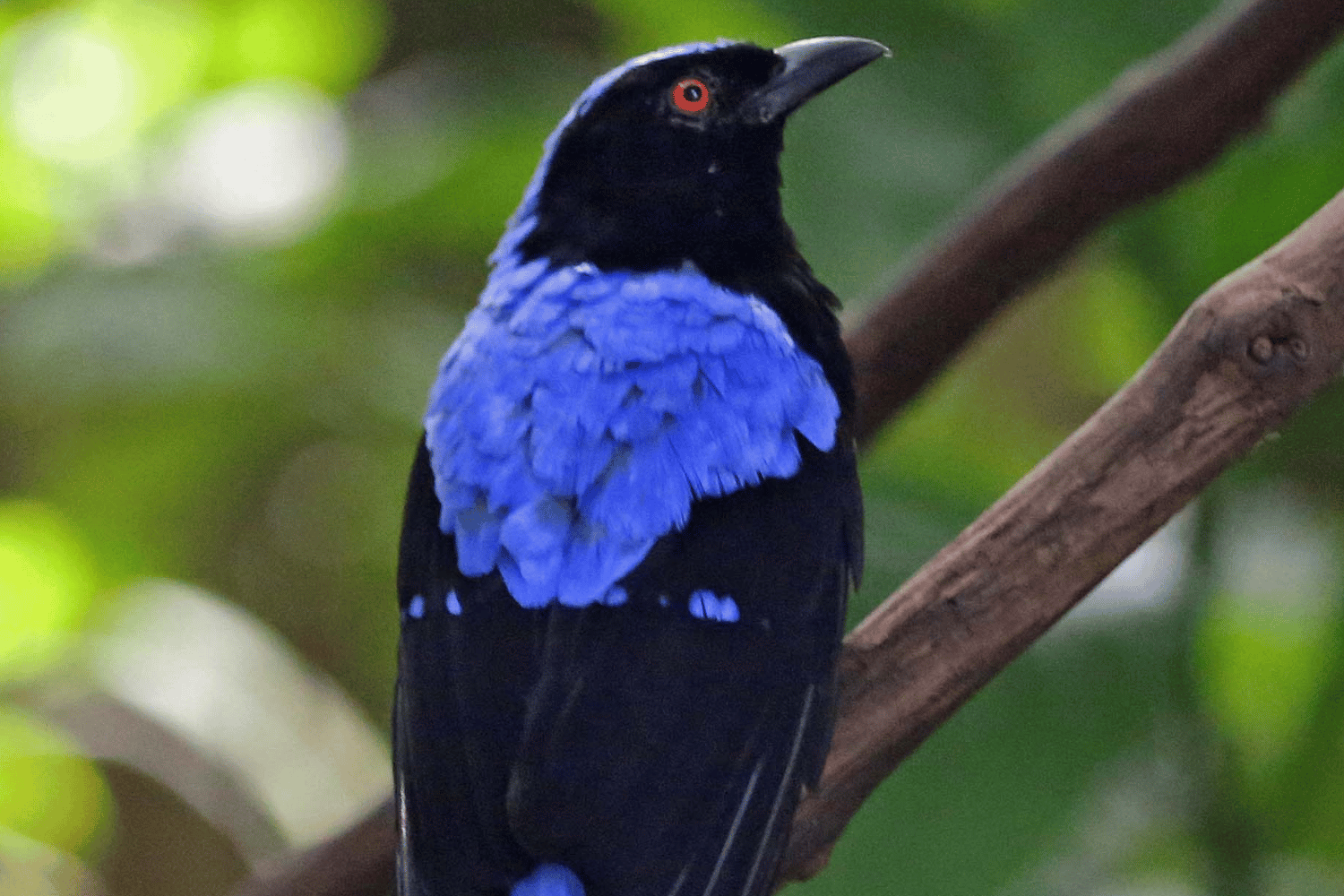
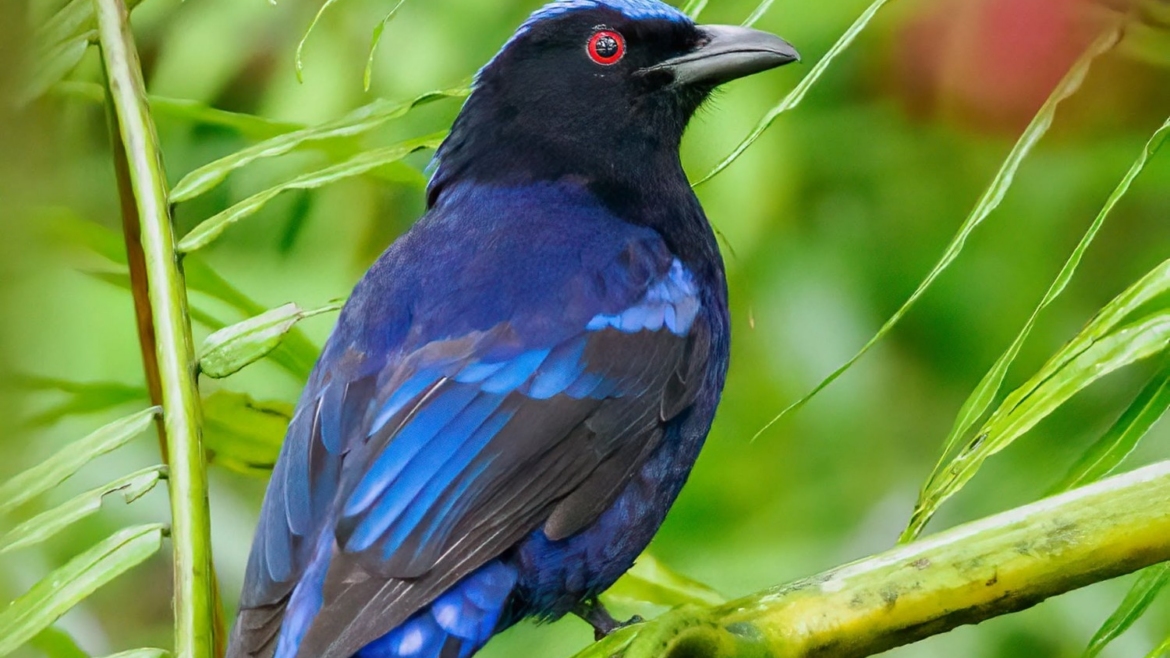
The Philippine Fairy-bluebird is linked to the Tigmamanukan, the legandary bird whose flight was believed to foretell good fortune or danger.
Imagine our ancestors preparing for a long journey through the forests of ancient Luzon. Then, from the trees, a magnificent dark bird with flashes of brilliant blue and striking red eyes suddenly crosses their path.
They stop.
If it flies in the auspicious direction, they take it as a sign to continue. If it crosses the other way, they may turn around, believing danger awaits them ahead.
For our ancestors, such an encounter could be an omen.
Today, the bird itself may be the one in danger.
The Philippine Fairy-bluebird, or Irena cyanogastra, is a striking forest bird found only in the Philippines. Measuring roughly 24 to 27 centimeters, it has deep blue-black plumage, brilliant blue markings on its crown, wings and rump, and piercing red eyes.
It inhabits forests in Luzon, Mindanao, Samar, Leyte and Bohol, generally feeding high in the canopy on fruits such as wild figs, along with nectar and insects. Its dependence on forests, however, makes it particularly vulnerable when those forests disappear.
The Philippine Fairy-bluebird has long been associated with the Tigmamanukan, the celebrated omen bird of pre-colonial Tagalog belief.
Historical accounts describe the Tigmamanukan as a bird whose movements were interpreted before a journey. Seeing or hearing it under favorable circumstances could mean good fortune ahead, while an unfavorable encounter could be taken as a warning to abandon or postpone the trip.
The bird therefore occupied an extraordinary place in the pre-colonial Filipino imagination. Nature wasn’t merely scenery. It communicated, warned and guided.
Centuries later, the Philippine Fairy-bluebird faces a threat that requires no supernatural interpretation.
The species is classified as Near Threatened on the IUCN Red List. Its population is threatened primarily by the continuing destruction and degradation of Philippine forests, particularly the lowland forests on which many endemic species depend.
Its disappearance would mean losing more than another beautiful endemic bird. We could also lose a living connection to stories and beliefs handed down from generations before us.
Our ancestors once stopped when this bird crossed their path because they believed it might be telling them something.
Perhaps we should stop and listen again.
This time, the warning is coming from the disappearing forest itself.
READ: