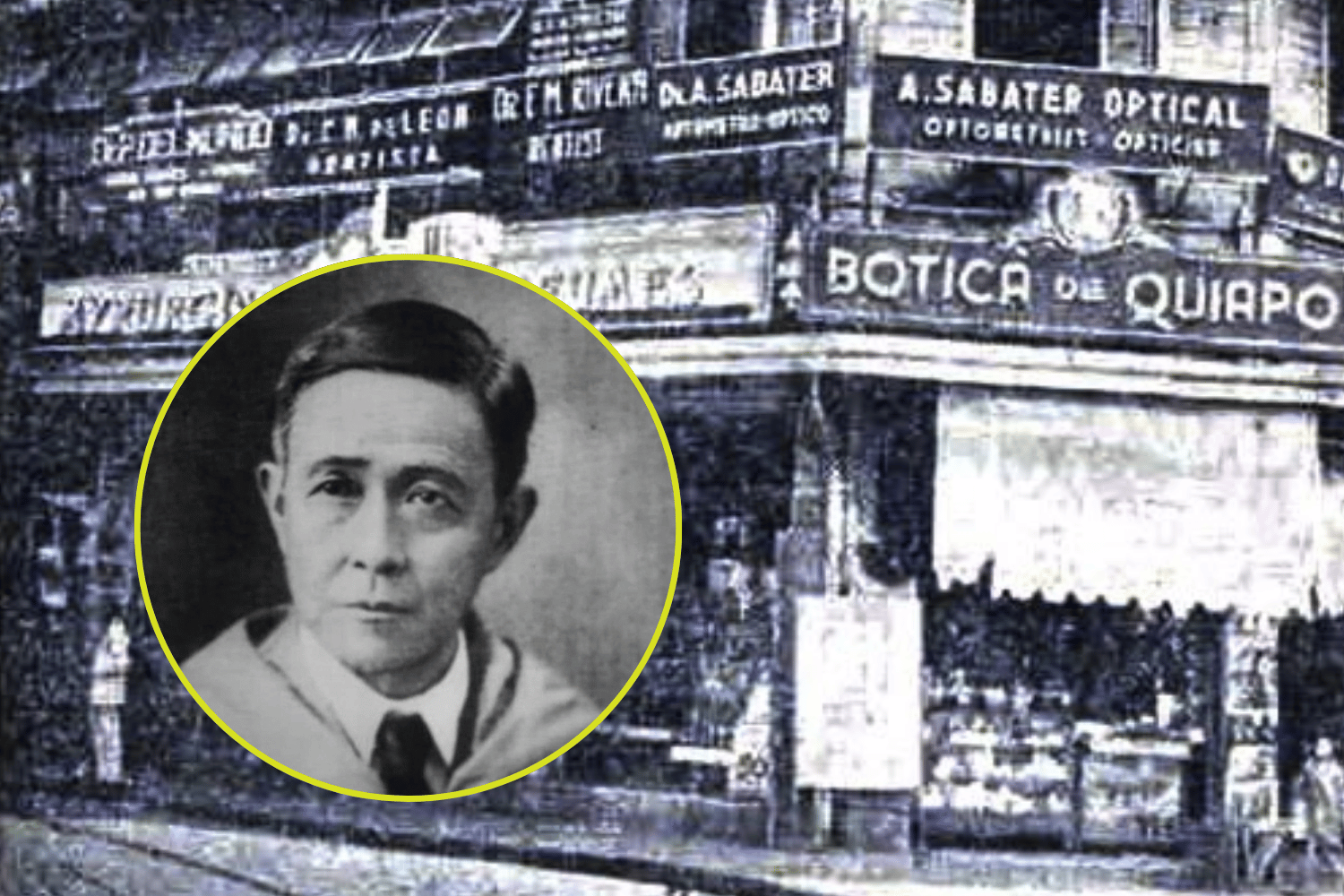
Botica de Quiapo served as a vital training ground for early Filipino pharmacists like Manuel A. Zamora.
Imagine walking into a pharmacy in Quiapo more than a century ago.
There are no blister packs, no shelves of mass-produced medicines and no computerized prescriptions. Behind the counter, a pharmacist weighs powders, measures liquids and compounds medicine by hand using a mortar and pestle. Nearby, an apprentice watches and learns.
That apprentice could have been Manuel A. Zamora, who would become one of the most important pharmacists in Philippine history.
And the place was Botica de Quiapo.
Its roots stretch back to the Spanish colonial period, when it operated as the dispensary of Ocampo y Arévalo in bustling Quiapo. Historical accounts also connect its early years with German pharmacist Gustav Grupe, or “Don Gustavo,” who arrived in Manila in 1866.
But Botica de Quiapo was more than a place to buy medicine. At a time when pharmacy in the Philippines was developing into a formal profession, boticas also served as practical training grounds where apprentices learned to measure, mix, compound and dispense medicines.
Zamora was among those associated with Botica de Quiapo.
He would later develop a stable medicinal preparation from tiki-tiki, or rice bran, which was used against infantile beriberi. Rice bran contains thiamine, or Vitamin B1, whose deficiency causes the disease.
The preparation became one of the best-known Filipino pharmaceutical products of its era.
Botica de Quiapo was not where Zamora ultimately manufactured his famous preparation—he later established his own laboratory on Calle Hidalgo—but his apprenticeship there helped build the practical pharmaceutical skills behind his later work.
The pharmacy’s contribution extended beyond Zamora.
Old boticas represented a crucial stage in the modernization of Philippine medicine. Pharmacists were becoming trained professionals, preparations were increasingly standardized, and pharmacies were evolving from colonial apothecaries into modern healthcare businesses.
Botica de Quiapo made that transition itself.
In February 1940, the business and its goodwill were acquired by the Gonzalez & Gonzalez partnership. Its new owners modernized the drugstore, expanded its pharmacists, clerks and sales organization, and developed a distribution network reaching beyond Manila into the provinces.
In many ways, its evolution mirrored Philippine pharmacy itself: from mortar and pestle to laboratories, professional education and nationwide medicine distribution.
Today, Botica de Quiapo may no longer have the familiarity of the giant drugstore chains found across the country.
But long before the modern Filipino pharmacy became an everyday institution, a botica in Quiapo was already helping train the people who would shape Philippine pharmaceutical science.
READ: