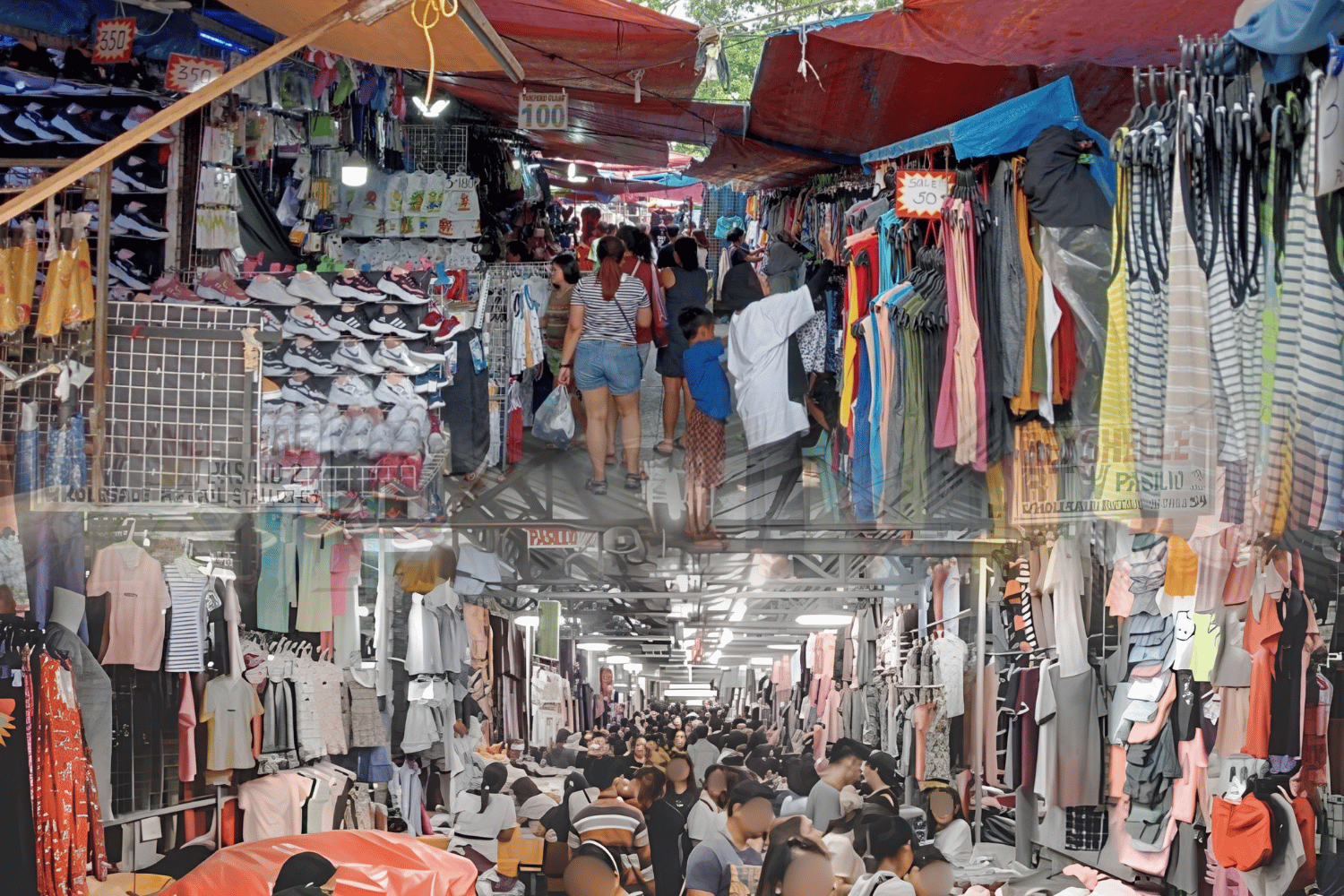
But the country’s “Garments Capital” struggles in the age of online shopping
Clothes have long been part of Taytay’s local economy, but the Rizal town’s reputation as the country’s “Garments Capital” grew from something much smaller: households turning sewing skills as a raket.
Women in Taytay initially used their sewing skills to make clothes at home, eventually producing enough garments to supply markets in Divisoria, Baclaran, Pasig, and other business districts of Metro Manila.
As demand grew, local entrepreneurs began supplying fabrics, sewing machines, and other materials, creating a network of small producers whose work could reach a much larger market.
What started as small-scale operations eventually grew into a local garment ecosystem connecting manufacturers, wholesalers, retailers, textile suppliers, and home-based workers.
By 2008, the trade had grown enough to establish a more permanent retail presence, with the local government setting up the Taytay Municipal Tiangge for garment vendors.
And in 2025, Taytay had 764 registered micro, small, and medium enterprises and 28 garment centers, showing how deeply clothing businesses had become embedded in the local economy.
But the town’s garment story is also part of a bigger Philippine apparel industry that has struggled to return to its previous scale.
The Philippine Statistics Authority reported that the country’s apparel sector employed 118,043 workers across 1,326 establishments in 2019—highlighting the role of clothing production as a source of jobs and small-business activity.
The industry has yet to return to its previous scale. PSA data showed that wearing-apparel manufacturing output in 2024 remained below its 2018 level, despite growing 7.4% during the year.
Now, Taytay’s garment businesses face another challenge: changing shopping habits.
Industry representatives told the Department of Labor and Employment in 2025 that online shopping was affecting foot traffic and sales at the town’s tiangges, as shoppers increasingly have access to clothing without having to visit the physical market.
Taytay businesses have responded by expanding into online selling, trade fairs, and pop-up stores.
The shift puts more pressure on Taytay’s small garment businesses to compete on more than low prices, particularly as online marketplaces give shoppers more choices without requiring a trip to the tiangges.
For an industry built from small sewing businesses and home-based production, the challenge now is reaching those shoppers wherever they choose to buy.
READ: