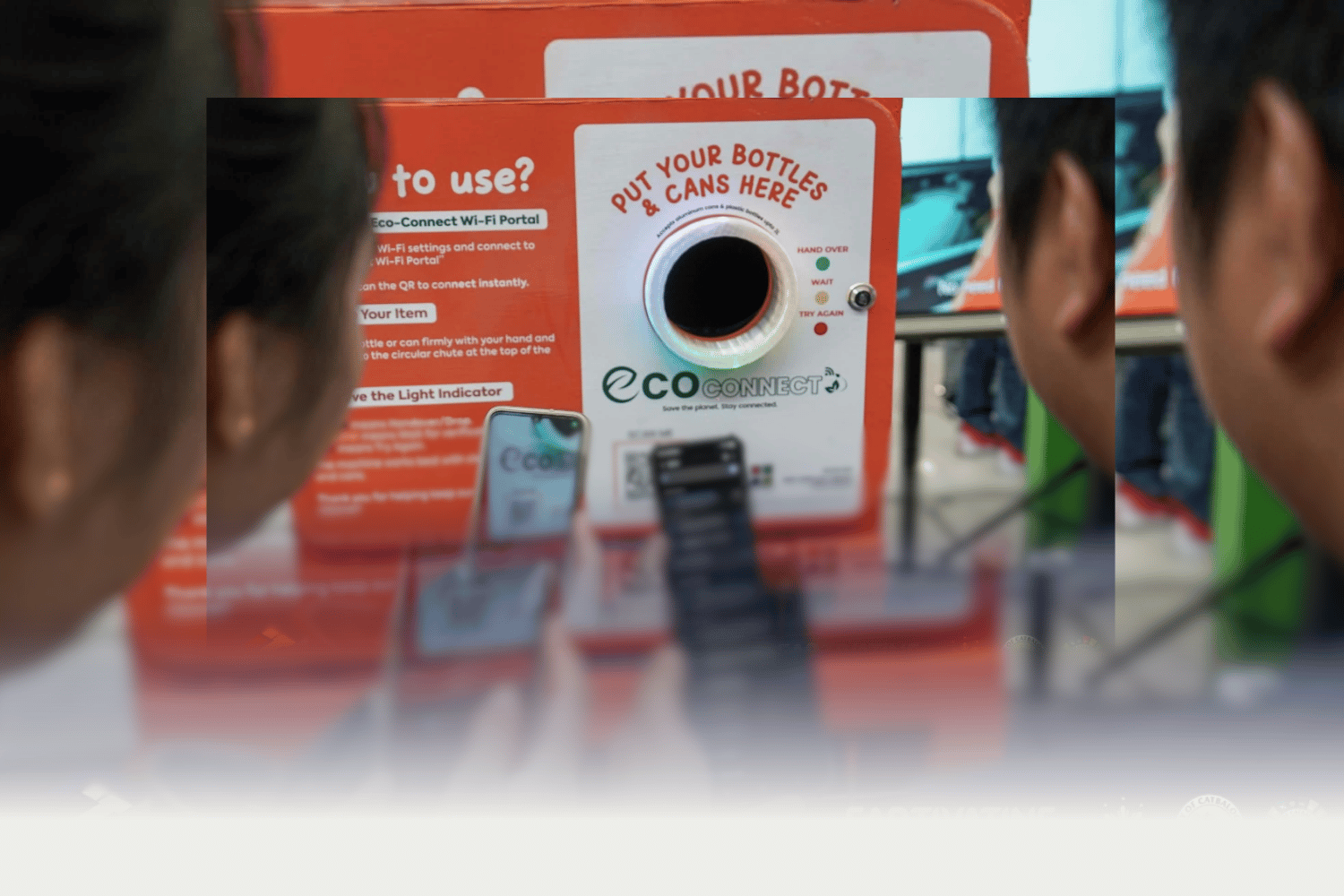
Eco-Connect in Catbalogan City gives users two-minute internet access per bottle inserted.
What if a plastic bottle could buy you two minutes of free Wi-Fi?
Samar National High School student Mary Angelique Cabrigas pitched that exact concept, winning third place at the 2025 Idea and Reverse Pitching Competition during the Regional Smart Communities Exposition and Networking Engagement (rSCENE).
Named Eco-Connect, the machine was launched by Catbalogan City’s Information and Communications Technology Office this October. It operates like a piso net, accepting plastic bottles instead of coins in exchange for internet access.
“What we’re solving here are two things. First, our environmental protection—the plastics. Because we noticed that in Antiao River, there’s a lot of plastic. Even in the parks,” Catbalogan ICT Officer Exequiel Cabrigas said in an interview with the Department of Science and Technology.
‘Not just a machine’
The machine’s premise is simple, but its underlying technology is precise.
Cabrigas said the unit uses a Raspberry Pi, a credit-card-sized single-board computer, to detect plastic bottles and tin cans before granting internet access.
Every plastic bottle inserted into Eco-Connect earns the user two minutes of connectivity, giving residents an incentive to collect and dispose of recyclable materials properly.
Rather than relying on power-hungry desktop processors, the unit runs on energy-efficient Arm processors, the same technology found in smartphones and tablets.
It also uses computer vision via a webcam alongside machine-learning models to identify recyclable materials.
Serving a larger purpose
With students increasingly relying on internet connectivity, Cabrigas said initial units will be installed in schools and public areas in Catbalogan City.
The planned sites include Samar National School, Samar State University, Catbalogan Community College, Catbalogan 1 Elementary School, Catbalogan 3 Elementary School, and Imelda Public Plaza.
“Actually, we have a partnership with the schools. The schools provide the internet to the machines. It’s their social responsibility. We will collect plastic, then we will bring it to our processing plant,” Cabrigas said.
The collected plastics will be processed into bricks or chairs, which will then be donated back to participating schools.
Eco-Connect is one of five smart-city solutions launched in Catbalogan City as part of rSCENE 2026, a DOST initiative promoting science-based, innovative, and inclusive solutions for communities.
The event brought together students, innovators, institutions, organizations, and technology advocates for exhibitions, competitions, presentations and networking.
For local communities, Eco-Connect shows how a student’s idea can address two concerns at once: access to digital connectivity and plastic waste.
READ: