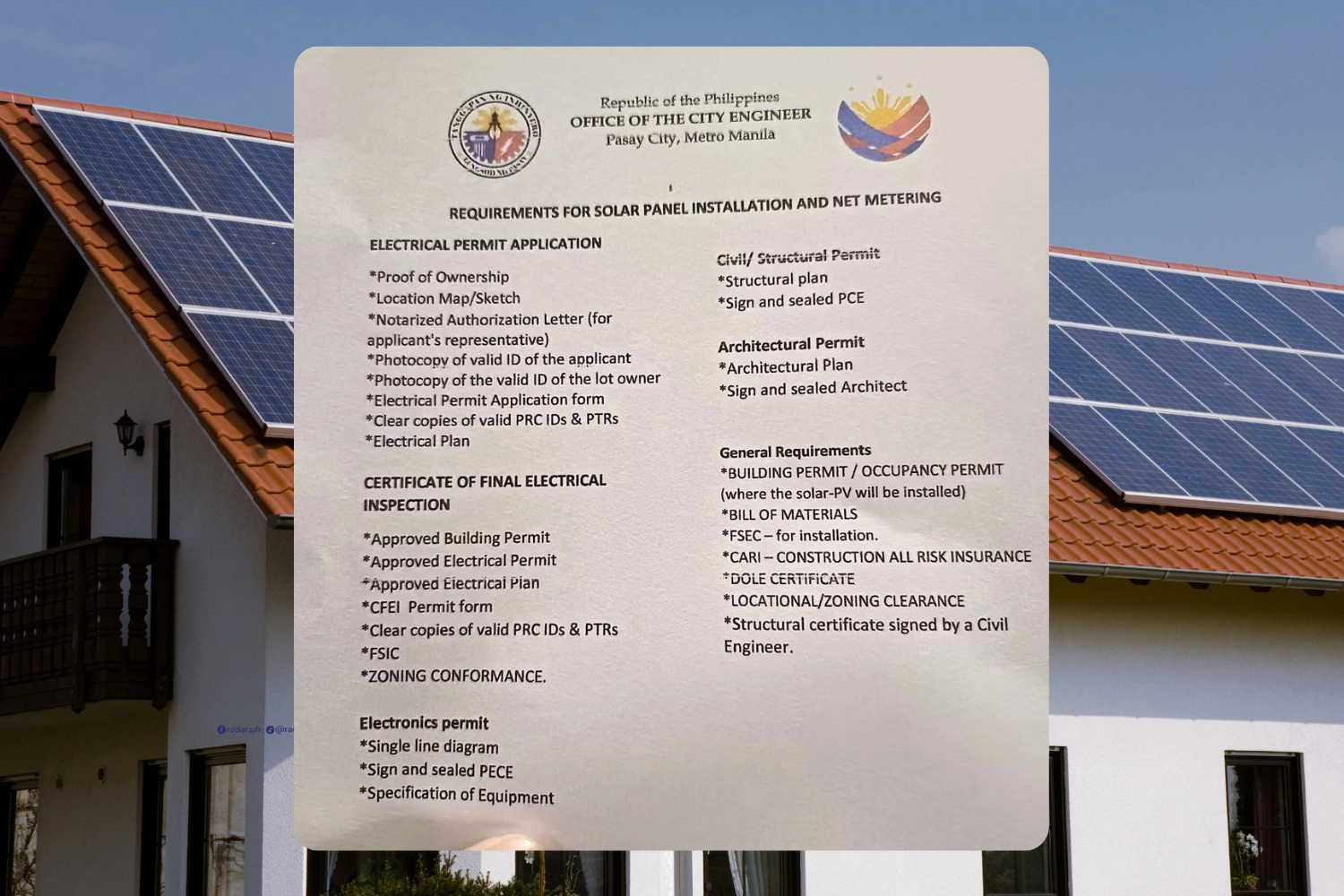
The statement comes amid online criticism of a circulating checklist bearing the name of Pasay City’s Office of the City Engineer, which lists 29 documentary entries covering permits, clearances, engineering plans, and professional certifications for solar installation and net metering.
While the checklist’s current status remains unverified, it has raised questions about whether local government requirements are discouraging households from adopting renewable energy.
ARTA acknowledged that excessive paperwork and approval delays have become serious concerns in the country’s transition to cleaner energy.
Government moves to simplify requirements
According to ARTA, it is working with the Department of Energy, Department of the Interior and Local Government, and other agencies to amend Joint Memorandum Circular No. 001, series of 2026.
The existing circular covers two local government issuances: the Electrical Permit and Certificate of Final Electrical Inspection.
Proposed amendments would expand the streamlined process to cover the entire net-metering application, from initial filing to the issuance of the Net-Metering Certificate of Completion.
Among the proposed reforms are standardized documentary requirements, a model ordinance for local governments, and alternative documentation for homeowners whose old building or occupancy permits are unavailable.
ARTA said the amendments are targeted for finalization before the end of 2026.
Stricter deadlines for approvals
ARTA also cited a March 30, 2026 DOE advisory directing distribution utilities to process net-metering applications within 10 working days, including technical corrections.
Local building officials are likewise directed to issue electrical permits and final electrical inspection certificates within three working days each, subject to deemed approval if left unacted upon.
ARTA encouraged consumers and solar installers to report excessive requirements and unjustified delays through complaints@arta.gov.ph or hotline 1-2782.
The agency’s acknowledgment reinforces a growing concern: while the Philippines wants more households to embrace solar energy, bureaucratic obstacles may be making that transition unnecessarily difficult.