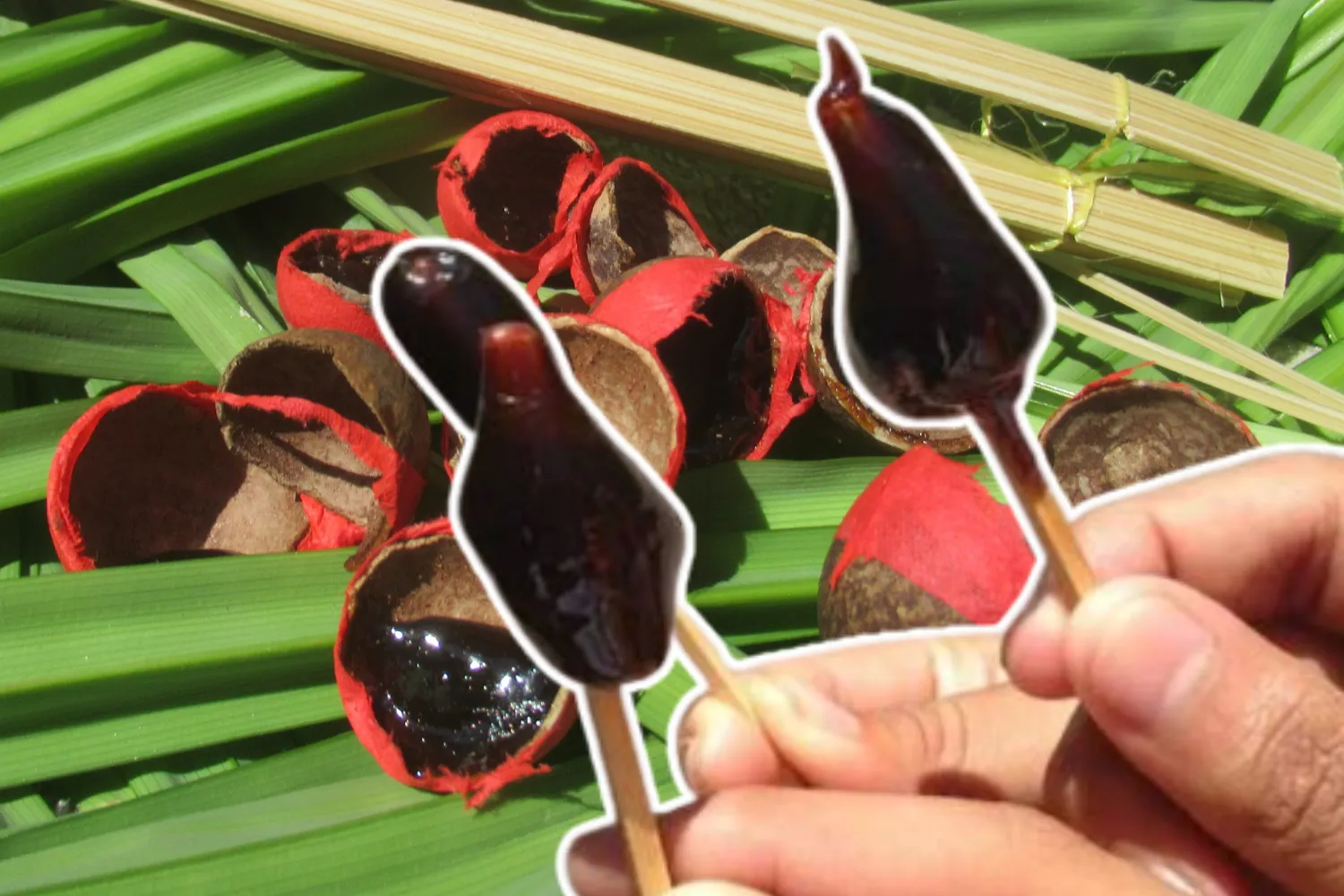
You probably remember buying it during a childhood trip to Baguio. A small bundle of bamboo filled with tiny brown shells, each hiding a sticky, sugary treat. And the best part? You had to pick it out with your finger or a little stick.
That was the irresistible charm of sundot kulangot, one of the Philippines’ most unusual traditional sweets.
Despite its rather unappetizing name, which literally refers to picking a booger, sundot kulangot is actually a miniature version of kalamay, the beloved Filipino sticky rice delicacy.
Made from glutinous rice flour, coconut milk, and brown sugar, the candy has a thick, chewy consistency and a rich caramel-like sweetness.
But what makes it special is its packaging.
The sweet secret inside a seed
Unlike commercially manufactured candies, sundot kulangot is traditionally packed inside the hollowed-out shells of bitaog seeds, also known as Palo Maria.
The seeds are split, cleaned, and dried before being filled with the sticky mixture. Each tiny shell is covered with red paper and arranged inside a split bamboo holder.
To eat it, you peel away the paper and use a finger or small stick to scoop out the candy.
The process is messy, playful, and arguably more entertaining than the candy itself.
Baguio’s famous pasalubong with Pangasinan roots
Although generations of Filipinos associate sundot kulangot with Baguio City, accounts of its traditional production point to Lingayen, Pangasinan.
Local makers reportedly took advantage of the availability of bitaog seeds and coconut-based ingredients to produce the miniature sweets.
The delicacy eventually found a bigger market in Baguio, where tourists eagerly purchased the unusual candy as pasalubong.
Another origin story traces a similar sweet to Bagar in Candon, Ilocos Sur, where local lore credits six elderly women with creating a resourceful version of kalamay after World War II.
However, these competing accounts remain largely rooted in oral tradition rather than extensively documented culinary history.
A name that carries an uncomfortable past
Older Filipinos may remember a longer name that attached the term “Intsik” to sundot kulangot.
The expression reflects a period when ethnic stereotypes and unflattering references to Chinese people were common in Filipino jokes and playground language.
The precise origin of that longer name is unclear, but its association with ethnic ridicule makes it inappropriate today.
The simpler name, sundot kulangot, preserves the candy’s mischievous character without the ethnic reference.
A disappearing piece of childhood?
Today, sundot kulangot is less conspicuous than Baguio’s more commercially popular strawberry jam, peanut brittle, and ube products.
Still, visitors may encounter it in traditional pasalubong stalls around Baguio Public Market, Mines View Park, and other tourist areas.
For those who grew up with it, sundot kulangot represents something that modern, mass-produced sweets cannot easily recreate.
It was never just about the taste. It was about opening those tiny shells, struggling to scoop out every last bit, and discovering that something with such a ridiculous name could taste so good.
And perhaps that is why, decades later, this tiny Filipino candy continues to occupy such a big place in childhood memories.