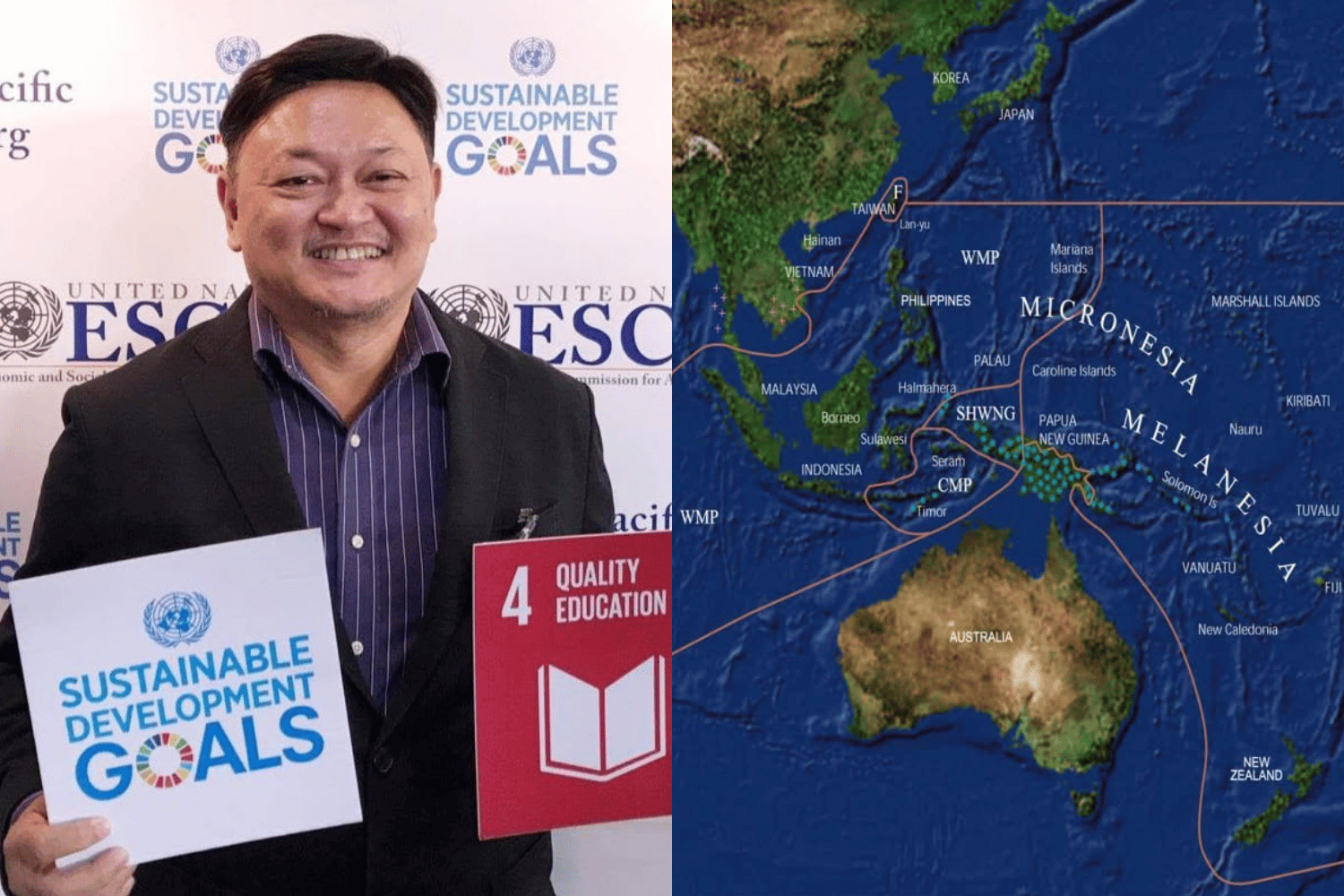
Dr. Nestor Castro says language and culture are being misused to justify China’s narrative over the northern Philippine islands.
A University of the Philippines anthropologist has challenged claims made by a Chinese researcher linking the cultural and linguistic ties between Batanes and Taiwan’s Orchid Island to support China’s narrative over the northern Philippine islands.
In a Facebook post, cultural anthropologist Dr. Nestor T. Castro questioned the credibility of Wang Yuanyuan, identified as a research fellow of the National Institute for South China Sea Studies (NISCSS), over remarks made during an academic symposium in China.
According to Castro, Wang cited “anthropological evidence” that the approximately 10,000 Ivatan residents of Batanes share cognate languages, customs, and underground dwellings with the Tao people of Orchid Island (Lanyu) in Taiwan. Wang also reportedly claimed that Filipino anthropologists confirmed in 2023 that elderly Ivatans still speak the Tao language, presenting this as proof that their ancestors migrated from Taiwan thousands of years ago.
Castro argued that such claims are being used by “agents of the People’s Republic of China” to justify China’s assertion over Batanes.
“Anthropologist ba talaga itong si Wang Yuanyuan?” Castro asked, suggesting that Wang appeared to be acting more as “a political operator of the Chinese Communist Party (CCP)” than an anthropologist.
The UP professor outlined several points disputing Wang’s assertions.
First, Castro explained that both the Ivatan language and the Tao language belong to the Western Malayo-Polynesian branch of the Austronesian language family—a linguistic group that also includes nearly all Philippine languages, as well as languages spoken in Malaysia, parts of Indonesia, Vietnam’s historic Champa region, and even Madagascar.
He stressed that mainland Chinese languages are not Austronesian.
“If we follow China’s logic, then the Philippines has a stronger basis for claiming Lanyu because of our closer linguistic and cultural relationship,” Castro argued.
Second, Castro noted that Austronesian-speaking peoples reached Taiwan around 5,000 to 6,000 years ago and the Philippines roughly 4,200 to 5,000 years ago—long before the modern Chinese state existed.
“Wala pang bansang Tsina 5,000 years ago,” he wrote, arguing that present-day China cannot claim prehistoric Austronesian heritage as justification for territorial claims.
Third, Castro pointed out that the indigenous people of Lanyu identify themselves as the Tao people, not Han Chinese. He added that the word “tao” or “tawo,” meaning “person,” is also widely used in many Philippine languages.
Finally, Castro argued that Taiwan itself has never claimed Batanes and questioned the logic of Beijing extending its territorial claims over the Philippine islands simply because it claims Taiwan as part of its territory.
The post comes amid continuing tensions in the South China Sea and growing concern over historical and anthropological narratives being cited in geopolitical disputes.
Castro’s remarks have drawn attention online as debates continue over how academic research should be used—and not used—in advancing territorial claims.
READ: