Filipinos cite rising costs and high underemployment that contradict the “economic milestone.”
Many Filipinos expressed disbelief over the World Bank classifying the Philippines as an upper-middle-income country, with some saying the milestone does not reflect their lived experience.
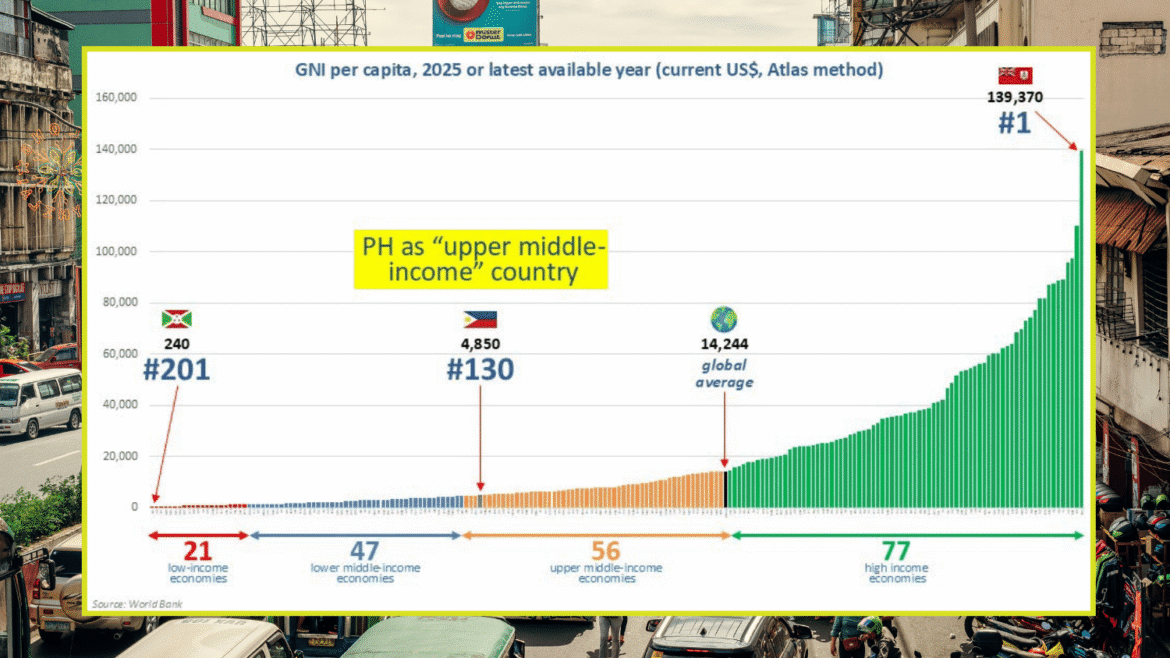
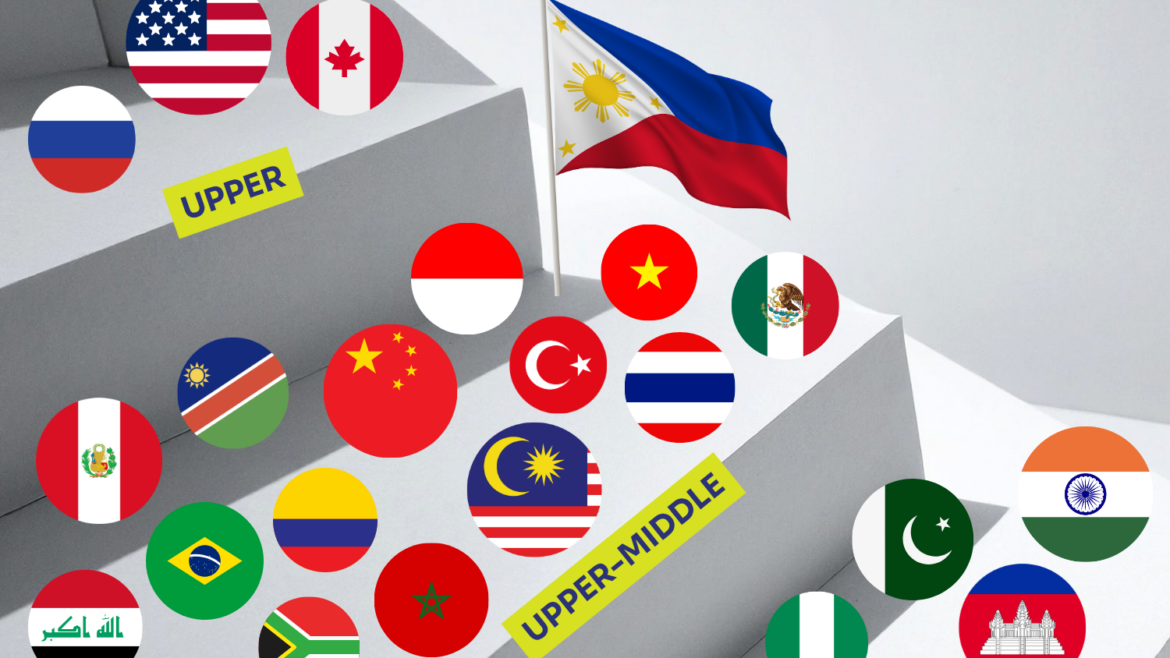
According to the World Bank, the Philippines posted a gross national income per capita of $4,850— exceeding the $4,636 threshold that keeps economies in lower-income classification.
Upper-middle-income economies are those with GNI per capita between $4,636 and $14,375.
While the classification signals macroeconomic growth, it does not fully capture differences in living standards, income distribution, and quality of life across the population.
As major media outlets broke the news, many commenters responded with skepticism over the classification.
“Prank of the year,” a Facebook commenter said.
Another user noted that during their time, fishing was extremely common but is rare nowadays. “Marami na ring naghahanapbuhay sa mga construction site kaysa mangisda,” they said. “Dati, kapag naubos ang bigas, puwede pang palitan ng kamote, pero ngayon pati kamote ay kinakain na rin.”
“Buong araw nagtatrabaho, pero ‘di pa rin sapat para mabuhay,” an X user said.
‘Arbitrary milestone’
JL Poquiz, an applied economist and research associate at the University of Cambridge’s Bennett School of Public Policy, described the milestone as “arbitrary,” pointing to how narrow the gap is between thresholds.
Reacting to a media art card on July 3, Poquiz noted that the Philippines crossed $4,850 against a $4,636 threshold—after missing it by $26 last year.
“A country $26 below the line and $214 above it are essentially the same economy,” he said.
For him, such a “sustained growth” may have “real consequences,” including less access to cheaper loans and fewer trade preferences.
Poquiz also criticized the framing of the art card, as it asks, “Ramdam mo bang upper middle income country ang Pilipinas.” For him, it turns a “statistical reclassification into rage-baiting.”
He said it is the “wrong question” to ask, as people feel prices, wages, and job security—and inflation rate is still high and underemployment is rising.
“So ‘hindi ko ramdam’ is an honest answer. But what nobody can feel is going over a classification threshold based on a national average,” he said. “It’s like asking a student, ‘ramdam mo ba na tumaas ang class average last quarter?’ They can tell you what happened to their own grades, but not the class average.”
Department of Economy, Planning, and Development Sec. Arsenio Balisacan said the classification “confirms the resilience of the Philippine economy,” but acknowledged that “income disparities persist, and many continue to face economic difficulties.”
“Our priority,” Balisacan said, “is to ensure that growth becomes more inclusive and that its benefits reach all Filipinos.”
READ: