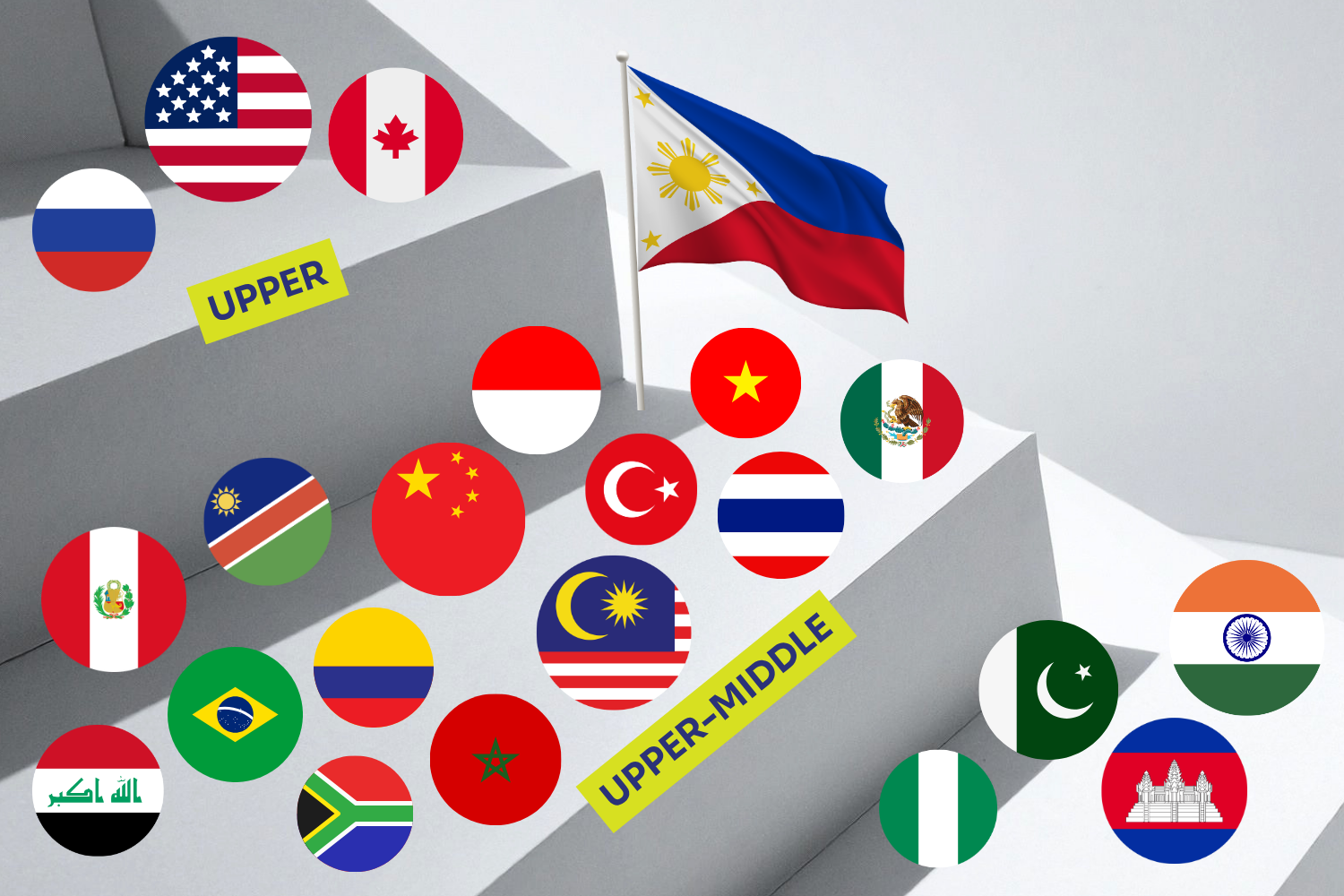
World Bank classification places the country in a broad mix of upper-middle income nations across Asia, Latin America, Africa and Europe.
The Philippines’ elevation to upper-middle income status places it in a much broader and more varied group than it might first appear.
Under the World Bank classification, the country now sits alongside economies across Asia, Latin America, Africa, Europe and the Middle East. This includes Thailand, Malaysia, Indonesia, Vietnam and China in Asia; Mexico, Brazil, Colombia, Peru and Ecuador in Latin America; South Africa, Botswana and Namibia in Africa; Turkey, Serbia and Georgia in Europe; and Jordan, Iraq, Algeria and Morocco in the Middle East and North Africa.
It is a wide mix of economies with very different levels of development, infrastructure and income distribution.
The label is based on one narrow measure, gross national income per capita. It does not account for how income is distributed across society, how affordable basic goods and services are, or how consistent living conditions are for most households.
That is why countries within the same bracket can look very different in practice.
Malaysia is often viewed as being closer to high-income status, supported by higher wages and relatively more developed infrastructure. Thailand has built a strong manufacturing and tourism base over several decades. China remains in this category despite being the world’s second-largest economy, as its national average is shaped by significant income gaps between urban and rural regions. At the same time, countries like Brazil and South Africa continue to face persistent inequality and uneven access to economic opportunity.
The Philippines’ inclusion in this group comes after years of steady economic growth and an increase in national income per person. It also strengthens the country’s position among investors and may improve access to financing that can support future development.
The classification is better understood as a statistical grouping rather than a shared standard of prosperity. Countries in the same bracket can be moving in very different directions, with some steadily improving wages and services while others continue to face structural gaps.
What the classification shows is where the Philippines sits in the global income ladder today. It does not fully capture how evenly that progress is felt across households, regions and income groups.
READ: