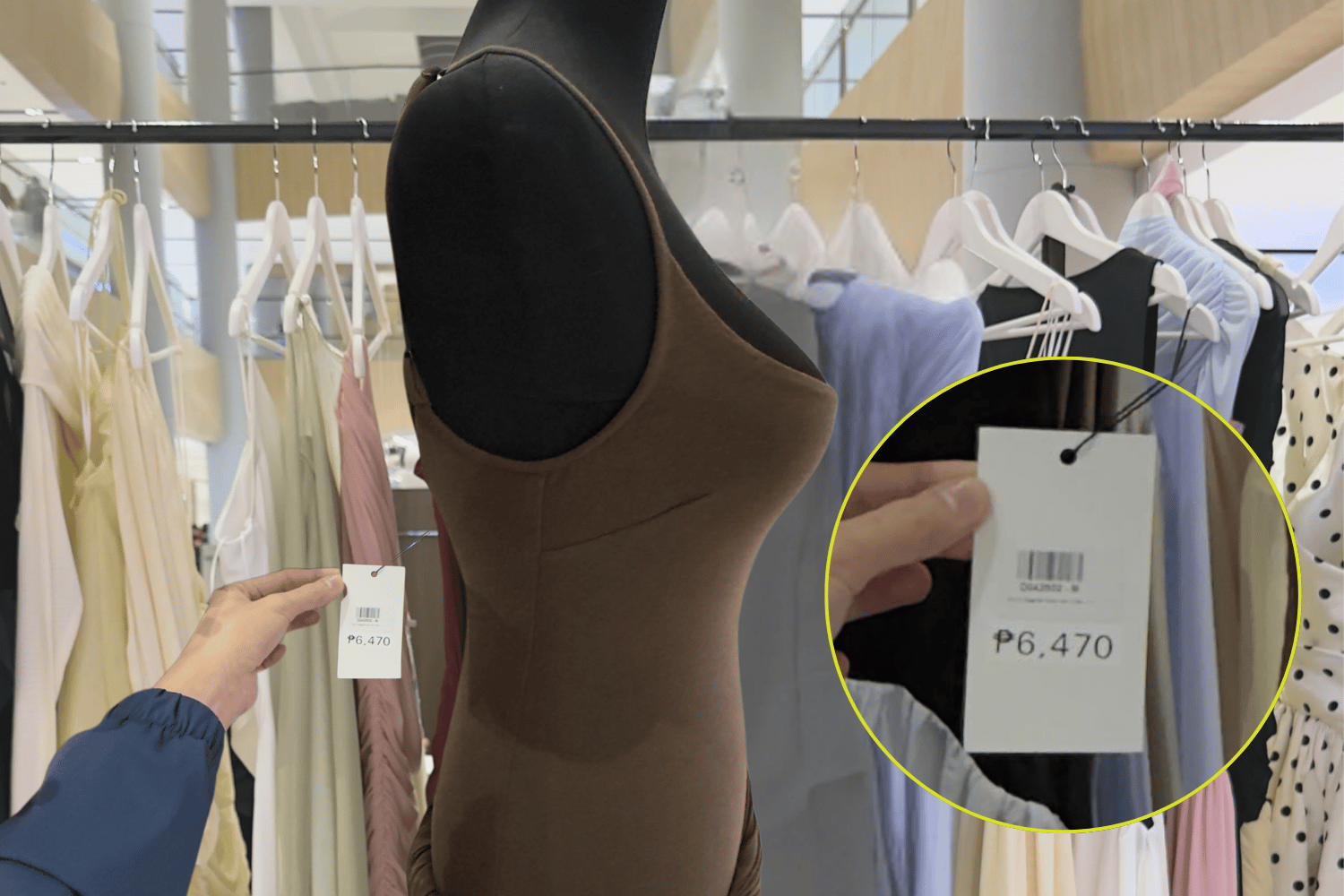
“COCOSIN is in the Philippines now?! I literally got mine in Vietnam for only 1.2m VND… and it’s double the price here?! Whattt,” a Threads user said in a post on Saturday, Sept. 19.
The Ho Chi Minh-based brand offers women’s clothing, from tops and dresses to skirts and gowns. The post came with photos of its stall in a mall, including an item’s price tag showing ₱6,470.
Despite the viral post’s suggestion, COCOSIN is not new to the Philippine market. It had its official local launch in November 2025 through the Manila-based Glocale Collective. The brand has held pop-ups before and currently has a stall at Glorietta 3 in Makati.
Its official website also accepts orders from the Philippines. Based on its built-in currency conversion, a drape top costs around ₱7,400, a spaghetti-strap dress about ₱8,600, an off-shoulder dress around ₱9,700, and a ruched gown roughly ₱10,500.
These prices are exclusive of shipping fees. Standard shipping, which takes 10 to 14 business days, costs ₱1,100, while express shipping of three to five business days via DHL Vietnam costs ₱2,300.
But the Threads user’s complaint raises a bigger question: what exactly accounts for the significant difference in prices?
In the comments, some users pointed to taxes, while others cited the higher operating costs of selling an international brand in the country.
According to the Bureau of Customs, imported goods are generally subject to duties and taxes. Philippine law also imposes a 12% value-added tax on imports based on the amount used to determine customs duties.
Depending on the shipment and applicable rules, customs duties, excise taxes, and other charges can add to the cost of bringing a product into the country.
But taxes are not the only expense an international brand has to account for when selling in the Philippines.
Importers can also pay for freight, insurance, brokerage, processing and other customs-related fees. Once products enter the local market, additional costs can come from warehousing, inventory, marketing and retail operations.
For a brand selling through a Philippine retail space, those costs can be different from the costs involved in selling directly from a store in Vietnam or shipping an individual order to a customer.
A physical store, for example, comes with rent and employee costs that would not necessarily be reflected in the price a customer pays when buying directly from a store in Vietnam. The local distributor or retailer also needs to account for its own margin.
All these costs factor into the final price, making the Philippines-Vietnam comparison more complicated than the “double the price” claim suggests.
READ: