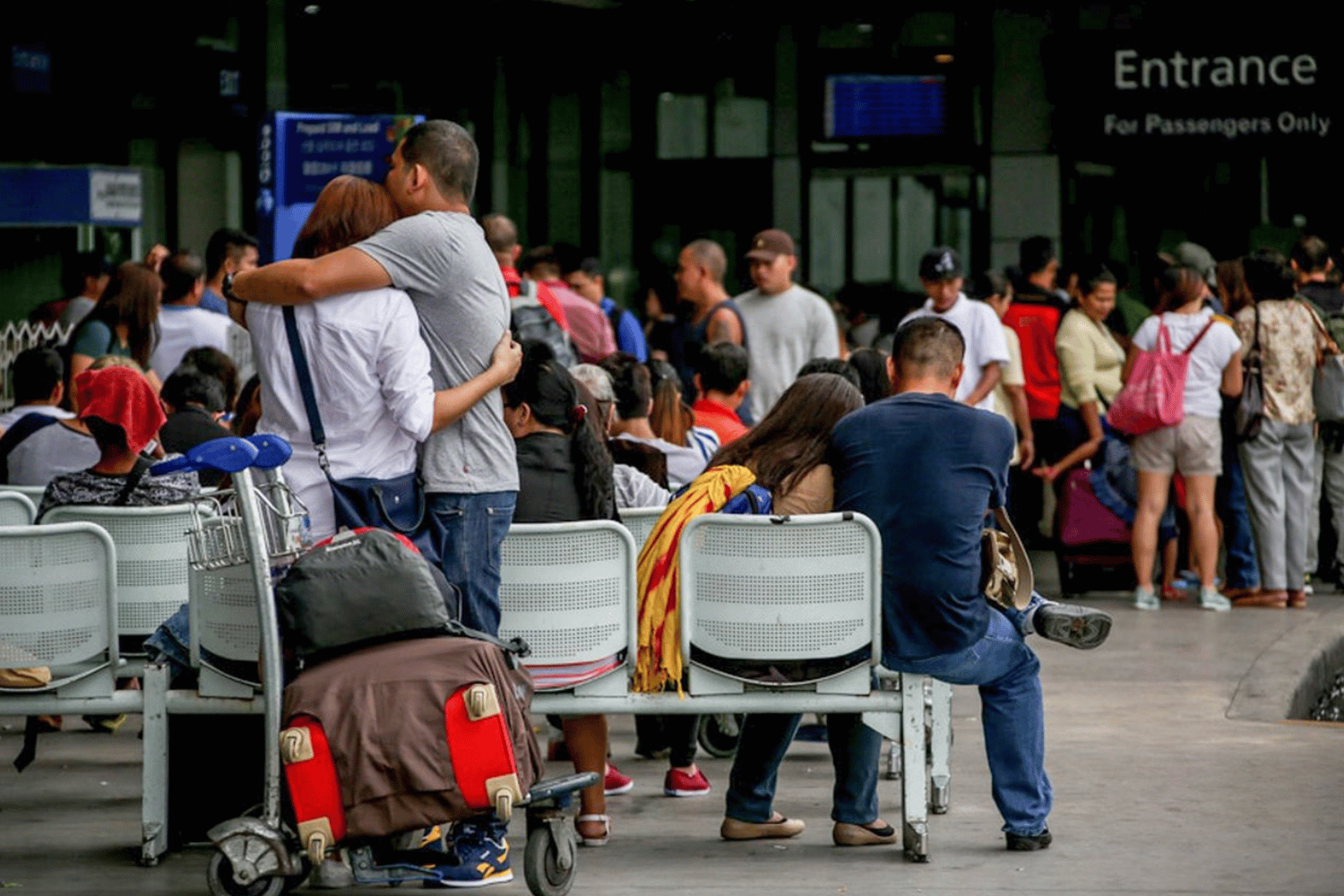
The image of the Filipino migrant as an overseas worker remains deeply embedded in the national imagination
Many Filipinos have imagined the same airport scene. A family hugs goodbye at NAIA. Everyone assumes the person leaving is chasing a better-paying job overseas. It’s a familiar story—but it’s far from the only one.
For millions of Filipinos, the decision to leave the country is shaped by reasons that have little to do with salaries. Some board a plane to reunite with loved ones after years apart. Others pursue degrees unavailable at home. Some are pushed by stronger typhoons, rising seas, or recurring conflict that make staying increasingly difficult. The Filipino diaspora, researchers say, is far more complex than the stereotype of the overseas worker.
Family comes first
Contrary to popular belief, one of the biggest reasons Filipinos permanently migrate isn’t employment—it’s family.
According to the Commission on Filipinos Overseas (CFO), most permanent Filipino emigrants leave through family-sponsored immigration, with around 60% settling in the United States. These are spouses, children, parents, and relatives petitioned by family members who have already established lives abroad.
The 2018 National Migration Survey conducted by the Philippine Statistics Authority (PSA) and the University of the Philippines Population Institute also found that family-related reasons remain a significant driver of migration. Beyond employment, many Filipinos relocate to live with parents, join spouses, or keep families together after marriage or long-term separation.
Researchers from the Migration Policy Institute note that decades of migration have created self-sustaining family networks, allowing migration to continue through successive generations rather than through labor recruitment alone.
Chasing a diploma, not just a paycheck
For many young Filipinos, an airplane ticket is also a ticket to a classroom.
Data from IDP Education Philippines estimates that around 53,000 Filipinos are currently studying overseas, with outbound student numbers growing by around 8% to 10% annually. Australia, Canada, and the United Kingdom remain among the most popular destinations because of their internationally recognized universities and post-study work opportunities.
Academic research has shown that overseas education frequently becomes the first step toward permanent residency, especially for highly skilled professionals pursuing advanced degrees, fellowships, and specialized training.
The goal isn’t always to earn more immediately—sometimes it’s simply to learn more.
When climate forces people to move
For some families, migration begins long before they cross international borders.
The Philippines is among the world’s most climate-vulnerable nations, and repeated disasters often force families to relocate internally before considering opportunities abroad.
UNICEF Philippines reported that the country recorded 9.7 million child displacements caused by typhoons and floods over six years—the highest absolute number recorded anywhere in the world, surpassing both India and China.
The International Organization for Migration and the United Nations have likewise warned that environmental degradation, sea-level rise, stronger storms, and declining rural livelihoods are becoming increasingly important drivers of migration, particularly in vulnerable coastal and agricultural communities.
For many households, leaving isn’t about ambition. It’s about survival.
Searching for safety
Economic opportunity isn’t the only thing people seek overseas. Sometimes, it’s peace of mind.
Studies on the Filipino diaspora note that political instability, armed conflict, and concerns about personal safety have long influenced migration decisions.
Historical research from Ateneo de Manila University traces earlier migration waves to periods of political uncertainty, including the Martial Law era, when some Filipinos sought stability and security abroad.
Meanwhile, the Internal Displacement Monitoring Centre has documented 1.4 million conflict- and violence-related displacements in the Philippines, with 53% occurring in Mindanao and 69% directly triggered by active armed conflict. Although many of these movements begin within the country, prolonged displacement often encourages families to explore permanent migration through relatives already living overseas.
More than an economic story
Scholars increasingly describe the Filipino diaspora as a web of relationships rather than simply a labor force scattered around the world.
Studies published by the Philippine Social Science Council argue that migration is sustained by “transnational agency”—family ties, community networks, and cultural connections that make moving abroad easier with each succeeding generation. Once relatives establish roots overseas, migration often becomes less about escaping poverty and more about joining loved ones, pursuing education, finding safety, or building a different future.
The image of the Filipino migrant as an overseas worker remains deeply embedded in the national imagination—and for good reason. Millions continue to leave primarily for employment.
But behind many boarding passes are stories that don’t begin with a job offer. They begin with a wedding, a university acceptance letter, a petition approved after years of waiting, a flooded hometown, or simply the hope of being together with family again.
Sometimes, the biggest reason Filipinos leave isn’t work.
It’s life.
READ:
Worry-free entry to UAE for multi-visa Filipino travelers
radar Lifestyle
June 26, 2026

EXPLAINER: Can your employer fire you just because you have two jobs?
Top Dagohoy
July 16, 2026

Falling English proficiency shuts doors to overseas jobs
John Lloyd Aleta
May 15, 2026