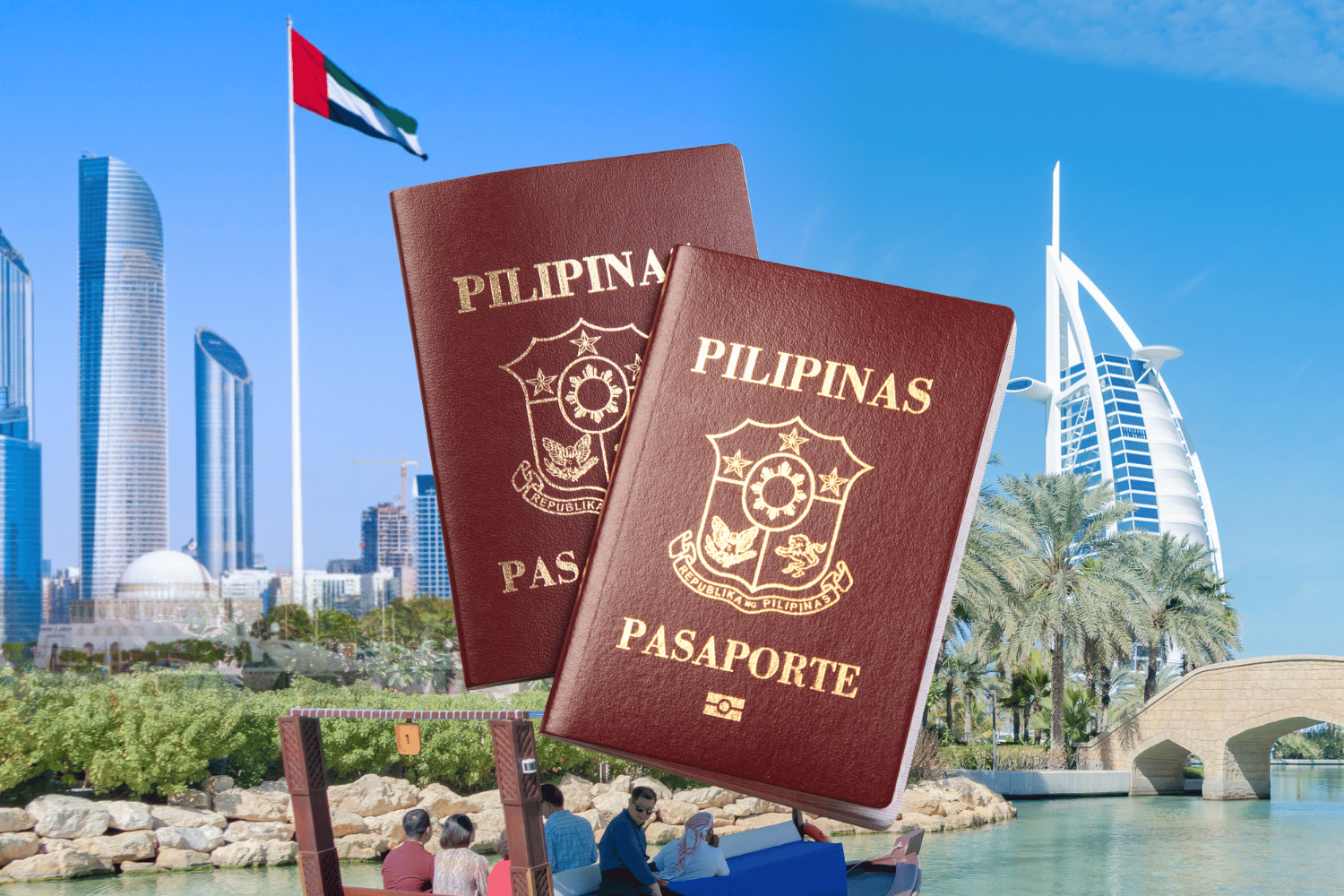
The new policy offers affordable short and long-stay options directly at UAE immigration counters.
In an official announcement by the Department of Foreign Affairs (DFA), the United Arab Emirates (UAE) officially activated a brand-new visa-on-arrival privilege for eligible Filipino international travelers.
Citing decades of “excellent bilateral relations” and expanding economic diplomacy, the UAE’s Ministry of Foreign Affairs expanded this framework to eliminate traditional visa friction, allowing qualified travelers to fly straight to Dubai or Abu Dhabi and settle entry fees directly at immigration border control.
Who is eligible?
This privilege is a massive win for middle-class global Filipinos, but it does not apply to every Philippine passport holder automatically. To bypass a pre-arranged tourist visa, a traveler must hold a valid Philippine passport and possess one of the following valid standard visas, residence permits, or green cards from these eight countries: USA, EU member states, Australia, Japan, Singapore, South Korea, Canada, and New Zealand.
Pricing and stay structure
Filipino travelers arriving at a UAE airport terminal are eligible to avail of two different stay packages by showing their passports and qualifying foreign visas at the immigration counter. The Short Stay option allows a maximum stay of 14 days for an entry fee of AED 100 (₱1,600) and can be extended once for another 14 days for AED 250 (₱4,000). If you wish to stay longer, you can choose the Long Stay package, which is valid for a maximum of 60 days for an entry fee of AED 250 (₱4,000). However, this option has a hard cap and is absolutely non-extendable.
Changing policy for pinoy mobility
The Philippine passport for years has been structurally limited, with extensive documentation, bank certificates, and agency fees needed for almost any major destination outside of ASEAN.
The UAE is slicing through red tape with conditional visa-on-arrival frameworks for a highly lucrative demographic—the mobile, multi-visa-holding Filipino professional. The logic is simple: if a traveler has already undergone the rigorous security and financial vetting needed to obtain a US Green Card, a Schengen Visa, or a Japanese multiple-entry visa, they are statistically confirmed as low-risk, high-value tourists.
READ: