Dayrit’s significance was about ordinary families returning again and again.
If you were a kid growing up in Manila in the 1980s, you might remember the excitement that came with hearing one simple plan: Kakain tayo sa Dayrit’s.
You piled into the family car with your parents and siblings, drove to Taft, and arrived already knowing what you wanted. There would be burgers, roast beef, potatoes, perhaps chorizo—and the familiar sight of everyone gathered around the same table.
Years later, you may forget what you ordered. But you remember who sat beside you, what your parents looked like when they were younger, the teasing among siblings, and that wonderful feeling that the weekend had properly begun.
For many families, Dayrit’s Burger & Roast Beef House became woven into those memories.
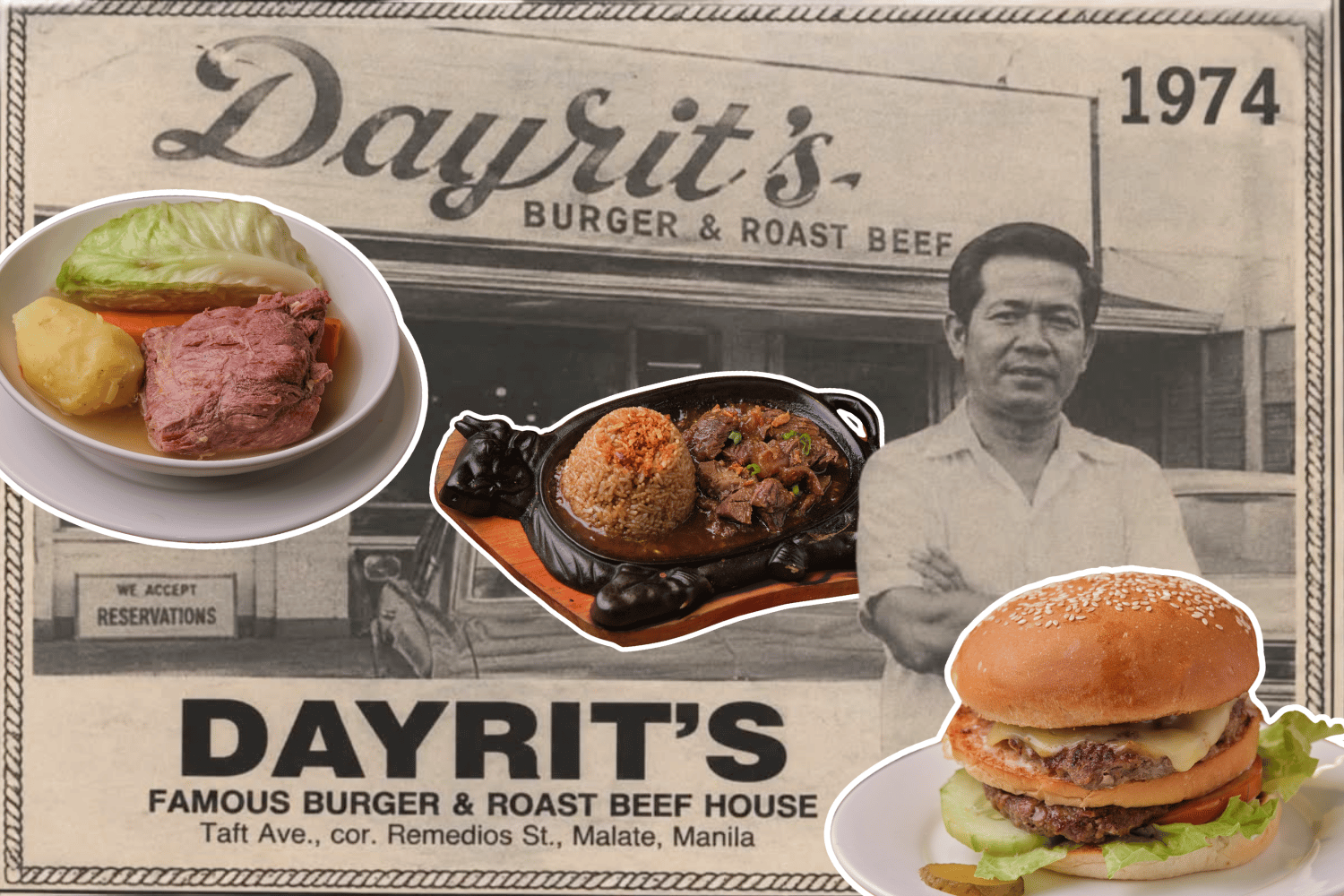
The restaurant opened in 1974, founded by Wilfredo “Freddie” Dayrit Sr., a Kapampangan businessman whose unexpected change in fortune eventually gave Manila one of its beloved old dining institutions.
Threads user Jojie Claudio recently revisited its story, triggering memories of a restaurant that once seemed to belong naturally to the Manila landscape.
“There was a time when Dayrit’s was simply part of the everyday Manila landscape—a familiar name you encountered on a drive through Taft Avenue, long before malls, food courts, and international fast-food chains transformed the city’s dining scene,” Claudio wrote.
Dayrit had previously owned a casino. When that business closed following the declaration of Martial Law, he turned his attention to food.
“When the casino business was closed after Martial Law was declared in 1972, Freddie turned to food,” Claudio wrote. “He began making tapa and chorizo for friends and neighbors, and what started as a modest food venture eventually became Dayrit’s Burger and Roast Beef House.”
Those beginnings help explain why Dayrit’s always felt less like a restaurant built around trends and more like somebody’s family kitchen that simply grew bigger.
Its early offerings reflected that spirit.
“The early menu was broader than people remember: burgers, corned beef, chorizos and hotdogs were among its specialties,” Claudio wrote.
Eventually, certain dishes became inseparable from the Dayrit’s name: its roast beef, Salisbury steaks, homemade meats and, of course, the Big “D” Burger.
Even former President Benigno “Noynoy” Aquino III reportedly carried his own Dayrit’s memories.
“And perhaps the strongest proof of its cultural staying power: Noynoy Aquino was reported to have been a loyal customer, with the Big ‘D’ Burger said to be his favorite since his congressional days,” Claudio wrote.
But Dayrit’s significance was never really about famous customers.
It was about ordinary families returning again and again.
Birthdays. Sunday lunches. Meals after church. A father ordering for everybody. A mother cutting a child’s burger in half. Siblings fighting over a bite and laughing about it minutes later. Children eventually growing up, starting families of their own, and discovering that the name Dayrit’s could instantly transport them back to a particular table with people they loved.
The old Dayrit’s Burger & Roast Beef House in Magallanes remains open.
“And the old Dayrit’s Burger & Roast Beef House in Magallanes is still operating, which makes it one of those rare survivors of Manila’s old restaurant culture,” Claudio wrote.
Perhaps that is why seeing the Dayrit’s name can hit differently when you have known it since childhood.
A restaurant can feed you for an afternoon. But stay around long enough, and it can become something else entirely: a marker of family history.
For some Manila families, Dayrit’s is exactly that—a place where they can still remember themselves together, young and hungry, around one table.
READ:
Is this the start of a new standard in fast food sustainability?
radar Business
April 27, 2026
What if Cindy’s had beaten Jollibee?
radar Business
June 26, 2026
FLASHBACK: Before food delivery apps, there was the ‘potpot’ bicycle bread vendors
Top Dagohoy
July 20, 2026