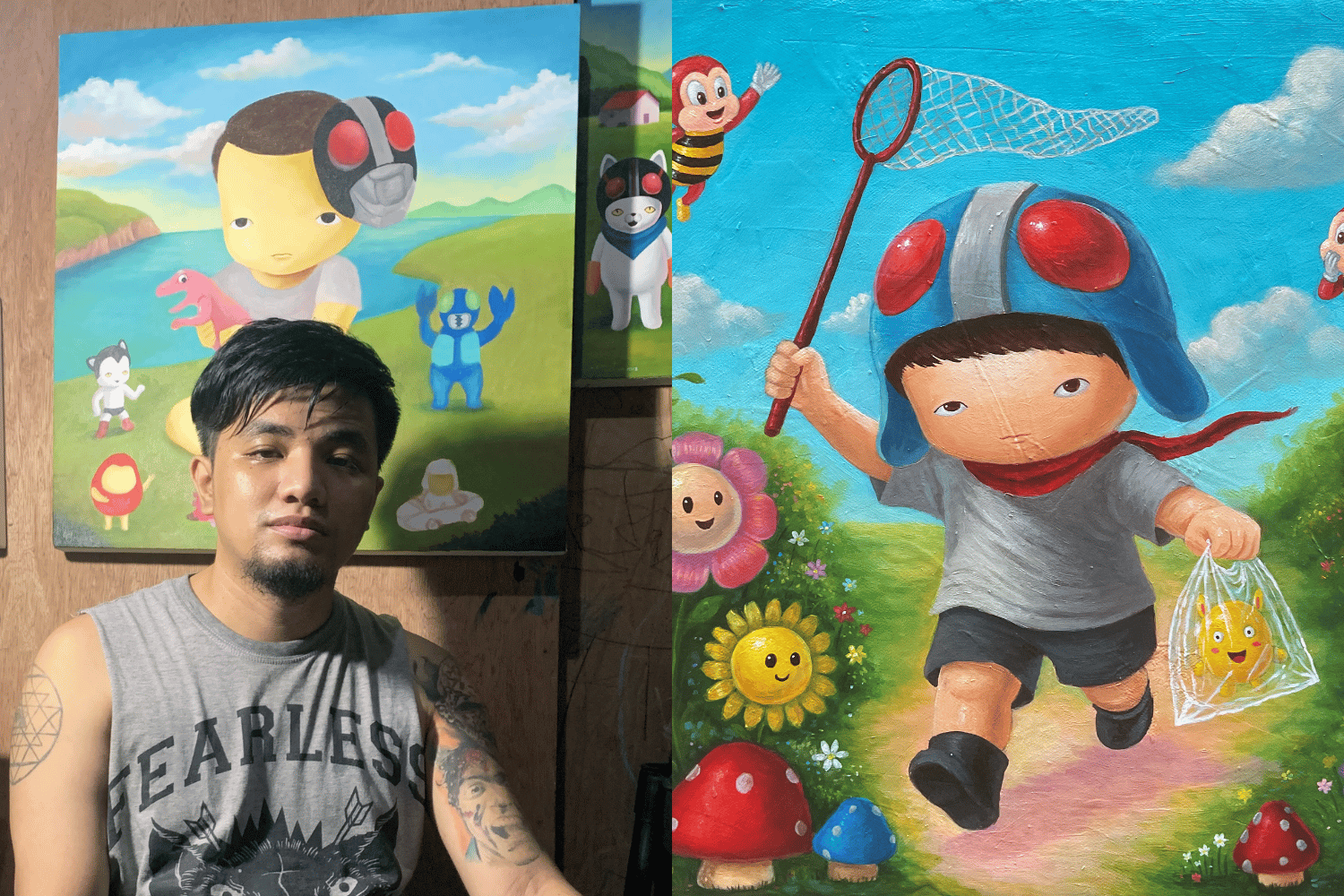
‘Homeworld’ traces down Ortega’s visual and emotional journey through childhood memories, folklore, pop culture, and persistent obsessions.
What if all the characters, monsters, toys and memories you grew up with could live together in one universe?
For Filipino visual artist Gemart Ortega, that universe already exists—and he has spent years quietly building it.
Ortega brings his deeply personal imagined world to “Homeworld,” his solo exhibition opening September 5, 4 p.m. onwards, at Space Encounters Gallery XL.
The Quezon City-based artist gathers influences that might seem unlikely companions: Filipino folklore, Japanese pop culture, animation, childhood toys, superheroes and creatures pulled from memory and imagination.
Yet inside Ortega’s paintings, they belong together.
At the center of “Homeworld” is Trameg, Ortega’s recurring childlike character and artistic alter ego. Recognizable by his oversized helmet, red scarf and almost permanently calm expression, Trameg wanders through strange worlds as though nothing about them is particularly unusual.
He hunts smiling bees across an impossibly cheerful landscape. He eats ramen surrounded by familiar Japanese monsters. Elsewhere, he simply stands beneath an enormous blue sky.
Monsters, superheroes and bizarre creatures are not intruders in Trameg’s world. They are neighbors.
That casual collision between the fantastic and the ordinary gives Ortega’s work much of its charm—and occasionally its uneasiness.
Born in 1990, Ortega studied Fine Arts at the University of the Philippines Diliman. His practice spans painting and drawing, with works exploring memory, identity, vulnerability and human emotion.
His art has also traveled far beyond the Philippines, with exhibitions in Taiwan, Hong Kong, Thailand, France and the United Kingdom.
“Homeworld,” however, feels decidedly inward-looking.
Swipe or click arrows to see photos