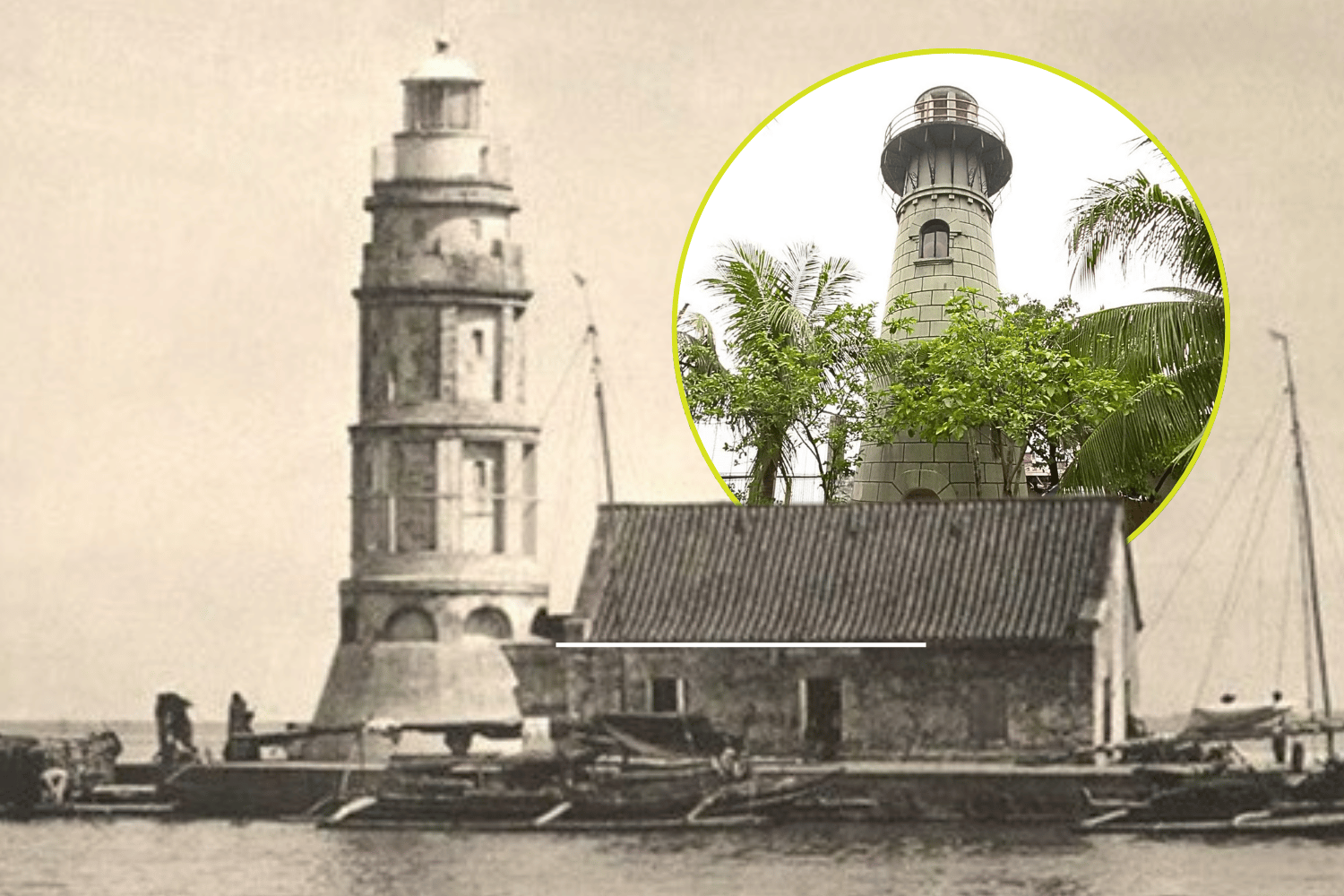
The lighthouse stayed where it had always been, but the mouth of the river moved farther away.
For more than three centuries, a light at the mouth of the Pasig River welcomed ships into Manila.
It survived earthquakes. It witnessed the rise and decline of the galleon trade. It stood through changes in colonial rule and even survived the devastation of World War II.
But the historic Parola ng Ilog Pasig did not survive modern Manila.
In 1992, the old lighthouse was demolished and replaced by a simpler concrete structure. The light remains, but one of Manila’s oldest and most recognizable waterfront landmarks is gone.
Manila’s first light
The story goes back to 1642, making the site of the Parola ng Ilog Pasig—also known as Parola ng Binondo and Faro y Luces del Río Pasig—the oldest known light station in the Philippines.
According to the historical marker of the National Historical Commission of the Philippines (NHCP), the first signal light was established at the mouth of the Pasig during the administration of Governor-General Sebastián Hurtado de Corcuera. It carried a “pirmihang pulang ilaw na panghudyat,” or fixed red signal light.
Its location was crucial.
Before Manila Bay was lined with the massive port facilities and reclaimed land we know today, the Pasig River was one of the principal gateways into the capital. Ships crossed Manila Bay and entered the river to reach the busy wharves of Binondo and Intramuros.
The Parola stood at that entrance—a beacon telling mariners that Manila was ahead.
The beautiful Farola
The light station was rebuilt in circular form and equipped with an Argand lamp in 1843, according to the NHCP.
Three years later came the lighthouse remembered in old photographs.
The Spanish colonial government erected a masonry tower that was first lit on September 1, 1846. The cylindrical stone lighthouse stood about 49 feet or 15 meters high, rising five levels to its lantern. Its original fixed white light could reportedly be seen from about 10 miles away.
The lighthouse became so prominent that historical descriptions called the Farola “one of the most conspicuous landmarks in the harbor of Manila.”
For generations arriving by sea, it was effectively Manila’s welcome sign.
A light that refused to fall
The Parola proved remarkably resilient.
The NHCP records that it survived the powerful earthquakes of 1852 and 1863. Technology changed around it: a sixth-order Fresnel lens was installed in 1866, and catadioptric lenses followed when the cupola was repaired in 1868. By the latter part of the 19th century, the lighthouse was displaying a flashing white light.
Its appearance changed, too. Historical records describe the tower as originally white before it was painted yellow by the 1870s.
Through all those changes, the Parola remained at its post.
Even the destruction of Manila during World War II did not erase it.
That makes what happened decades later even more painful from a heritage perspective.
The sea moved away from the Parola
Or, more accurately, Manila moved toward the sea.
The development and expansion of the modern Port of Manila, together with successive reclamation projects, pushed the shoreline farther into Manila Bay.
The lighthouse stayed where it had always been, but the mouth of the river moved farther away.
Today, the historic lighthouse site is approximately 1.5 kilometers upriver from the present mouth of the Pasig River. Port development and reclaimed land eventually obscured the lighthouse from the broad expanse of Manila Bay.
A beacon originally built on the edge of the bay gradually found itself surrounded by a completely different Manila.
Then Manila lost the old Parola
In 1992, the Spanish-era lighthouse disappeared.
The historic tower was demolished and replaced with a new reinforced-concrete lighthouse built on the foundation of its predecessor. Lighthouse historian Russ Rowlett’s Lighthouse Directory describes the replacement bluntly as “much inferior architecturally to its predecessor.”
The loss becomes more striking when viewed against the lighthouse’s history.
A structure that had survived major 19th-century earthquakes and endured Manila’s turbulent transformation was no longer there.
What survived was the place and its purpose—not its architecture.
The Parola is still there—but it isn’t
Today, there is still a lighthouse at the historic site.
But anyone searching for the elegant tower seen in photographs from the Spanish and American periods will not find it.
The modern lighthouse is a simple concrete structure. The Philippine Coast Guard occupies the station beside it, while the surrounding community carries perhaps the strongest surviving reminder of the old landmark: Parola.
The NHCP itself recognizes the site’s historical importance. A historical marker for the Parola ng Binondo was installed in 2002, recording a history stretching from its first signal light in 1642 through its technological upgrades and later rehabilitation by the Philippine Coast Guard.
And that leaves Manila with an unusual kind of heritage site.
The light survived, but the lighthouse did not.
The Parola ng Ilog Pasig once marked the physical boundary between Manila and the sea. Sailors looked for it as they approached the city; generations knew its silhouette on the waterfront.
Today, the shoreline has moved, the harbor has changed, and the graceful old tower exists only in photographs and historical records.
Manila still has its Parola.
But the Parola that once welcomed the city home has been lost.
READ:
FLASHBACK: What happened to Nayong Pilipino?
Top Dagohoy
August 2, 2026
FLASHBACK: What happened to the National Planetarium in Luneta?
Top Dagohoy
August 4, 2026
FLASHBACK: Hoskyn’s in Iloilo was the Philippines’ first department store
Top Dagohoy
August 7, 2026