One of the earliest surviving Renaissance depictions of the Philippines was created by an artist who had never even set foot in the archipelago.
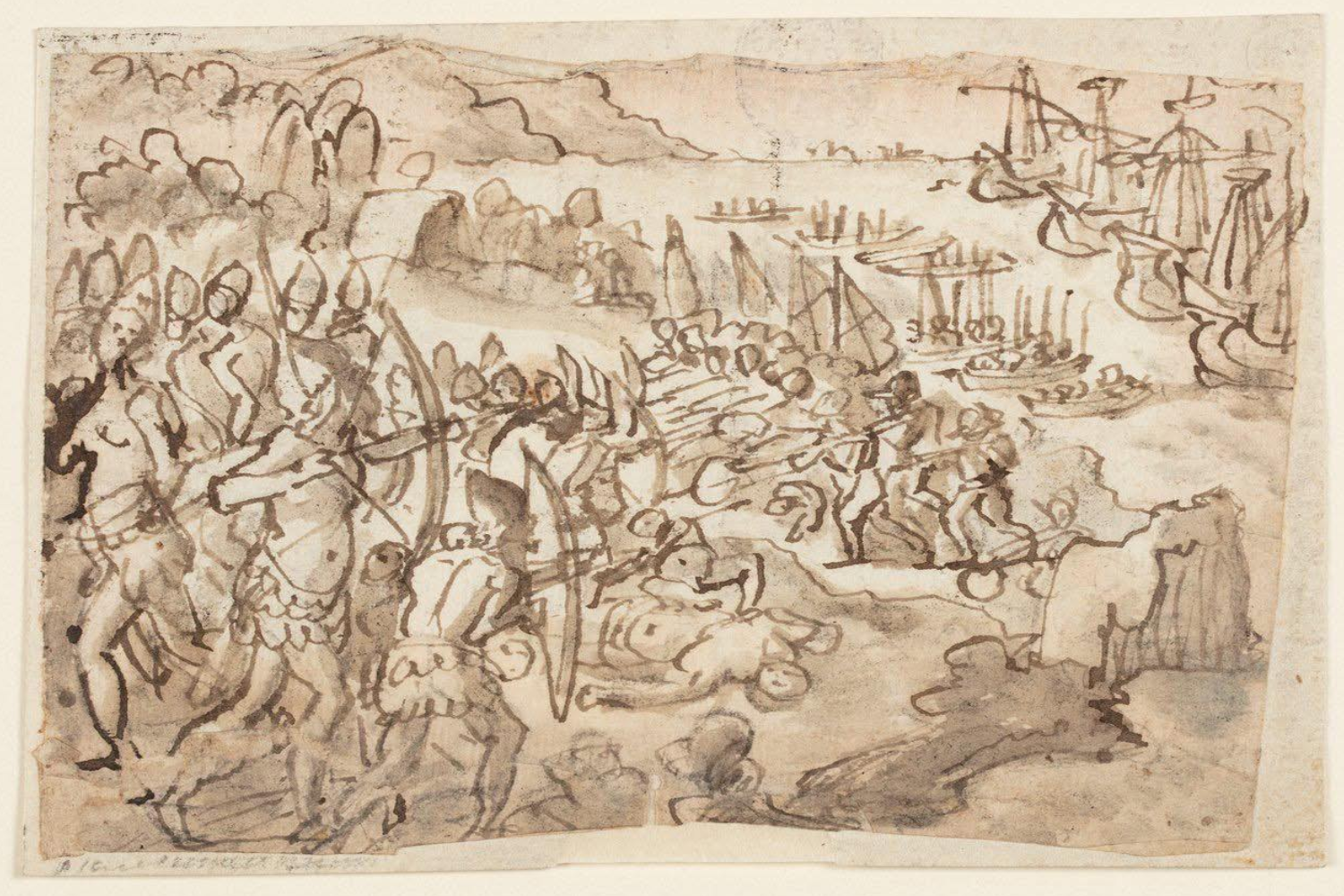
Filipino art historian Geronimo Cristobal, a PhD candidate in history of art at Cornell University, recently highlighted “Conquest of the Philippine Islands” by Flemish Renaissance artist Jan van der Straet, better known by his Latinized name Johannes Stradanus or Italian name Giovanni Stradano.
Created during the 1590s, the pen-and-ink drawing with gray wash is preserved at the Cooper Hewitt Museum in New York City.
In a blog post on June 17, Cristobal explained that the surviving work is a preparatory drawing (modello) for a monochrome (grisaille) painting executed by Stradanus’ son, Scipione Stradano, for the funeral ceremonies of Spain’s King Philip II in Florence on Nov. 12, 1598.
The original painting was part of a temporary decorative program commemorating Philip II, but Cristobal said it appears to have been dismantled after the ceremonies. The modello remains the principal surviving record of the composition.
The artwork depicts Spanish troops landing from ships battling with Indigenous defenders along the coast. Five vessels are moored in the bay, while smaller boats ferry more troops ashore.
“The prominence of ships and coastal geography presents the conquest as a maritime enterprise,” Cristobal said.
Cristobal noted that the drawing is part of the Medici court’s commemorative culture rather than serve as a visual record of the event itself. He said contemporary scholarship has connected the work to a Florentine intellectual milieu shaped by travel literature, printed histories, and discussions of overseas expansion within the Accademia degli Alterati (Academy of the Altered) and the Medici court.
“The Philippines appears here as a distant possession of the Spanish monarchy incorporated into a global narrative of exploration and conquest,” he said. “The islanders, rendered according to conventions used by Stradanus in other images of non-European peoples, reflect contemporary European conceptions of overseas societies more than direct observation of the archipelago.”
More than 400 years later, the surviving drawing tells two stories at once: one, about the birth of Spanish colonial rule in the Philippines, and another, about how Europe imagined—and presented—the distant archipelago to the rest of the world.
READ: