Her work challenged governments, patriarchy, colonialism and comfortable versions of Philippine history.
There is something increasingly difficult to explain about Lualhati Bautista not being a National Artist.
Not because she was simply famous. Not because she accumulated awards. But because Bautista achieved something remarkably difficult for a serious Filipino writer: she wrote about the country’s biggest political and social questions in a language ordinary people actually read.
Born in Tondo in 1945, Bautista began writing as a teenager and eventually became one of the most recognizable names in Filipino literature. She won major prizes, including multiple Palanca Awards, wrote novels and screenplays, and saw her work cross from books into classrooms and popular cinema.
But her strongest credential may simply be the books themselves.
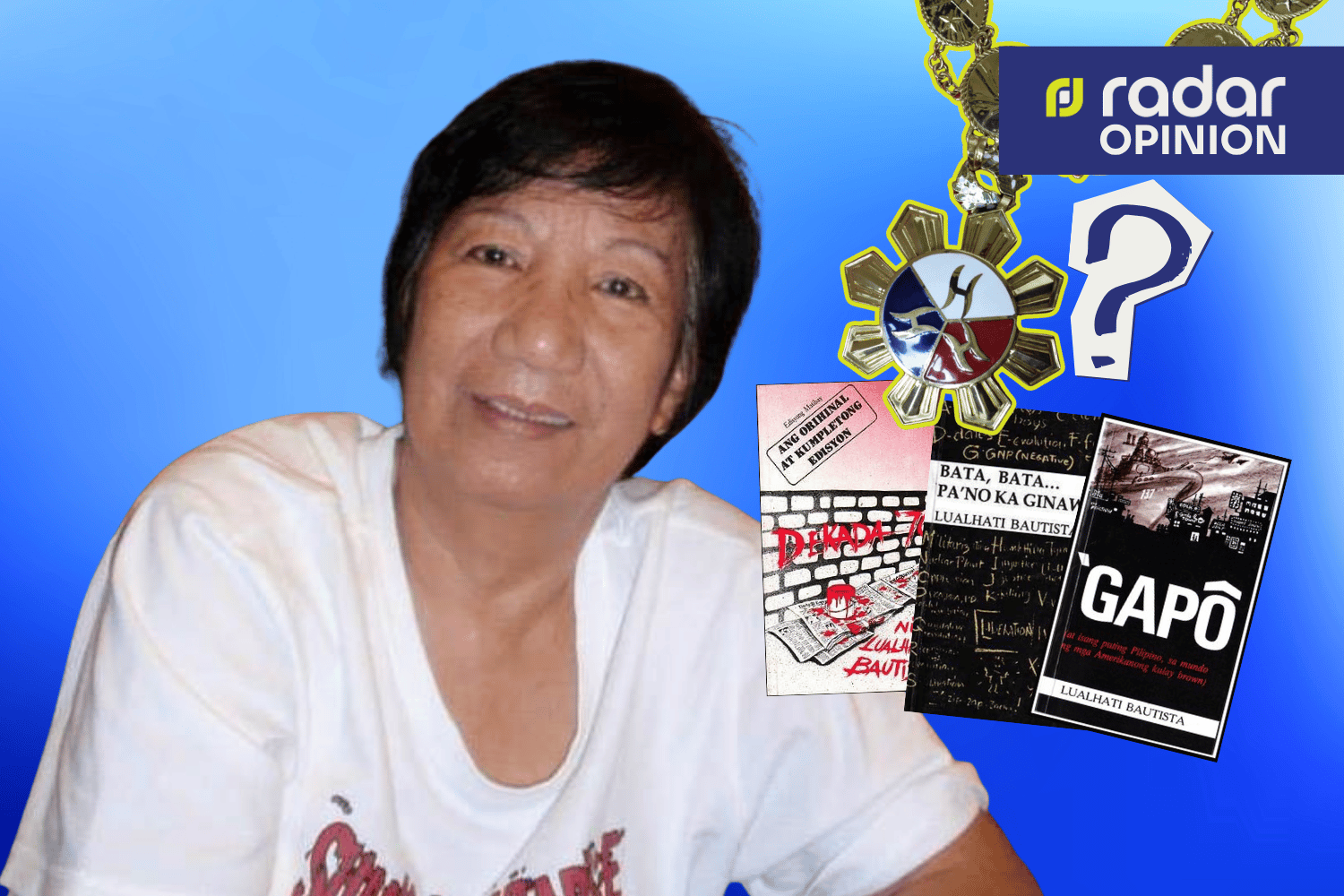
“‘GAPÔ” tackled American military presence, colonialism and inequality. “Dekada ‘70” brought Martial Law into the home, showing dictatorship not as an abstract chapter in a history book but as something that entered marriages, families and the lives of children. “Bata, Bata… Pa’no Ka Ginawa?” placed a complicated, independent woman at the center of a story about motherhood, sexuality and patriarchy. “Desaparesidos” returned to the violence of political repression and the people who disappeared under it.
These were political books, but Bautista did not write like someone delivering a lecture.
She wrote in Filipino—direct, conversational, sometimes funny, sometimes angry, often painfully familiar. Her characters sounded like people Filipinos knew. Her concerns were enormous, but her language was accessible.
That accessibility should not be mistaken for simplicity.
It was precisely Bautista’s gift.
She could make a reader think about dictatorship through a mother worrying about her sons. She could discuss patriarchy through arguments inside a household. She could take subjects usually confined to classrooms, rallies and academic papers and turn them into stories people wanted to finish.
That is why her readership matters to the National Artist question.
Bautista was not merely admired by fellow writers. She was read by generations of students, discussed in classrooms, adapted into films and rediscovered whenever the country found itself debating Martial Law, women’s rights, political repression or historical memory.
Few writers remain that relevant decades after their major works first appeared.
And few Filipino-language writers have managed to occupy both literary and popular culture so completely.
There is no evidence that Bautista was deliberately denied the honor because of her politics, and it would be irresponsible to claim otherwise. But her continued absence inevitably invites questions. She was outspoken. Her politics were unmistakable. Her work challenged governments, patriarchy, colonialism and comfortable versions of Philippine history.
Perhaps that made her inconvenient.
But inconvenience is a strange reason to hesitate over a National Artist. Artists are not supposed to make nations comfortable. The best of them often force nations to look at themselves.
Lualhati Bautista did exactly that.
Her social impact is no longer something that needs to be predicted. It already happened. Her novels entered the curriculum. Her characters entered popular culture. Her stories reached the screen. Her Filipino prose reached readers who might never have considered themselves literary readers at all.
And more than four decades after “Dekada ’70,” Filipinos are still arguing about the very things she wrote about.
That may be the strongest argument for her recognition.
Lualhati Bautista did not simply produce important literature.
She helped Filipinos understand their country in their own language.
Every National Artist list without her makes that omission harder to defend.
READ: