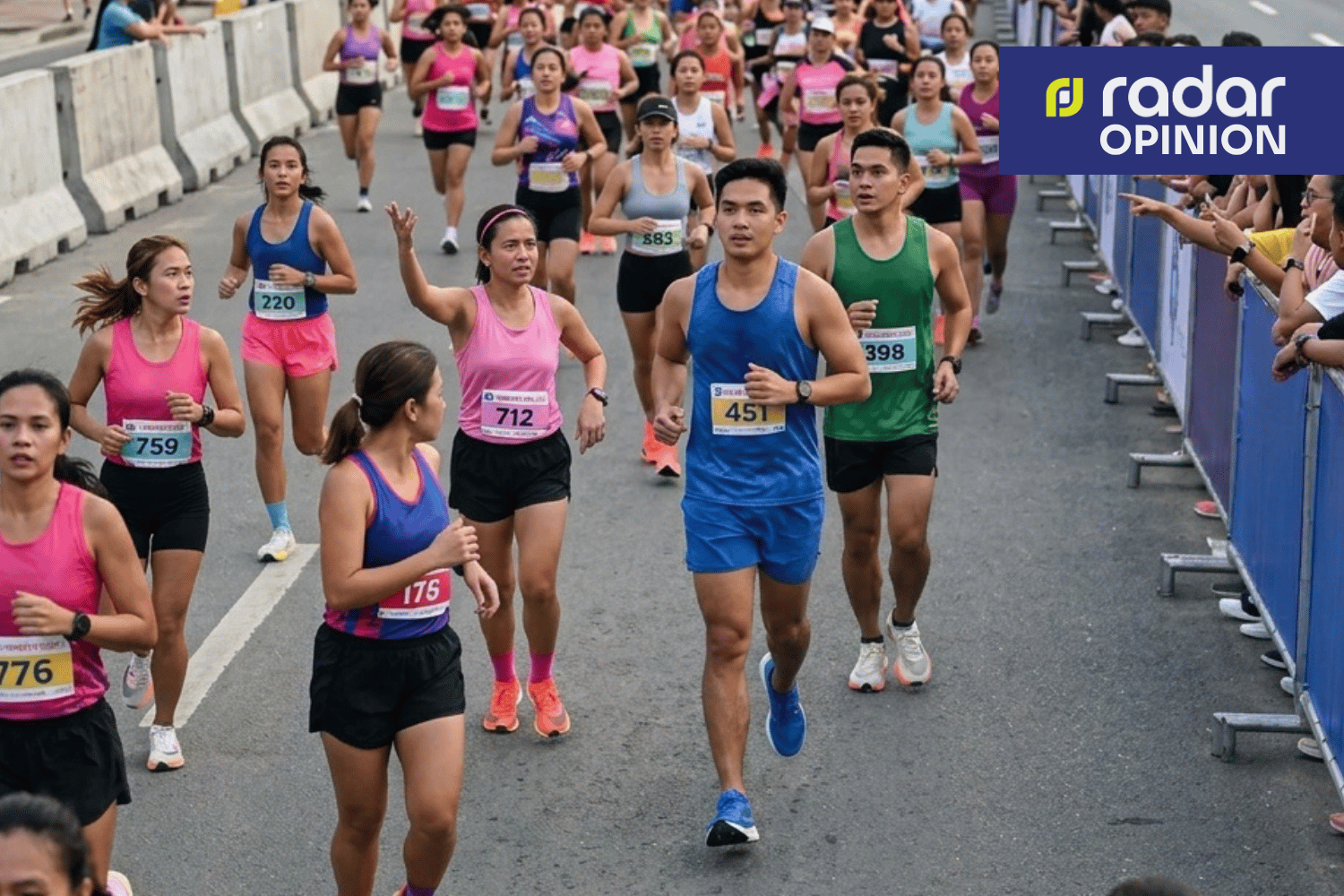
Sometimes, support means staying out of women-only events.
Men were spotted participating in running events widely understood to be women-only and were rightfully clowned for it. But their presence begs the question: why DO men even enter these events, and is there a better way to protect safe spaces for women?
Women’s Run PH hosted the Luzon leg of its nationwide run series, sponsored by feminine wash brand Lactacyd, in Makati City on October 25. Like other editions of the series, which is organized by RunRio, the event was women-only.
Many participants criticized the run for accepting men into the roster despite guidelines that supposedly restricted participation to women.
“Sobrang disappointing na ANG DAMING LALAKE KANINA. WOMEN’S RUN NGA EH. Karamihan pa dito mga lalakeng sinasamahan yung mga jowa nila. Hindi kayo nahihiya?” said Threads user Jehanne Geli.
The backlash against the Lactacyd Women’s Run PH echoes controversies surrounding Nike’s After Dark Tour in other parts of the world, which faced similar issues of male sign-ups despite its women-first orientation.
The Nike run series held its most recent iteration in London, United Kingdom, on October 17. UK outlet Metro noted that the event’s marketing included messages such as “We invite women to join us in reclaiming the night.” The organizers also employed women security staff and provided restrooms and facilities exclusively for women. Still, around 14 men were supposedly spotted in the sold-out race, which had 5,000 participants.
“Those 14 men likely signed up for different reasons. Perhaps some wanted to support girlfriends, or show allyship. It’s also entirely plausible to suggest a handful also did it to prove a point. Their participation also represents 14 tickets that went to men, rather than women,” wrote Metro’s Lifestyle Editor Kristina Beanland.
The discrepancies in both the Nike and Women’s Run PH events may be attributed to unclear eligibility guidelines.
On its website, Women’s Run PH says that “all people who identify themselves as women can participate in the race,” adding that age limitations per category will vary across events. Though the series limits sign-ups to women, Women’s Run PH also hosts the annual Buddy Run, which allows participants to bring male companions.
Nike says its After Dark Tour “was created for women,” clarifying that each city will have different legal requirements for participation. For the upcoming Manila leg on November 21, registration is open to “participants who identify as female, including female-identifying and non-binary participants.”
“To preserve the integrity of the women-centered competition, only participants who meet the event’s eligibility requirements will be eligible for official rankings and awards,” the Nike website added.
The wording used by Women’s Run PH is presumably broad enough to include trans and queer femme identities that are also part of women-centered spaces, while the Nike After Dark Tour explicitly names these demographics.
The issue does not lie with people assigned male at birth who identify and present as feminine. Regardless of the political debate around womanhood, trans and queer femmes are similarly harassed and deprived of safe spaces for self-expression in a patriarchal society.
Instead, the issue more clearly lies with seemingly cisgender men inserting themselves into spaces explicitly meant for women’s empowerment. There is a time and place to express allyship and support, but it is definitely NOT by taking up literal spaces and slots meant for women.
The discussions around these runs and their shortcomings are not simply a men vs. women debate or a “no boys allowed” declaration. They are a call for spaces where women can exist without worrying about harassment or being made to feel inferior to men.
Men are not the problem in isolation. The problem is the patriarchal orientation of society as a whole, which also harms men but encourages them to perpetuate systems from which they ultimately benefit.
While individual men are not the root cause of this lack of spaces for women, those who join these runs despite knowing WHY they exist should still take responsibility for their actions. Too many sexual harassment cases have proven that men’s faults are likely to be excused, whether in the most innocuous or sinister contexts. Opposing patriarchy must extend to even the smallest situations, like apologizing and making amends for participating in runs meant only for women.
More importantly, organizers of these events must be clear about their priorities. If profit is deemed more important than ensuring that these spaces remain women-only, then that should be made clear. Otherwise, better screening and verification policies should be implemented.
Stories of women being catcalled and groped while running are all too common. Women in sports, including high-profile athletes like Simone Biles, also unfortunately have their fair share of sexual harassment incidents. Even scarier are the stories of women who go out at night only to be found naked and dead the next day.
While the messages behind these women-only runs promote empowerment and community, the reality behind the need for these events is grim. Men benefit from a system that inherently disadvantages women; surely skipping a single run won’t be the end of the world for them.
READ:
OPINION: It’s rude to ask married women when they’ll have a baby
Top Dagohoy
September 3, 2026
Beyond the debate: The reality of trans athletes in sports
Von Cuerpo
March 31, 2026

UP Diliman extends free no-scalpel vasectomy, urges men’s family planning role
Denchelle Castro
July 19, 2026