BiDaKidney, OrthoFlex are national winner, runner-up at 2026 James Dyson Award.
For four University of the Philippines Diliman students, engineering became a way to tackle two very different problems in Philippine healthcare: making dialysis less burdensome and bringing stroke rehabilitation closer to patients.
Their projects, BiDaKidney and OrthoFlex, took the top two spots in the Philippines at the 2026 James Dyson Award, an international competition that challenges students to create inventions that solve real-world problems.
Both now move on to the international stage, where Dyson engineers will select the Top 20 projects from entries around the world.
The shortlist will be announced on Oct. 14, followed by the global winners on Nov. 4.
BiDaKidney: Making dialysis more accessible
For Andrew Jacob Buensalido and Allyson Cabrestante, the problem was dialysis.
A sibling of one of the inventors works as a healthcare provider at a government hospital and saw the conditions patients undergo for dialysis. That experience inspired the students to build BiDaKidney for people with limited access to dialysis treatment.
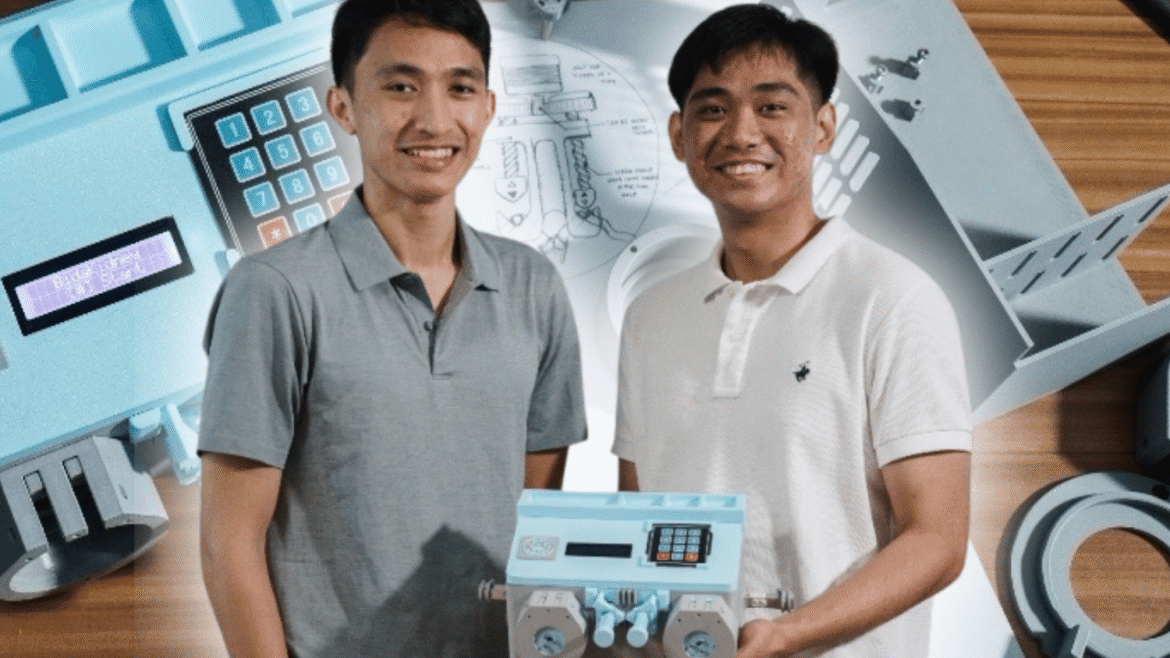
BiDaKidney is a low-cost, semi-automated peritoneal dialysis machine that works with widely available peritoneal dialysis sets. Rather than trying to compete with expensive automated cyclers, the students designed it as an upgrade to manual dialysis—automating essential parts of the process without the specialized cassettes and costly features of high-end machines.
That difference is also reflected in its price. The team estimates BiDaKidney could provide automated therapy for around $100 (₱6,300), roughly 1% of the cost of commercial cyclers, which can exceed $10,000 (₱630,000). At 2.5 kilograms, it is also designed to be carried and used at home, school, or work.
The name comes from “bida” or Filipino for hero—a nod to the millions of Filipinos living with chronic kidney disease whom the students hope the project can reach.
“We were thinking about how we could help patients spend less of their lives managing dialysis and more of their time living it,” Buensalido said.
The project is not finished yet. The team plans to improve its usability, work toward scalable manufacturing, and conduct formal clinical testing and broader patient evaluations.
OrthoFlex: Bringing stroke recovery beyond hospitals
For Jabez Bote and Ada Koreen Bacay, the problem was stroke recovery.
OrthoFlex is a motorized elbow brace designed to help stroke patients perform the repetitive flexion and extension exercises needed to regain movement.
The project was built around a gap in rehabilitation care: facilities can be expensive and concentrated in urban areas, while there are not enough therapists to meet demand.
For some patients, particularly those outside major cities or unable to afford continued private therapy, rehabilitation can be interrupted or abandoned.
OrthoFlex aims to make some of that repetitive therapy possible outside a hospital, using a portable device controlled through a smartphone.
It is also designed with affordability in mind. The team puts the prototype cost at around ₱3,500 and estimates a selling price of about ₱10,000, compared with similar products costing at least ₱25,000.
The team is still refining OrthoFlex, with plans to add a battery for greater portability, a dedicated emergency-stop button, and potentially iOS support.
Two conditions, two devices, one aim: to make healthcare fit more easily into people’s lives.
READ: